Tage Alter Musik in Herne 2026 Review: Feste Veneziane
By Mengguang Huang(Photo: © Tage Alter Musik in Herne)
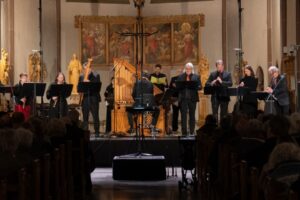
West German Radio (WDR) played a vital role in Europe’s early music revival. Countless specialists launched their career with its support, numerous works got rediscovered by its broadcast and record publications. This November, WDR’s celebrated Tage Alter Musik in Herne 2026 turns fifty. To mark this milestone as a grand festival opening event, a meticulous Giovanni Gabrieli program took place at the Herz-Jesu-Kirche in Herne, delivered by the joint force of Musica Fiata and La Capella Ducale.
Unlike our 24-hour streaming era, accesses to fine live musical experiences were rare for sixteenth-century ears. Visitors to St Mark’s Basilica in Venice must have been amazed by the unforgettable experience of vocal-like cornetts and warm brass filling the massive stone space. Gabrieli served as organist at St Mark’s from 1585 until his death in 1612. Though he was never the maestro di cappella, the city’s procurators paid him well to compose for major feasts. Since the 1990s, many historically informed recordings have reconstructed these Venetian festivities. Consequently, our ears are already familiar with this long-echo sonic concept. As these grandly paced, spacious textures are no longer novel to modern ears, their predictable structures can risk listener fatigue. For music director Roland Wilson, this ambitious single-composer program faced a real challenge in keeping audiences engaged throughout the 100-minute performance.
Wilson’s answer was to dig deeper inside the music. The personnel configuration and stage positioning changed for every single piece throughout the concert. Much like a demonstration recital on a baroque organ, this progression vividly showcased the vast possibilities and the rich acoustic diversity inherent in this music.
The concert opened with “Omnes gentes plaudite manibus.” Published in 1597, it is a brief but stately piece. Singers and players split into four groups, with a stunning chamber organ in the middle, creating a grand welcome. Next came Canzon XVI from 1615. Strings, trombones, and cornetts formed two opposing choirs. Wilson himself played the cornett, leading a lively dialogue across the church.
The mood darkened in “Exaudi me, Domine.” Two opposing groups—one of basses, the other of tenors and soprano—demonstrated antiphonal pious pleas. Their somber timbres eventually merged into one. In that moment, one could sense the sound vibrating stone wall physically. “Timor et tremor” scaled things down to six singers and organ. This madrigal-like piece was built on slow chromatic shifts. The ensemble, including three tenors Tobias Hunger, Georg Poplutz and Christian Volkmann, delivered brief melisma, alongside the tight vocal imitation in the middle section, with real urgency.
“Surrexit Christus” brought three male voices together. Their solo passages felt vibrant and intimate. Unfortunately, the accompanying instruments here sounded somewhat muddy. A similar balance issue affected the following Canzon duodecimi toni, an early prototype of the concerto grosso. The forte-piano contrasts could have been more apparent, and the two solo violins needed more improvisatory flair.
The night reached its peak with “In ecclesiis” from 1615. The singers split into two groups for an unforgettable performance. The piece unfolded in three distinct sections. First, a tenor soloist dialogued with the full choir singing “Alleluias” accompanied by the brass. Next, soprano Erika Tandiono joined the tenor for a captivating duet. The two vocal line listened to each other with supreme sensitiveness. Finally, the full vocal ensemble, including basses Wolf Matthias Friedrich, Georg Lutz, united for a thrilling “Alleluias” close again.
“Domine, Deus meus” returned to an intimate scale with six voices, including altos David Erler, Christoph Dittmar, and organ. It was deeply emotional and inward-looking, driven by sophisticated inner lines moving at steady pace. Canzon VIII offered a pure instrumental break. High and low-pitch ensembles vividly exchanged phrases from opposite sides, letting the music breathe naturally.
For “Hodie Christus a mortuis” in ten parts, the singers shifted to the left side of the stage. This piece’s spatial move refreshed the acoustic perspective. Sadly, the following famous Sonata piano e forte was a slightly muted performance. For this one of the earliest music with explicit forte-piano dynamic markings, however, the brass timbre covered the strings. The forte sections turned unclear, and the dynamic contrasts fell short. “Misericordia tua, Domine” luckily restored the momentum. This mature twelve-part work built steadily in excitement from start to finish.
A brief organ toccata from a Turin manuscript served as a bridge, preparing the ear for the massive twenty-part “Magnificat con il sicut locutus est in ecco.” A work standing right between the Renaissance and the Baroque, it blends old polyphony with a modern basso continuo line. Here, four singers started deep inside the altar area. As they sang the echo passages, they walked slowly toward the main ensemble. The brighter, grander sound of the main group stood in fuller contrast to these distant voices.
For a festival with such deep academic standards and ambitions, this kind of one-composer program is a natural expression of its core identity. It is akin to curating a blockbuster exhibition of dozens of paintings on similar themes by Titian. It remains a precious curatorial opportunity. Yet, viewed through the lens of historical context, these works would originally have been interwoven with a much broader variety of genres, and might even have been performed alongside a complete Mass. Furthermore, considering the actual listening endurance of a contemporary audience, a more mixed program structure would arguably feel far more engaging.