Wexford Festival Opera 2026 Review: The Gambler
An Unrelentingly Dark Tale Expertly Captured By Valentin Uryupin & Ivan Popovsky
By Alan Neilson(Photo: Padraig Grant)
In 1866, Dostoyevsky’s short novel “The Gambler” was published. It is a story based on the writer’s own experiences and ironically was written to pay off his gambling debts. It is a brilliant account of the psychological and emotional turmoil brought about by addiction to the roulette wheel. It captures the exhilaration and excitement of winning large sums, followed by the despair, desperation, and financial difficulties, even ruin, that fall upon the losers when their luck turns, which it always does! He presents us with characters who are totally in thrall to the casino and the little ball that always has a greater chance of landing on a losing number. They are obsessives who convince themselves that they know how to win. They abandon rationality, and in the process their lives are degraded and destroyed. He also draws attention to the cast of characters that inhabit the world of the casino, who add to the dynamic that accelerates the obsession and drags the gamblers into the abyss. Dostoyevsky includes few positive role models. Rather, he populates the casino with hangers-on, moneylenders, and men and women looking to take advantage of the gamblers. There is also, of course, the crowd encouraging the obsessives to take bigger risks, on whom it showers its praises, but on whom it will quite happily turn its back if they should lose.
It is a magnificent novel, one that has attracted praise from some of the greatest artistic minds, including Sergei Prokofiev, who in 1929 premiered his operatic adaptation of the novel at Brussels’s La Monnaie. Although its premiere was enthusiastically received, it did not enter the mainstream. Even today, it has only managed to establish a toe-hold on the international stage. It was first performed at the Wexford Festival in 1973, and this year was included as one of the three operas chosen to celebrate the company’s 75th anniversary.
The opera sticks closely to Dostoyevsky’s narrative, although focusing solely on the period set at the spa town of Roulettenberg. It is here that the gamblers congregate to play the tables. It is also where the fundamental drivers of the plot play out. However, Prokofiev decided not to bother with its final section; rather, he preferred to leave questions about the fate of the characters after they had departed the town to the imagination. It was the casino, the gamblers, and the gambling that was the focus of his interest.
Prokofiev, who wrote his own libretto, created a claustrophobic environment in which the characters moved solely between their hotel and the casino, in what was almost a closed community. When the General’s old relative, Grandma, arrived at the hotel halfway through the opera, it felt as if an outsider had just appeared; and in true literary fashion, like all outsiders, her behavior shatters the fragile equilibrium that exists.
Popovsky’s Monochromatic Staging Successfully Highlights the Lure of the Casino
The stage director, Ivan Popovsky, along with set and costume designer Maria Tregubova, brilliantly captured the atmosphere. Two white façades, which were angled toward each other, represented the hotel and the casino. To ensure nobody was in any doubt, the words “hotel” and “casino” were painted in large letters on the buildings. In between was an empty space for the guests to take their evening walks, although it was occasionally littered with tables and chairs so they could relax and mix with each other. Nothing else existed, for only the hotel and the casino mattered to the gamblers and the human vultures that preyed upon them. As the opera draws to an end, the two façades move toward each other, causing the space between them to close, trapping Alexei and Polina, the opera’s central characters, into a confrontation caused entirely by their reliance on their luck or lack of it at the roulette tables.
Popovsky and Tregubova decided to set the work in the mid-19th century, in line with Dostoyevsky’s novel. Costumes were, therefore, as one would expect for typical Victorian men and women of means, with the occasional exaggeration for effect, but there was a significant twist. All the characters on stage were dressed in white or black and white clothing. In fact, everything on the stage, including props and scenery, was black and white. There was no color; it was an insipid, monochromotic staging.
But this was clearly Popovsky’s intention, as it opened a window onto the psychology of the characters. At the same time, it allowed the thrill, the energy, and the emotional excesses of the casino to be highlighted
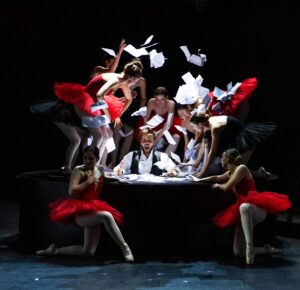
To the gamblers, driven by the adrenaline that surges through their bodies, it is only the excitement of the roulette tables and the world of the casino that matters. Everything outside its doors is dull by comparison; it is monochromatic with little to stimulate the senses. In Act four, Alexei returns to the casino in an attempt to win money to pay Polina’s debts. It was the only time that we are allowed to see inside the building. Immediately the stage was flooded by young ballet dancers, dressed in red or black tutus, who spun round and round like numbers on a roulette wheel. The color added an excitement that brilliantly brought the stage alive; its contrast with the world outside the casino doors was stark!
There was one other incident in which color was introduced onto the stage. At the end of Act three, a red carpet is rolled out between the two white façades, which was then used to pull the General into the abyss.
Strong Characterizations Underpin Forceful Dramatic Presentation
Popovsky elicited strong, clearly defined performances from all the characters, successfully keeping the focus on the damage they were doing to themselves and the effects that their addiction was having on those around them. None of the characters are spared, apart from the very rich, retiring Englishman, Mr. Astley. All are ruined, humiliated, or degraded, seduced by the casino’s veneer of entertainment and easy money. Even the characters who hover around its edges, living off the gamblers’ obsession, are not spared; the Marquis and Blanche, with their smiling, friendly faces, who exploit them for all they can get, are forced to bail out when their victims lose.
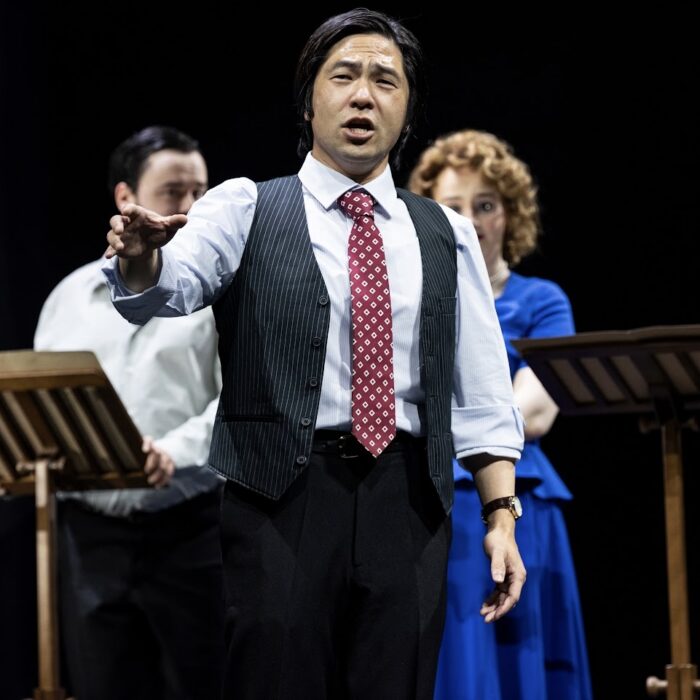
The main character of the narrative is Alexei, whose obsessive, volatile personality was persusively captured by baritenor Igor Onishchenko. Although Alexei is a man of limited means, he plays the tables but with little luck. He is also obsessed with Polina, who, recognizing the fact, takes advantage of the situation by encouraging him to behave in an irresponsible manner. Alexei was, of course, not particularly concerned; after all, he is a risk-taker, and he loves the feel of adrenaline pumping through his veins. Onishchenko possesses a lyrically warm, flexible, assertive voice that he infused with plenty of passion to promote the idea of Alexei as an obssesive. In Act four, he is completely overwhelmed by his obsessions and degenerates into a near state of delirium, his voice moving rapidly through different emotional states, propelled by the momentum of the music as he breaks the bank at the casino, and is then wooed and rejected by Polina, as he offers her the money to pay back the debt she owes to the Marquis.
Of course, it is not just Alexei who is damaged by his obsession. Polina’s father, the General, played by bass, Alexei Botnarciuc, was a particularly sad figure. A wastrel who lavishes his money on his mistress, Blanche, while losing at the tables and running up debts to the Marquis, had few redeeming characteristics. Botnarciuc characterized him as a stupid, entitled individual who expected people to fall in line with his demands. He is not concerned about his financial situation, as he has a large inheritance to rely on when Grandma dies, which he assumes will be any day soon. When she failed to do the decent thing and die, and then, worse, went on to lose his inheritance at the casino, he exploded into a fit of anger and panic before simply dissolving into an emotional mess. Botnarciuc was in fine voice throughout, expertly molding the vocal line to fit his inability to control his life, which was wholly dependent upon his luck at the casino.
Polina, essayed by soprano Sophie Gordeladze, was herself not averse to gambling and, like her father, was in debt to the Marquis. She was a mixture of inconsistency, manipulation, and intense passion, which crystalized in her treatment of Alexei, whom she loved, but treated with contempt and cruelty. Gordeladze’s deft vocal characterization successfully brought these traits to the fore with a clearly articulated, colorful, and emotionally sensitive performance replete with animated inflections. All of which, she intensified in the final Act as her swirling emotions moved between genuine affection, love, insecurity, self-recrimination, and the need to harm Alexei. At times, her voice was empty, hollow, almost as if she were in a comatose state. She would swing into passages of passionate longing or deliberately taunt by telling him that she was the Marquis’ mistress before finally unleashing a searing vocal attack as she threw the money into Alexei’s face. It was a wonderfully expressive performance that caught the complexity of her damaged personality.
The wily Grandma Babulenka may not be the opera’s main character, but it is her refusal to die and her determination to try her luck on the tables that catapults the narrative towards its inevitable conclusion. The role was played by Clarry Bartha, whose aging voice was perfectly suited to the character. True, there was a thinness and certain degree of weakness to her singing, but she also possessed a sharp determination and clarity that gave her character an authority and status that deterred any opposition to her will.
Tenor Gavan Ring portrayed the Marquis as a thoroughly dislikable character. He may be pleasant and helpful on the surface, but he always has an eye on what can be gained from any situation. He exploited the General by charging him extortionate rates on his debt and took Polina as his mistress while pushing her into debt. His singing was expressive with a pleasing swagger to the voice, which reinforced the impression of a suave, confident man of means.
Mezzosoprano Hilary Ginther played Blanche, the General’s mistress, as a simple woman who was motivated purely by money. With the General’s ruin, she moved on to Prince Nilsky without much thought.
Tenor Seán Tester showed off his resonant, energetic voice to good effect as the well-heeled Prince Nilsky, whom he portrayed as a ridiculous figure, totally unaware of the trouble lying ahead of him after taking up with the parastic Blanche.
Mr. Astley, whose sole dramatic purpose is to act as a reference point from which to judge the other characters, was played by baritone Rory Musgrave. He produced a reading with a familiarity that perfectly captured the sympathetic, well-balanced nature of an Englishman.
The minor roles of Popatych and The Baron were given neatly defined and well-sung performances by tenor Joshua Baxter and bass-baritone Wonsick Oh, respectively. The actress Olga Conway convinced as the Baron’s wife.
The Wexford Festival Opera Orchestra under the direction of Valentin Uryupin produced a strong interpretation that successfully captured the changing tensions and complexity of the drama, while simultaneously delivering the heavy ambience that saturates the narrative. There is very little about the piece that could be termed light, either musically or dramatically, and Uryupin ensured that this was maintained throughout the performance. The balance between the orchestra and the singers was neatly managed; the singers were always given the necessary space to develop their characters and were never drowned out by the orchestra.
Overall, it was a musically and theatrically strong production, in which the depth and detail that the singers were able to bring to their characterizations really stood out. It was also a sensitive presentation that captured the darkness that lies beneath the thrill and sparkle of the casino, which it did without ever pushing an agenda.