Opera Lafayette 2026-27 Review: Les Surprises de l’Amour
By David Salazar(Credit: Steven Pisano, Courtesy of Opera Lafayette)
On Nov. 9, 2026, Opera Lafayette made its annual trip to New York to present the first of three performances of the modern world premiere of Rameau’s “Les Surprises d’Amour.”
The work, which features three stories spread across a prologue and two acts, explores how love overcomes “war, reason, and even religion,” per Artistic Director Patric Dupre Quigley in a statement in the program. The first story centers on Astrea converting Vulcan’s war factory into one that manufactures Cupid’s arrow, while the second spotlights the musician Linus and his love for the atronomy Muse Urania. The latter wants Linus to focus on intellectual goals until Cupid intervenes, bringing the two lovers together. The final story explores Adonis, who is wary of love thanks to Diana’s indoctrination. But Cupid intervenes and has Adonis fall in love with Venus.
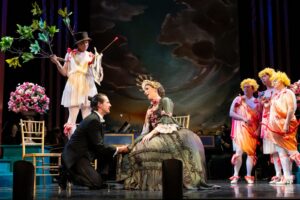
The New York performance (the production heads to Folger Shakespeare Library in Washington D.C. later this week) took place on the stage of the Kaye Playhouse at Hunter College with the proscenium itself featuring three sets of stages. Upstage was the orchestra with Quigley leading the proceedings and the orchestra, his back turned to the audience. Stage left featured a throne whereupon Louis XV, interpreted by William Townsend, would sit throughout the entire proceedings. Opposite him was another stage with a few chairs that would be used by different performers throughout the show. In between these three main “stages” was an empty space where most of the action would elegantly take place. Directed by Chas Rader-Shieber, the production was minimalist but clear in its use of space. At times four dances would take center stage during major transitional moments. Featuring choreography by Isaac Lerner, the four dancers (Emily Aslin, Alexzander Larson, Cori Lewis, and Matthew Spangler) were fantastic to behold, often appearing together, but each also getting individual moments to shine. Early on, during the Vulcan factory sequence, they appeared as Cupid’s envoys, hiding behind and making quippy gestures to the audience to bring attention to their stealth. The audience reacted with laughter at each one of these moments.
To add to the comedy of the evening, Rader-Shieder and Jimmy Stubbs, the scenic and costume designer, brought in small “sets” to each of the acts. A mini-forge elicited tremendous laughter as it was carried on in the first act. Trees dominated the stage in the second story, while Venus got her own throne-line conch during her scene. Diana carried a life-sized dog sculpture onto the stage, with soprano Emilie Kealani intoning a bark of her own to comic effect. The production didn’t need more than these sparse elements because the blocking proved a strong point in the production. In the final story, Venus enters from stage right and later in the evening, Diana enters stage left, amidst her similarly clothed comrades. Many of Uranie and Linus’ dialogue takes place at the center of the stage with chairs dominating the space, emphasizing the static nature of their relationship. The opening forge sequence is replete with Vulcan and his workers. They spin about in the early going and eventually transform into Cupid’s allies, taking up place on the stage right seats. Cupid was often placed center upstage, emphasizing his dominance throughout the story (the first instance of Cupid is in this spot and at curtain call, Cupid also comes from this same place). Arias were given space to breathe with actors allowed to move about the stage. Costumes, while also minimal were effective with white and a peachy pink the dominant color palette. In all, it was clear that a great deal of care and attention to detail was placed in designing the staging and production.
How Quigley pulled off the proceedings is mesmerizing. With his back to the audience and the singers, he didn’t miss a beat all evening. I looked around for indications of a camera or monitor (which I imagine had to be somewhere) for the singers to follow but could not find one. Regardless, even with that aid, there has to be a tremendous amount of trust between performers and conductor to pull off a performance in which this visual distance exists. Throughout the night, I noticed several moments in which singer and conductor breathed together and shaped lines together with an ease and flexibility that is often lacking at other notable opera houses where the conductor is right in the singers’ faces. Moreover, balance was marvelous and every single artist sounded comfortable on stage. Even the tuning of the instruments had a mesmerizing ceremonial quality to it, partially due to its duration, but also because the harpsichordist Leon Shelhase provided his colleagues with arpeggios as they tuned. What I enjoyed most was the elegance with which the ensemble played. Often in historically-informed performance, the gestures are overwrought as if to bring attention that “this is how it’s supposed to be played.” Sometimes that effect can be mesmerizing and can add a unique dimension to the music (especially in the most renowned pieces). However, in an opera, a balance must be struck and Quigley managed it extraordinarily throughout. That translated to the singers as well with how they styled their lines, especially the appoggiaturas, exquisitely. This was some of the finest operatic conducting I have witnessed in some time.
The cast of artists was also extraordinary. Leading the war was soprano Elizabeth Sutphen. As the opera opens, she plays the silent role of Madame la Marquise de Pompadour, tidying up the set for the performance, dragging in the King, and then sitting kindly by his side as the show commenced. But in Act one and two she took on protagonist roles, first as Uranie, and then as Venus. In both roles she demonstrated an elegant soprano with gentle legato and strong breath control. But her Venus was particularly striking with the soprano alluring in her phrasing of her entrance and then delivering, perhaps, the musical highlight of the night during her final aria. Here, as she invoked Cupid to fly away, Rameau writes her extended coloratura lines, which Sutphen dispatched with graceful bravura.
As Amour (Cupid), Kayleigh Spouse displayed a bright soprano with truly impressive trills throughout. Her entire interpretation of Cupid was spunky and playful, Spouse always a bright spot every moment she was onstage. Meanwhile, Emilie Kealani displayed great range in her two roles. As Astrée, she sang with delicacy, while as Diane she thundered onstage in her opening lines, her presence matching her vocal potency.
Hadleigh Adams got to also play two contrasting roles. In the prologue he was the forceful Vulcain, his baritone allowed to roar into the space; he also displayed great flexibility in some of the faster passagework of his early entrances. But in the first Act, there was space for a more gentle vocal approach as Linus. Finally, Philip Lopez appeared as Le Temps in the first Act and then as Adonis in the final one. He had charm and gusto in both of them but it was as Adonis that he made his biggest mark, his bass-baritone roaring deliciously in his early exchange with Cupid and slowly softening as he conceded to love.
The chorus and orchestra also deserve their flowers, the former for the physical and musical energy they provided to the proceedings and the latter for its cohesion and strong balance.
In all, from the musical cohesion to strong staging, this was an artistic triumph for Opera Lafayette and as the artists came onstage to take their well-deserved recognition, the audience gifted them with effusive ovations.