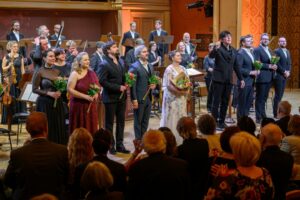
Collegium 1704 2026-27 Review: Susanna
By Mengguang Huang(Photo: Petr Dyrc)
In Dresden’s Old Masters Picture Gallery hangs a portrait of Faustina Bordoni, the soprano who once sang Händel in London and later made this city her home. Her soulful gaze captured in that picture is a quiet reminder that every concert we hear will one day become part of music history’s long river. Tonight at the elegant Annenkirche in Dresden, Händel’s oratorio “Susanna,” performed by Collegium 1704 and an outstanding cast, was certainly a night to remember.
Under Václav Luks’s energetic direction, the affection and chemistry between the ensemble and the cast overflowed. This seamless rapport felt like a destined connection. The entire oratorio, driven by broad phrasing, was given a spacious atmosphere. The tireless pulsation of the lower strings were deeply moving. The string section painted scenes with remarkable vividness, evoking the immersive feel of reading great literature in that long-gone era of text-only media. The basso continuo also moved with organic transitions. In particular, the restrained use of the chest organ gave the work its essential aura.
Collegium Vocale 1704 delivered a refined structural performance. Their polyphonic lines were clean, lofty in conception, and free of superficial display. In the opening chorus, “How long, oh Lord! Shall Israel groan,” they mastered effortlessly the sevenfold lamento bass over a passacaglia structure. The unison call of “Jehova!” then abruptly cut through the bass line. They powerfully conveyed the moral parable of salvation for the captive Israelites during the exile. At the end of Act one, “Righteous Heav’n” built intense drama through double fugues and chromatic shifts. In Act three, the chorus transformed into mocking Babylonians with cruelty, gloating over Susanna’s dark fate.
The cast was exceptionally well-balanced. One cannot help feeling that each singer fit perfectly for their respective roles. Händel’s vivid musical painting, combined with tonight’s outstanding execution, allowed the audience to follow the plot directly through the music itself. Anyone with a basic knowledge of the story could grasp the narrative without reading the libretto. Yet, this does not mean the text was ignored; almost all singers displayed exceptional declamation. The two-hour-and-fifteen-minute performance ran without an interval.
Soprano Kateryna Kasper as Susanna convincingly embodied a steadfast faith. Within a libretto preaching Christian chastity on top of an Old Testament story, she perceptively portrayed Susanna’s melancholic foreboding of future misfortune. In Act two, her “Crystal streams” was captivating. Accompanied by fluid strings, her voice remained supple even in those extensive passages of low notes. You could almost feel the shimmering nuances of sunlight on water. In the trio “Away, away!,” when she encountered the two elders, Kasper captured Susanna’s helpless vulnerability. After the wrongful judgment, she expressed her inner piety and dignity. And her devotion to her husband was deeply sincere. After stepping back from the edge of life and death, her final solo aria, “Guilt trembling,” provided an unforgettable moment of transcendent joy. For this aria precisely, any audience tonight could feel a great privilege to witness this rare vocal miracle.
Countertenor Gabriel Díaz brought a magnetic tone to Susanna’s husband Joacim. In their early love duet, “When thou art nigh,” his parallel thirds and sixths with Kasper created a profound emotional bond. Even when Susanna was accused by elders, his portrayal of doubt was merely a hesitant struggle, preserving the character’s deep affection for his wife. Before that, his aria of distant longing paired beautifully with the attendant’s (soprano Helena Hozová) pastoral aria, “Ask if yon damask rose be sweet.” Together, they evoked the warm stillness of an Arcadian garden, soon to be shattered by invaders.
The two Elders offered a memorable contrast in timbre and personality. Tenor Ondřej Holub played the First Elder with winding, hypocritical phrasing, unleashing unrestrained harmony in “Tyrannic love!.” Tomáš Šelc brought an unmasked desire to the Second Elder. His coarse bass, together with the large leaps, and the bassoon in “The oak for thousand years,” turned his arrogance into pure grotesqueness.
Soprano Tereza Zimková as Daniel was an absolute highlight. Though she entered the scene near the very end of the oratorio, her luminous soprano cut through the darkness like a divine revelation. The lively and sutble rhythmic shifting of her recitatives drove the resolution with brilliant clarity.
Baritone Pavol Kubáň sang Susanna’s father Chelsias with convincing warmth, especially in the aria for “Who fears the Lord.” Despite slightly muddy diction in his recitatives, he painted an overall persuasive father figure. Bass Jiří Miroslav Procházka also handled his role as the Judge with direct precision.
Part of the Prague–Dresden Music Bridge, which Collegium 1704 launched in 2008, tonight’s concert let us witness the bond between music and performers unfold in real time. Stepping out of the Annenkirche, you might find the voices of the evening still lingering around you, and your footsteps, quite unintentionally, tracing the rhythm of “Guilt trembling.”