Washington National Opera 2026-27 Review: Madama Butterfly
Karah Son Dominates Opening Night at Constitution Hall
By Francisco Salazar(Photo: Cory Weaver)
On Nov. 7, 2026, the Washington National Opera (WNO) opened its 2026-27 season at Constitution Hall.
The opening marks the first season that the WNO is an independent company after having left the Kennedy Center due to the unstable and corrupt Trump administration. As such, the season will be performed in multiple locations, giving audiences new experiences and different ways of seeing an opera performance.
For its first opera of the season, the company presented a new production of “Madama Butterfly” and the result was solid.
Bringing it Close
With the Washington National Opera moving to Constitution Hall, Artistic Director Francesca Zambello devised the idea to bring opera closer to the audience and thus created a “thrust stage” that was in the middle with audience members sitting on all three sides of the stage. It almost felt like going to an arena or stadium and watching a pop concert. The result was a visceral experience that brought the god-like quality of opera singing closer to the audience.
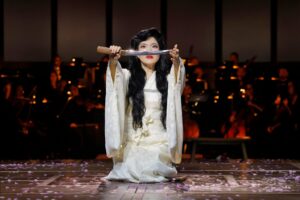
That being said, on the first go around, E. Loren Meeker had the challenge of creating a visual spectacle in a minimal and smaller stage, resulting in some unique ideas. One of the most inspiring was the use of dancers in choreographed dances by Kanji Segawa. The dancers created the atmosphere for Butterfly’s world, from unfurling the shoji doors at the start to bringing in the paper lanterns during the humming chorus. They also participated in the ceremonial elements of Butterfly’s life, such as the changing scene for her wedding night with Pinkerton and heightened Butterfly’s feelings and memory in a gorgeous dance at the beginning of the Act three prelude and during the duet with Pinkerton. This choice gave these moments a sense of nostalgia and beauty. But perhaps the most visually compelling moment came at the end once Butterfly died. Here the dancers unfolded a gorgeous drape that looked like a pink flower reminiscent of the cherry blossom that hugged the top of the ceiling throughout the entire evening. It is also important to note that this final scene was also one of the most devastatingly-directed Butterfly scenes I have seen with the child running to Butterfly’s arms and Pinkerton arriving and embracing both. It was truly a compelling and perfect way to end the opera.
Another element of the production that worked well were the costumes by Tim Burrow which were impressive and elegant, especially for its use of fabrics in Butterfly’s costumes and the dancer’s silk and colorful outfits.
But it didn’t all work. Act two was very static, especially in its blocking. The singers looked like they lacked enough space to truly move. While the first half of the act is more intimate and plays into the realism of Butterfly’s world, the minimalism of the set seemed appropriate. But it also felt disconnected from the rest of the production and the lighting was flat and uninspired. The other issue was the projections which didn’t add much from where I was sitting and seemed like a lost opportunity. They were also static and, while they created a mood, there seemed like a little more could have been done.
But these small issues were not enough to take me out of what was an inspired production and what I consider a powerful way of presenting opera.
Butterfly
In the role of Cio-Cio San, Karah Son was making her company debut, bringing her acclaimed portrayal that she has sung more than 300 times. Son realizes every aspect of Butterfly’s character. At the beginning, she inhabits the innocence and youthfulness of the character and the fear and hesitation in the Act one duet with Pinkerton. In Act two she gives life to Butterfly’s nostalgia, longing, and abandon, and then to the hope that that she feels as she sees Pinkerton’s ship arriving. In the final act, Son is possessed by the tragedy and the despair of knowing what her ultimate fate is. Son was compelling throughout. You couldn’t look away.
Vocally, the soprano brought it all. Her opening entrance, “Ancora un passo or via” was filled with delicacy, especially as she ascended to her High C and sang with a suave piano legato. The ensuing “Gran ventura riverenza” was playful and youthful with a voice retaining a light quality. In the duet, “Viene la sera” and “Vogliatemi bene,” the voice obtained a lusher sound with deeper low notes and a rounder middle voice emphasizing a maturing woman.
Act two was all about Son as she sang with great commitment, especially in “Un bel di vedremo” which she started with full sound and then brought back to a lighter quality as she sang the phrases “Chi sarà? chi sarà?” From there she returned to a passionate and gut wrenching climax on “io consicura fede l’aspetto,” her soprano resounding in the space. Son scaled it back in her opening exchanges with Sharpless and later with Yamadori, showcasing that same youthful and playful nature in her Butterfly from the first Act. Even as Will Liverman read Pinkerton’s letter to her, Son’s voice retained a brightness, showcasing Butterfly’s anticipation and yearning for his arrival. But it was in the “E questo e questo?” and “Che tua madre dovra prenderti” that Son had some of her finest moments, emphasizing the lower and middle richness of her voice that expressed Butterfly’s desperation. Each text was emphasized with passion, richness, and attention to diction. Another passage that stood out for Son was “Bianca, bianca…il vessillo Americano delle stelle…” which she sang with hope and tenderness. The voice floated with brightness at the beginning before the emotional climax, which she delivered with resonance. The ensuing Flower duet saw Son sing with a softer timbre, floating high notes with delicacy and bringing out extended lines that were beautifully connected.
Her Act three was pure emotion with the final aria “Con onor muore chi non puo serbar” sung with desperation and pain. It was heart-wrenching.
That said, Son’s voice could sometimes grow coarse, especially as she had to scale the volume down. At moments when she had to ascend to her higher notes, the intonation could be a bit flat. Her chest voice also felt disconnected from her middle voice, especially in moments of “Un bel dì vedremo.” However, that did not take away from a beautiful portrayal.
Solid Casting
In the role of Pinkerton, Matthew White was also making his company debut and sang with an ardent timbre in the first act, especially during his aria, “Dovunque al mondo lo Yankee vagabondo” and the ensuing “Amore o grillo.” He particularly emphasized the brighter qualities of his voice that displayed a pompous and playful Pinkerton. His duet with Son’s Butterfly, “Vogliatemi bene” also showcased White’s gorgeous legato phrasing and a passionate timbre that easily rose to the highest parts of his voice. However, his stage presence was a little stiff, causing some awkwardness during his duet with Son and the two seemed to have little chemistry.
Act three proved to be stronger for White, as he delivered impassioned desperation in his “Addio fiorito asil” with his high notes reverberating intensely. In the subsequent trio “Io so che alle sue pene,” he sang with surrender and the final calls of “Butterfly” were heartbreaking. By the end, one felt that this Pinkerton matured and learned from his selfishness.
In the role of Suzuki, Michelle Mariposa gave a moving portrayal especially in the Act three solo exchanges, “Anime sante degli avi!” where you felt her compassion and desperation as the mezzo dug into her chest voice. In the trio “Io so che alle sue pene,” her voice also rang out with chilling effect. In her final exchange, as Son’s Butterfly questioned Mariposa’s Suzuki, you could feel her fear and pain at hiding anything.
Mariposa’s Act one was also a delight especially as she dispatched the staccato exchanges in her opening entrance and her prayer was sung with great articulation and rhythmic precision. The Act two flower duet was also a highlight for Mariposa as she blended her smooth mezzo voice beautifully with Son’s brighter soprano.
As Sharpless, Will Liverman brought a suave baritone in the first act that matched White’s pompous Pinkerton. However, in Act two Liverman brought a gentler tone to his baritone, especially as he read the letter and when Butterfly’s child was revealed. You could sense remorse in his vocal delivery but also in each look. Then in Act three, Liverman delivered a poignant and assertive performance in his brief exchange with Pinkerton. In the trio, his voice grew with power and forcefulness as he accented certain lines to reflect his own distress. It was chilling as he delivered his “Andate: il triste vero da sola apprenderà” as White sang his “Addio fiorito asil.”
Lauren Carroll gave a solid portrayal as Kate Pinkerton showcasing a lush soprano, while Rodell Rosel’s Goro was playfully unpredictable. Atticus Rego as Bonze and Chandler Benn as Yamadori brought booming voices to the production.
In the pit Erina Yashima gave a solid and refreshingly brisk performance of the Puccini’s masterwork. She moved the tempi along making for the climactic moments to feel even more impactful. When the singers needed to rallentando or stretch the line, like in “Addio fiorito asil,” “Un bel di vedremo,” or in the Act one duet, she gave them space and time. The Act three prelude was another highlight where Yashima stretched the tempo but gave it an ebb and flow that made the piece even more moving. There were, however, some balance issues in Act one and two and sometimes the orchestra and singers were not always together. That may have been caused by the placing of the orchestra in the back and the performers still getting used to concept.
In all, it’s good to see the Washington National Opera finding its footing and experimenting with the art form.