The Frick Collection Concert Season 2026-27 Review: Anthony Roth Costanzo’s ‘Countertenor’
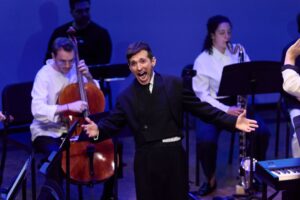
By Jennifer E. PyronThe Frick Collection’s Stephen A. Schwarzman auditorium was the perfect space to feature Grammy-winning countertenor and opera director Anthony Roth Costanzo’s performance of “Countertenor.” Costanzo shared personal anecdotes of things that have changed his life, from being naked for Philip Glass’ “Akhnaten” and surviving cancer at 26-years-old, to reflecting on his journey of marching to his own beat.
Keyboardist and music director Dan Schlosberg accompanied him alongside an ensemble packed with brilliant musicians. Throughout the night, Costanzo delicately interwove both the music from his newly-released album and text excerpts from his first book, making this performance feel like a get-to-know-you experience rather than a product push.
The history of countertenors begins in the 16th century with the castrati, whose voices the world craved. Said Costanzo, “One thing we know for sure is that the inception of the singing castrato is closely tied to early falsettists (whom we now call countertenors).”
His matter-of-fact manner when recounting the history of what sets a countertenor apart from most voices was uniquely inviting. He sustained an empathetic tone all night. The audience could not take their eyes or ears away from him as he made everyone feel like part of his world.
This was not just another recital with a setlist. Costanzo’s “Countertenor” embodied his unapologetic way of life.
Laika
“Laika” by Osvaldo Golijov (2024) with text by Leah Hager Cohen was composed for Costanzo and is the opening track of “Countertenor.” Costanzo’s voice, as he sang its smooth legato lines with crisp English diction, made me want to listen to it on repeat. There is a mysterious quality surrounding “Laika” that lingers in the back of one’s mind. Experiencing this song live was the highlight of his performance for me. Costanzo’s high notes lifted into the auditorium with ease, evoking a feeling of weightlessness.
The song is also meditative, like so many of Philip Glass’s works, and reminded me of how I felt when I saw “Akhnaten” for the first time. There is a still state that Costanzo knows how to tap into when he performs that is one of his greatest gifts. The space between the notes, which he treats with care and love, is a rare trait in any singer. Listening to him in this size of auditorium also added to the intimacy of this song.
The story of “Laika” is about an innocent Soviet dog that is put on a spaceship, becoming one of the first animals to go into space. Costanzo’s voice guided listeners through the dramatic swells of the music, examining the loneliness and heartbreak at its core. Listeners took away their own reflections and some may even have dreamed as the soundscape built an alternate universe for one to float in.
The ensemble, Dan Schlosberg (keyboard), Colin Brookes (viola), Paul Wonjin Cho (bass clarinet, basset horn), Coleman Itzkoff (cello), Jay Julio (viola), and Chelsea Lane (harp), played with dedication to the softness of the composition. The bass clarinet’s rich color supporting the shimmer of the harp was breathtaking.
Walk Like a Man
Thomas Morley’s “Will You Buy a Fine Dog?” was performed next with a silly playfulness. The repeating phrase “with a dildo” made it extra cheeky.
Costanzo spoke about the countertenors he looked up to most during his childhood, especially Klaus Nomi, and how riveted he was when watching his music video, “The Cold Song” (1981). In honor of Nomi, Costanzo performed Lou Christie and Twyla Herbert’s “Lightnin’ Strikes” (1965). The ensemble turned into a full-blown band and had a riot getting rowdy with this song. Costanzo used a megaphone that made the performance feel experimental and fun. It is not every day one goes to an opera singer’s intimate recital and gets to relish in the excitement of something out of the ordinary. I enjoyed this moment especially because I felt like Costanzo was more naturally himself — wild and free.
Vivaldi’s “Gelido in ogni vena” (Frozen in every vein), from “Farnace, RV 711,” was another highlight of the evening. Costanzo’s voice was supported by his vocal technique, creating smooth legato lines that melted into the pulsing ensemble playing alongside him. His high notes were pure and unobstructed as he allowed them to organically blossom with the climactic phrasing of the music. This piece reminded me about what makes Costanzo one of the most versatile countertenors today. His agility and willingness to take repertoire risks are admirable.
Bob Crewe and Bob Gaudio’s “Walk Like a Man” inspired Costanzo from an early age. He recalled a moment when his father told him that he did not have to “sound like a man.” Costanzo went on to talk about his experiences discovering his voice’s unique timbre as a young person. The ensemble played with excitement and Costanzo gave a thrilling take on the iconic piece. John Madara and David White’s “You Don’t Own Me” also aligned with this level of entertainment, and watching never-before-seen Disney footage of Mickey Mouse added to the fun.
Countertenor
Costanzo’s performance reflected a man who learned that he never had to “sound like a man” and built a career out of a voice that defied what most expected from him. Whether floating through the infinite sound world of “Laika” or using a megaphone in honor of Klaus Nomi, he was unapologetically himself. He gave the audience a glimpse into his world one memory at a time.