Wexford Festival Opera 2026 Review: The Rose Of Castile
Soprano Eleri Gwylim Impresses As The Rose
By Alan Neilson(Photo: Padraig Grant)
Few people today will recognize the name of William Balfe’s 1857 opera “The Rose of Castile,” and for most of those who have, it is more likely to be thanks to James Joyce’s numerous references to it in “Ulysses.” Certainly, very few will have actually seen a production, unless, that is, they are regulars at the Wexford Festival Opera. It was the choice for the festival’s first opera, back in 1951, no doubt partly due to the fact that Balfe lived in the town during his early childhood. It was then reprised in 1991 and has now received a new, abridged production as part of its pocket opera program to celebrate the festival’s 75th anniversary.
Attracted by its light, breezy storyline and the cheerful, accessible melodies of its arias, duets, and ensemble pieces, audiences flocked to the theaters to see it following its London premiere in 1857, to the extent that it soon became one of the most popular operas in the English-speaking world, chalking up thousands of performances up to the outbreak of the First World War in 1914. After which, it virtually disappeared, so that Joyce’s joke from “Ulysses” – Which opera do you associate with a railway line? The rows of cast steel – is today more likely to be met with bemused faces rather than a knowing smile.
The actual plot, written by Augustus Glossop Harris and Edmond Falconer, is certainly of its time, which is probably one of the reasons for the opera’s disappearance. With its Victorian sensibilities, bourgeois values, and tightly corsetted morality, it is unlikely to appeal to today’s audiences. Even its lightweight humor is more likely to generate a smile than outright laughter. It certainly does not possess the fizz and sparkle of a Rossini or a Donizetti comedy.
The convoluted storyline that relies on a queen disguised as a commoner disguising herself as a queen and a muleteer being mistaken for Don Sebastian, who is actually a king, while the queen’s cousin, Don Pedro, tries to gain the throne at her expense by encouraging her to marry a commoner, has plenty of scope for comedy. One can easily imagine the fun Rossini would have had with it. However, Balfe did little to exploit its possibilities. In fact, given the narrative’s potential, it plays out in a far too predictable fashion. The Wexford audience, which was well-disposed to the production, were mildly amused, but actual laughter was only occasional and low-key.
All of which is not to say that the music is not attractive; pleasing melodies pepper the score. It would take a deliberate effort on the part of the audience not to enjoy its light, tuneful arias, duets, and larger ensemble pieces, but apart from the famous Act two laughing trio “I am not the Queen, ha, ha!” they are not particularly memorable.
Hadrill’s Introduction of a Narrator Sharpens the Drama
The director, Heather Hadrill, decided to reset the story in 1929 Spain, having identified parallels with its original Middle Ages setting. Don Pedro is a military figure who wants to take full political control from the Queen, while in 1929, Spain had a constitutional monarchy with General de Rivera acting as military dictator. The political atmosphere in both cases was thus defined by the power relationship that existed between the monarchy and the military. Even if the comparison were a superficial one, it really did not matter, as the drama translated neatly to the 20th century in any case. It was Hadrill’s introduction of a new character, however, that proved to be key to the whole production.
Even in its complete version, its convoluted plot can be a little tricky to follow. This production used an abridged version, which would have been almost impossible to understand without prior knowledge. Hadrill’s solution was to set it in the year 1929, the year when The New York Daily Mirror’s Walter Winchell became the world’s first gossip columnist. Hadrill decided to use Winchell as a narrator-cum-society reporter to keep the audience informed about the latest romantic and societal intrigues within the ruling elite. It was a non-singing, spoken role, and it proved to be an excellent device for moving the narrative along at pace, while keeping the audience abreast of developments. By adding dialogue to the light music and the silly plot, however, it produced the unfortunate side effect of giving it the appearance of an operetta.
The role of Winchell was played by Peter McCamley, who convincingly adopted all the stereotypical, larger-than-life behavior of a New York reporter, dressed in scruffy clothing and sporting an accent with a heavy Brooklyn drawl. He set the scene at the beginning of the show and appeared regularly with updates to ensure no one was left bemused by the onstage nonsense, in which the disguised characters disguised themselves and second-guessed the real identity of those masquerading under false names, always incorrectly, of course.
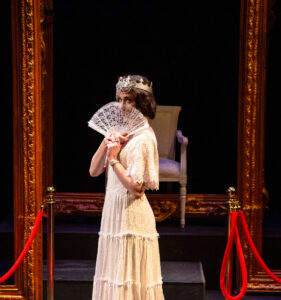
Lisa Krügel, responsible for the stage and costume designs, mixed traditional Spanish costumes with clothing from the period. The low-budget stage designs rarely consisted of more than a few tables and chairs but successfully created the appearance of a nightclub or a bar. At the back of the performance area was a raised platform, used for a throne, in front of which stood three large golden picture frames so that the characters could take up poses that could be used for photographs in Winchell’s column. Two large playing cards, one representing the Queen of Hearts and the other the Prince of Diamonds, as obvious references to Elvira and Manuel stood at the back next to the throne. It all added up to a basic, functional staging that provided a suitable backdrop to the drama, for which Cian Redmond’s lighting designs brought color and the necessary atmosphere.
Warren Oversees a Lively, Bright and Energetic Musical Performance
The musical director and pianist, Rebecca Warren, elicited fine performances from the cast, supporting them with a light accompaniment that captured the flippant nature of the narrative, while convincingly playing up the dangers that lurked behind Don Pedro’s smiling face.
The leading role of Queen Elvira of Leon was played by soprano Eleri Gwilym. During last year’s festival, she impressed with a haughty, self-absorbed, and vicious portrait of the princess in Zemlinsky’s “The Dwarf.” Queen Elvira, however, is a very different figure: she was spirited, good-natured, and playful. Vocally, it was also a very different role, although one that again allowed her to show off her wonderful upper register to good effect. It is clearly a register in which she feels very comfortable, dancing across the vocal line with carefree abandon, pinging out high notes, and indulging in light, bright passages of coloratura, leaps and pleasing embellishments. Moreover, it was all done with a smile on her face. It was a role that she really seemed to enjoy.
Tenor Eamonn Walsh, playing the role of Manuel the muleteer, who is the King of Leon in disguise, produced a theatrical performance that deliberately relied on stock, usually overstated, gestures. Elvira, however, actually believes him to be Don Sebastian, the king’s brother, whom she has never met but is supposed to marry. With his suave looks and cool demeanor, he certainly looked the part of the virile tenor, which he supported with his smooth, lyrically appealing singing, and with whom Elvira naturally fell in love. Their love duet, “Twas rank and fame that tempted thee” proved to be one of the high points of the show: their two voices beautifully blending with each other to create delightful, easy-on-the-ear declarations of love.
Baritone Rory Musgrave produced a convincing Don Pedro without ever taking the character too seriously. He was authoratitive and confident and acted out the role with a slightly exaggerated swagger that ensured he could never be taken as a genuinely sinister figure. It was impossible to believe that after kidnapping Elvira, he would do her any harm. The opera is too light for such behavior! It was a role that also enabled him to show off his attractive timbre, sensitive phrasing, and ability to develop a clearly defined character through the voice.
Mezzo-soprano Erin Fflur as Donna Carmen, Elvira’s confidante, added balance to Gwilym’s light, sparkling soprano with her darker, warmer, weightier voice. Although a relatively small role, she acquitted herself well.
Mezzo-soprano Myrnna Tennant cast in the role of Beatrix, successfully played up her role as a straight-laced traditional courtier who acts to preserve the queen’s honor.
Don Pedro’s two sidekicks, Don Sallust and Don Florio, were played for laughs by tenor Jonah Halton and bass-baritone Conor Cooper. Both produced solid performances in what were relatively small roles.
To be honest, I can’t say that “The Rose of Castile” is the type of opera that I am drawn to; it is too light and frothy, and far too whimsical for my taste. However, it was well-presented, and the singers impressed. On reflection, however, it was not such a bad way to spend an afternoon.