The Quarrel of the Buffons – An 18th-Century ‘Culture War’
By Nico De NapoliLong before people spoke of culture wars in political terms, they were already fighting over what counted as legitimate culture and who had the authority to define it.
In 1752, an argument broke out in Paris over an Italian comic opera – and it didn’t stay contained for long. Within months, it had drawn in composers, philosophers, critics and the crown itself, and split the city into two furious camps.
The dispute, known as the Querelle des Bouffons (usually translated as the Quarrel of the Comic Actors), began when a touring Italian company performed Pergolesi’s “La serva padrona” (The Servant Turned Mistress) at the Académie Royale de Musique (the future Opéra de Paris).
Italian opera by this point had developed into two broad forms. Opera seria (serious opera) was grand and affecting, but highly conventional. Its plots were drawn from classical history or mythology. Opera buffa (comic opera), by contrast, was faster-moving and built around recognizable social types rather than legendary heroes. Its plots were often centered on domestic disputes, sometimes carrying a light undercurrent of social criticism.
“La serva padrona,” first staged in Naples in 1733, belonged to the second kind. It was about a maid, Serpina, who gradually maneuvers her employer, Uberto, into marrying her. The simplicity of the plot was part of its charm. When the company brought it to Paris, it received a warm reception. To part of the city’s intelligentsia, it offered a refreshing alternative to French lyric tragedy, which could seem ceremonial.
This reaction produced immediate opposition. Defenders of French opera argued that Italian comic opera was charming but limited – pleasant, but incapable of the depth and richness of French lyric tragedy. The debate quickly outgrew Pergolesi’s work entirely. One side was defending the sophistication, grandeur and institutional authority of the French tradition; the other was drawn to something that felt more immediate and unburdened by elaborate convention.
At stake was a larger, still relevant question about what art ought to do for us. Should it elevate or entertain? Preserve tradition or challenge it? Demand something from its audience or meet the audience on its own terms?
In spite of its apparent simplicity, comic opera was not simply “easy” music for people who couldn’t appreciate something more sophisticated: it represented a different conception of what artistry and sophistication might mean.
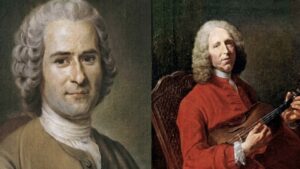
The philosopher and writer Jean-Jacques Rousseau became one of the most prominent defenders of comic opera. He admired what he saw as the natural expressiveness of Italian melody and was sharply critical of French opera. He argued that the French language was less suited than Italian to lyrical singing and that French music relied too heavily on convention. This position reflected broader ideas in his work: he was suspicious of artificial social conventions and often contrasted them with a more natural form of feeling. Italian opera, particularly comic opera, seemed to him closer to genuine human expression.
At the centre of the French side stood Jean-Philippe Rameau – born in 1683, the same year as Bach and Handel, and for much of his early career better known as a music theorist. In 1722, he published his Treatise on Harmony, an influential study of chords, bass lines and the logic behind musical progression. He came to opera relatively late in life. His first major work, Hippolyte et Aricie, was performed in Paris in 1733, when he was almost 50. Over the next three decades, he wrote a series of important stage works, including Castor et Pollux, Les Indes galantes, Dardanus, Platée and Zoroastre. Ranging from tragedy to comedy and from mythological drama to exotic fantasy, they include gods and heroes, but also dancing, feasting, storms, dreams, and comic misunderstandings.
By the time the Querelle broke out in 1752, his reputation for being learned, complex and demanding had made Rameau a convenient symbol: the most sophisticated face of French opera and therefore its most obvious target.
After his death in 1764, however, his music largely disappeared from the stage. The later 18th century increasingly favored composers such as Haydn and Mozart, and the 19th moved towards bel canto, grand opera and many other traditions. Rameau’s operas were expensive to stage and required a particular style of singing and dancing that fewer and fewer people still knew how to do. For nearly two centuries, he was remembered mainly as a theorist and the composer of a handful of keyboard pieces.
That began to change from the 1970s, as the early-music revival brought fresh attention to Baroque repertoire. The composer once accused of being too cerebral and formulaic turned out to have written some of the most theatrical and entertaining operas of his age. Productions of “Les Indes galantes” and “Platée” showed that these were not museum pieces: they could still be moving and amusing.
Ultimately, the Querelle was never really about Pergolesi or Rameau. It can look like a disagreement about musical taste, but taste is never entirely free-standing. It is often shaped by what we have been taught to value and by the institutions and social groups we identify with – which is why public debates about music often become arguments about who has the authority to define culture as a whole.
To prefer Italian or French music became, for some, a way of declaring what kind of culture they believed in – and, in the process, the dispute picked up the vocabulary of conflict such arguments tend to acquire: sides, camps, defenders.
Musical quarrels also have a habit of recurring. A century later, the so-called War of the Romantics would divide composers, critics and performers over very similar terrain – tradition vs progress – for reasons that, once again, were not simply musical. The question of whether music should continue developing along established lines or move towards new forms was inseparable from broader anxieties about modernity.
In the Querelle, the argument about French and Italian opera was also an argument about whether an established cultural tradition had become too artificial and whether something apparently lighter and more natural represented the future.
In both cases, music became a battlefield because it offered an abstract way of arguing about social change.
There is something very familiar in all this. It comes up whenever people argue about popular vs serious music, accessible vs difficult literature, mainstream vs experimental cinema, or whether a given artwork is “too intellectual.”
We might think we are discussing harmony, form or taste, when we are often truly arguing about something much deeper. The argument isn’t simply about stylistic preference: it is about cultural identity. Criticism of the art form can therefore start to feel like criticism of the people who value it, making neutral ground surprisingly difficult to find. Perhaps that is one reason musical quarrels have such a long afterlife.
The Querelle des Bouffons was ostensibly about opera, but its longevity suggests that – like the musical battles that followed it – it was never only about music.
Categories
Special Features