The Case for Reimagining The Mikado
By Timothy NelsonIN Series’ 2026-27 season is titled “Sic Semper Tyrannis,” a season that will cover a breadth of styles and forms, and almost 1,000 years of music history. This year of theater is intended to lift up the unique power of art, music, and theater, to unmask tyrants and tyranny, and to do so with beauty, joy, transformation, and even laughter. Obviously, this season comes out of the moment through which we are living, and is born from a recognition that, not unlike during the COVID-19 pandemic, it is small organizations, with less to lose, that have the privilege and also the responsibility to stand up – to make “good” trouble, to call a spade a spade, and to broadcast that the emperor has no clothes.
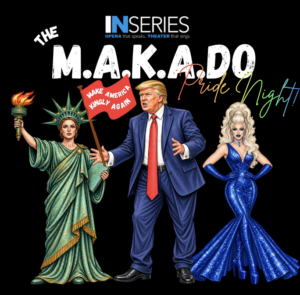
Naturally, much of such a season is dedicated to the tyranny of despots, but there are other forms of tyranny which must be unmasked, and as artists that work with a deeply established canon of historic works, a current epidemic of cancel culture is one such tyranny. We open our season this coming weekend with a new work called “THE M.A.K.A.DO” (“Make America Kingly Again”), based on the beloved and now rarely performed operetta of similar name by W.S. Gilbert and Arthur Sullivan, “The Mikado.” Our new version resets the original into a great gilded oval office populated with all the usual suspects – a fumbling orange idiot risen from criminal slumlord to Lord High Retributioner Koch-Co, a chainsaw-wielding space junkie Pish-Tush, an All American tenor disguised as Yankee-Poo, a drag queen seeking love and opportunities to read children’s book called Ms. Kitty Katishaw, and a surprise Makado that shows up not only as a woman and mother, but as lady liberty herself. The score is loaded with additional tunes from the great American lexicon reorchestrated for a John Philip Sousa-style town band, and entirely new song and spoken text was written by Bari Biern, a comedic writer for many years with the famed touring DC satire company The Capitol Steps. It is irreverent, audacious, hilarious, pointed, and full of love for the piece, the people, and our country.
Opera, even more than theater itself, is committed to a wonderful canon that includes many deeply problematic pieces that carry with them, in addition to their stunning music and moving narratives, baggage of histories of oppression, injustice, racism, colonialism, and the ills of a world increasingly global and capitalist. This is inescapable and can never be ignored. Opera has done a lot of damage, and without recognizing and reckoning with this fact, it is condemned to wither and to die. Just one corner of that complex canon are works growing out of 19th century orientalism, fetishization and infantilization of the East by the West. Much-beloved, and important, awesome works come from this space: “Madama Butterly,” “Turandot,” “Les Pêcheurs de Perles,” “Lakme,” and, yes, “The Mikado.” It’s critical to recognize that these works and the orientalism of which they are examples is not monolithic. They are their own works, each different and problematic for different reasons. Each must be considered separately, different ideas and solutions imagined for their contemporary representation. There is no one shoe to fit all these pieces of art.
As makers of art, at the very core of our set of ideas, must be a commitment to more art, not less. Especially when greatness is recognized in a work, testified to by generations of audiences moved deeply by their experiences with works, the answer from artists and arts institutions must NEVER be cancellation. Silence, negation, absence of art – censorship – is always the true enemy of growth, change, evolution, and, most importantly, the conversations that give rise to change and adaptation. If I believe one thing, it is a belief that wrestling with the canonical angel, daring to get it wrong and daring to question what really is essential in the work, is the only way to save many of these works.
“The Mikado,” as is well documented, was probably the least “orientalist” of all such works. It was never intended to be about a real Japan and could have just as easily been set on the moon. In truth it uses the “otherness” of Japan to a late Victorian Londoner as a safe place from which to lampoon British social hierarchies and hypocrisies. Still, it is offensive at times, not just in its words but in the pentatonic patronization of its score even. IN Series’ THE M.A.K.A.DO manages to take away all references to Japan through its new text but also by cleverly replacing its moments of Asiatic music with insertions of Americana – “Yankee Doodle”, “Hail to the Chief”, “Stars and Stripes Forever,” even “YMCA” and “I Will Survive.”
In opera, much more so than in theater, we are addicted to a myth of fidelity to the score, to originalism. We long to make our canon relevant, but we rarely dare to mess with the thing itself, where the problem lies. We adorn traditional musical performances with increasingly abstract directorial concepts to hide the ugliness of our flawed canon, because we are so afraid to change the canon, to be irreverent. Irreverence is a sacred act, and only by empowering our artists today to change the canon, to mess with it and experiment, to REALLY wrestle with it, will we even manage to save it truly. What works for “The Mikado” will not work for “Madama Butterfly” or “Turandot.”
The solutions which coalesce so effectively in The M.A.K.A.DO only work for this piece now. The point is to be willing to do the hard work of reflection, truth telling, and reconciliation with each piece, at each time one produces it. That is standing up, that is being honest, that is serving an audience and a repertoire simultaneously. It’s the hope of IN Series that this production can serve as more of an example than model, but definitely as a way to perform great and flawed works of the canon with pride in their relevance to the people and the moment now.
Categories
Special Features