Musikfest Berlin 2026 Review: La Sainte Face
By Zenaida des Aubris(Photo: Fabian Schellhorn)
The name Yvonne Loriod (1924-2010) is most likely not one you are familiar with. But if you are at all interested in the music of the 20th century, you will certainly know the name of her husband — Olivier Messiaen. Loriod was his pupil and an acclaimed pianist in her own right. But no one knew that the stacks of manuscript paper piled in a corner of their Paris home contained compositions of her own. Only in 2016, six years after her death, when all musical materials were transferred to the Bibliothèque Nationale de France, were the manuscripts identified as hers. Now, one of the most substantial of them, the 250-page “La Sainte Face,” has received its world premiere, with Kent Nagano conducting the WDR Symphony Orchestra at Musikfest Berlin in the Philharmonie.
Conductor Kent Nagano Discovers Loriod’s Manuscripts
It was no coincidence that Nagano stood on the podium. In 1982, the young Californian conductor made his way to Paris to assist Messiaen with what would become one of the seminal operas of the late 20th century, “Saint François d’Assise.” He became so close to Messiaen and Loriod that he lived in their home for a time and later referred to them as his “European parents.” Yet even Nagano knew nothing of Loriod’s compositional activities. Since the manuscripts came to light, he has made their discovery something of a personal mission.
Loriod was only 21 when she completed “La Sainte Face” at Pentecost 1945, only weeks after the end of World War II in Europe. Conceived as a contemplation of the Holy Face of Christ in the spiritual tradition of Saint Thérèse of Lisieux, the work is also dedicated to Jean-Claude Touche, the prodigiously gifted 18-year-old organist and composer who served as a medic during the liberation of Paris and died from a gunshot wound on August 25, 1944.
That biographical conjunction gives “La Sainte Face” an extraordinary historical charge: a young saint who died at 24; a young musician killed at 18 amid the liberation of Paris; and a 21-year-old pianist, herself poised to transform the performance of modern piano music, secretly composing a vast meditation on suffering, death, and transcendence as Europe emerged from catastrophe.
Composition Details
Loriod divided the roughly 90-minute score into two parts. The first comprises 14 interconnected contemplations on the image of Christ preserved, according to Catholic tradition, on the Shroud of Turin. She described its underlying music as an “infinitely pure, tender raga” unfolding freely beneath the individual movements. At its center is an unusual trio of soprano, flute, and harp, around which strings, winds, percussion, and two Ondes Martenot continually form and dissolve into new constellations.
The music begins almost beneath the threshold of hearing. A solitary flute emerged from silence, joined by harp and soprano, creating less the impression of a composition beginning than of our becoming conscious of music that was already there. Loriod explicitly asks for precisely that sensation: the opening should not “give the impression of a beginning.”
From there, the score contemplates the features of the suffering Christ with sometimes startling physical specificity: the distorted mouth, battered nose, lowered eyelids, burning tears, wounds of the crown of thorns, blood caught in the eyebrows. Yet Loriod rarely indulges in crude pictorialism. Violence arrives in brass and percussion spasms and eruptions; around it lies a strangely suspended world of luminous instrumental color, best expressed in a sequence performed by seven flutes.
Inevitably, Messiaen hovered nearby. Loriod’s use of Indian modes and rhythms recalls techniques her teacher codified in his 1944 Technique de mon langage musical. The two Ondes Martenot (an early electronic instrument first created in 1928 and producing sounds like a theremin and cello) and her construction of large structures from constantly changing instrumental groupings also anticipate the sound world of Messiaen’s “Turangalîla-Symphonie.” Most intriguing is Loriod’s extraordinary demand for seven flutes in the eighth contemplation, playing together at fivefold pianissimo. Decades later, Messiaen would deploy seven flutes in “Saint François d’Assise.” Who influenced whom? “La Sainte Face” suddenly complicates a musical history we thought we knew.
This is perhaps the greatest significance of its rediscovery. Loriod can no longer be viewed solely as Messiaen’s incomparable pianist, muse, pupil, and eventually wife. The score suggests a creative exchange whose direction may have been considerably less one-sided than posterity has assumed.
Illuminating Performance
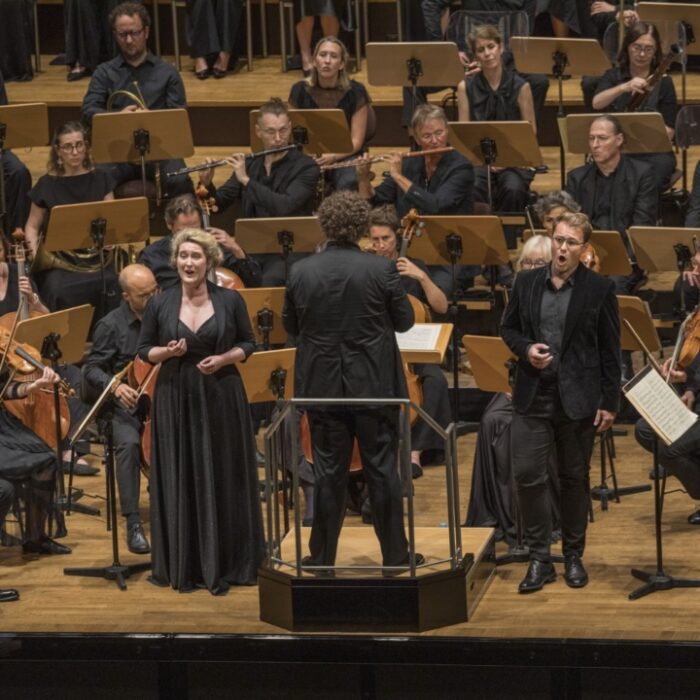
Nagano approached the work not as an archaeological curiosity but as living music. He allowed its long spans to breathe, resisting the temptation to manufacture drama where Loriod instead demands contemplation. The WDR Symphony Orchestra responded with remarkable delicacy, particularly in passages where conventional orchestral mass evaporates into isolated points of sound.
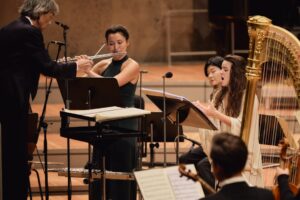
The three soloists immediately surrounding Nagano were central to the performance. Wendy Vo Cong Tri on flute and Emily Hoile on harp were almost continuously engaged, creating the shimmering connective tissue from which Loriod’s orchestral visions emerge. Sarah Aristidou brought her silvery soprano to writing that exists somewhere between chant, invocation, and aria. Hers was the human thread running through Loriod’s tapestry of sound, gradually elevating what might have remained an elaborate devotional meditation into something approaching a Passion.
Loriod’s musical language can be repetitive, and across 90 minutes its devotional intensity occasionally risks becoming static. Yet the sheer originality of her orchestral imagination repeatedly renews the ear. Seven flutes can become a single breath; bells appear as distant signals; the Ondes Martenot lend the texture an almost disembodied radiance. What initially seems austere gradually reveals an astonishing sensuality of sound.
The second part, a “Meditation on the Lily,” grows from another intensely personal religious memory: a lily Loriod offered in thanksgiving at Paris’s Église de la Sainte-Trinité in June 1944. Here the soprano becomes increasingly prominent, resonating against bells before the score finally opens outward into repeated Alleluias. The radiant ending is the opposite of the first part, which emerges from — and eventually disappears back into — near silence.
More Performance Highlights
The first half of the concert cleverly placed Loriod within a broader dialogue between faith, memory, and musical inheritance. Argentine composer Alex Nante’s ten-minute “Ein feste Burg,” written in 2025 at Nagano’s request, takes Bach’s chorale not as material to dismantle but as an object of contemplation. Fragments are examined, repeated, and subtly refracted, occasionally slipping toward medieval sonorities or Nante’s own language. For Nante, repetition is a meditative act: composition becomes less invention than listening to what inherited material still has to tell us.
Between Nante and Loriod came Jean-Claude Touche himself. Henry Fairs performed Touche’s “Trois pièces pour orgue” on the Philharmonie’s monumental Karl Schuke organ, with its more than 6,500 pipes, giving musical presence to the young man whose death had haunted Loriod while she composed “La Sainte Face.” What might otherwise have seemed a historical footnote became part of the evening’s emotional architecture.
Ultimately, the premiere did not answer the many questions surrounding Yvonne Loriod. It made them more urgent. Why did she hide these works? How much did Messiaen know? And how deeply might her musical imagination have entered his?
The manuscripts lying unnoticed in that Paris apartment may require us to revise one of 20th-century music’s most familiar relationships. At the Philharmonie, “La Sainte Face” ceased to be an archival curiosity. It became the voice of a composer who had been hiding in plain sight.