Lisbon Operafest 2026 Review: Turandot
The Ice Princess comes to Lisbon and a Requiem for Liù
By Ching ChangAs any Lisbon opera lover will tell you, Portugal’s operatic landscape has lagged disappointingly behind that of other European cities of comparable size. Seasons have often been frustratingly short on ambitious, adequately-funded productions that feature significant national and international talents or marquee guest artists—the major names in the discipline one might reasonably expect to see and hear in a prominent European capital with some regularity.
More recently, this already uneven landscape has been further destabilized by the multi-year closure of the Teatro São Carlos, Portugal’s jeweled historic opera house, which is currently undergoing much-needed renovations to modernize its technical infrastructure and backstage facilities.
A Mirror for Puccini
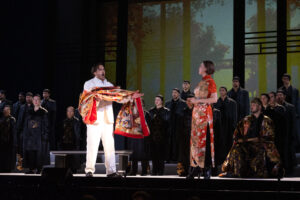
Against this backdrop, independent festivals have seized the opportunity to step into the void. Lisbon-based Operafest—now in its seventh year as Portugal’s largest independent summer opera festival—has done precisely that with an ambitious staging of Puccini’s beloved “Turandot.” Marking the festival’s first imported international production, Operafest has brought to Lisbon German régisseur Daniela Kerck’s much-praised, edgy, and minimalist staging created originally in 2024 for the Hessisches Staatstheater Wiesbaden. Serving as both stage director and designer, Kerck infuses the work with a striking visual and spatial sensibility, reframing the opera’s narrative by casting Calaf as a representation of Puccini himself across particular periods of his life.
More significantly, this staging engages directly with the unfinished nature of Puccini’s score by ending the opera with the slave girl Liù’s death, following the practice made famous by Arturo Toscanini. Kerck eschews the more popular completions of the score by Franco Alfano, or the metaphysical investigation in the conclusion presented by Luciano Berio, but she nevertheless manages to insert her own imprint into the ending by inserting immediately after Liu’s death a performance of Puccini’s own 1905 one-movement “Requiem,” a piece originally composed to honor Giuseppe Verdi on the fourth anniversary of his death.
Within the context of this staging, the “Requiem” serves as a poignant elegy for Liù and as an elegant device through which Kerck rebalances the prominence of the opera’s three protagonists. By elevating the servant girl’s role, she also draws a poignant parallel with a tragic episode in Puccini’s own life: the fate of Doria Manfredi, the young maidservant in his household who was driven to suicide after Puccini’s wife falsely accused her of having an affair with the composer.
Musical Standouts
Fittingly, the superb Romanian soprano Aida Pascu delivered a deeply moving portrayal of Liù, bringing a rich, unexpectedly dark timbre to a role more often entrusted to lighter voices. Projecting such emotional intensity and intimacy across a vast outdoor venue is no small feat, yet Pascu accomplished it with remarkable command.
Russian soprano Olesya Golovneva offered a compelling portrayal of Turandot. While her instrument is perhaps a size or two lighter than one might expect for the soaring climaxes of “In questa reggia,” she more than compensated through a penetrating exploration of the ice princess’s complex psychology. Her intelligent, nuanced characterization grounded her Turandot in the ice princess’ human failings, rather than merely an emblem of authority, contributing significantly to the production’s tightly woven ensemble feel.
As Calaf, Mexican tenor Rodrigo Garull brought an attractive, ringing tone to the role, delivering a strong performance that showed only fleeting signs of strain in the score’s most punishing passages. His handling of the pivotal riddle scene was particularly impressive, revealing a seasoned artist with an assured command of the part and a keen understanding of the dramatic stage assignment.
Portuguese baritone Nuno Dias anchored the supporting cast with a noble portrayal of the exiled king Timur, singing with a resonant and incisive impact.
The surrounding ensemble proved uniformly strong, highlighted by the standout trio of baritone Tiago Amado Gomes (Ping) alongside tenors Bruno de Almeida (Pang) and Alberto Sousa (Pong). While the three ministers are often clustered into an indistinguishable unit on stage, this cast breathed a refreshing degree of individuality into their respective roles.
Rounding out the production’s notable vocal contributions, Diogo Oliveira commanded attention as the Mandarin with his roaring, imposing presence; while tenor Luís Caetano delivered a deliciously reedy tone as Altoum. Despite occasional imprecision in his Italian diction, Caetano captured the emperor’s weariness in a manner somewhat suggestive of Chinese opera.
Under the baton of maestro Osvaldo Ferreira, the Portuguese Philharmonic Orchestra played with assertive energy, providing a solid musical foundation for the drama. The opera chorus, prepared by Filipa Palhares, faced the assignment with courageous verve, delivering Puccini’s demanding score with determination. Unfortunately, their work was sometimes betrayed by the event’s sound engineering. In some moments, the outdoor amplification rendered the orchestra’s tone rough and overly bright, while simultaneously depriving the chorus of a cohesive, well-blended acoustical balance.
The production unfolded in the expansive outdoor courtyard of the Cartuxa Convent in Oeiras, just outside Lisbon. Dating to the 16th century, this historic property may not rival the sheer scale or atmosphere of the Arena di Verona or Bregenz, yet it is a captivating venue. It offers tremendous promise as an open-air summer destination for locals and visitors alike, providing a unique setting that could help Operafest forge a truly distinctive identity.
In past editions, Operafest’s projects have yielded mixed results, alternating between excellent performances and improvisatory experimentation that at times flirted dangerously with the farcical. Yet, its most vital quality has always been evident from the start: a fearless willingness to take risks, which frequently paid off handsomely. In many respects, this “Turandot” marks a coming of age for Operafest, a year-round, multidisciplinary arts organization anchored by its ever more popular summer festival.
Despite lean budgets, this year’s edition demonstrates the organization’s remarkable administrative efficiency, particularly in its attention to operational services and audience support. These crucial elements—which significantly enhance the public experience but are frequently neglected in Portugal’s cultural sector—reflect the extraordinary organizational prowess of artistic director Catarina Molder, who effectively serves as the festival’s de facto Intendantin.