Opera Holland Park 2026 Review: Un ballo in Maschera
By Mike Hardy(Photo: Craig Fuller)
“Truth is stranger than fiction, but it is because fiction is obliged to stick to possibilities; Truth isn’t,” proclaimed Mark Twain.
Who knows what he would have made of Verdi’s “Un ballo in Maschera,” currently being performed in London’s Holland Park Opera, where the hugely implausible plot is based on the real-life assassination of King Gustav III of Sweden in 1792.
Gustavo, the King of Sweden, is a ruler in love with, and hankering after, his closest and fiercely loyal friend’s wife, Amelia. What’s more, he has enemies, and murder and vengeance are being sought.
Madame Arvidson, a mysterious prophet-cum-medium-cum-fortune teller, informs Gustavo that Amelia loves him too but, unfortunately, he is soon to meet a grisly end at the hands of the next man who shakes his hand. Which turns out to be his best friend Count Anckarström.
Anckarström then discovers that Gustavo and Amelia have met clandestinely and erroneously concludes that his best friend and his wife have been having an affair. He vows revenge and joins the plot to assassinate the king at a masked ball, where all will be in disguise.
Later at the ball, the Count discovers which masked guest is the King and he approaches and shoots him in the back. The dying Gustavo confesses that while he loves Amelia, her sacred marriage vows remain intact, along with her fidelity. He pardons all his conspirators, bidding farewell to all and his country before passing.
Which, to be honest, is a fiction somewhat stranger, and definitely more sanitized, than the truth. In reality, the genuine assassination was driven by deep political hatred of the King’s autocratic rule and reforms, not by a love affair. Gustav III actually lasted almost two weeks before eventually succumbing to his wound. And far from being pardoned, Jacob Johan Anckarström was sentenced and subjected to a brutal public execution. He was flogged in three separate public squares over three days, had his hand amputated, and was eventually beheaded and quartered. Not really suitable material for even the most macabre of opera composers, especially when it’s far simpler to employ the ubiquitous opera themes of betrayal, a love triangle and vengeance.
Teaming up with librettist Antonio Somma, Verdi based the story on Eugène Scribe’s libretto for “Gustave III,” which also mirrors the real 1792 murder of King Gustav III of Sweden. Alas, Verdi faced severe censorship battles over this royal assassination plot, particularly from Neapolitan censors who rejected entirely the depiction of a monarch being murdered on stage. Consequently, the plot was rewritten from Sweden to Boston, in colonial America, before premiering in Rome in 1859. Performances in today’s opera houses see the characters and settings returned to the original Swedish theme.
Production Details
In Rodula Gaitanou’s first revival of her 2019 acclaimed production, it’s impossible to state with any certainty what her overall aim was in terms of its era placement. The characters retain their Swedish names but unless the designer, takis, commissioned IKEA to produce the folding, dark wood high paneled walls enclosure set, then the original Scandinavian influence stopped at the names only.
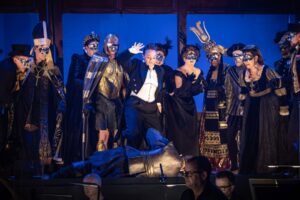
The opera opens with what appears to be traditional Swedish Royal court fencing practice, although either as a consequence of the limitations of fight director Bret Yount or stringent health and safety directives, it lacked any credibility whatsoever. Further, this opening scene merely serves to further confuse Gaitanou’s intentions when she presents the characters in trench coats, trilby hats and occasionally sunglasses, looking for all the world like extras from Elliot Ness’s “Untouchables.” Certainly, that period is reiterated in the final Act where the masked ball guests look like they are from the Hollywood golden era.
Cast Highlights
King Gustavo is portrayed by Matteo Desole. In an earlier performance of this opera, it was announced that he was somewhat indisposed due to some malady, but there was no evidence of any lingering effects here. His Act one romanza “La rivedrà nell’estasi,” where he expresses joy at discovering his paramour, Amelia, will be attending the upcoming ball, was sung eloquently with a bright and polished tone. His second Act duet with Amelia, “Teco io sto! … Oh, qual soave brivido,” where they each confess their forbidden love was suitably accomplished, particularly in the upper register. His finest work, however, was in the Act three aria “Ma se m’è forza perderti” where he sung with great poignancy and elegance with rich Italianate phrasing. He is something of a regular at both Opera Holland Park and Glyndebourne, and one would hope that Covent Garden comes calling before too long.
Sadly, whatever affliction Desole suffered in a previous performance appeared to have transferred itself to fellow colleague baritone Dario Solari, singing the role of Count Anckarström. He sung with a rich, dark, warm timbre throughout the evening, but he was very clearly ailing at times. Right from his opening passages, he broke in the middle register. He sung a very solid “Alla vita che t’arride” where he warns the King of potential threats to his wellbeing. But his keynote aria, “Eri tu che macchiavi quell’anima” in Act three, was affected by three further breaks. Despite this, it was still remarkable that he portrayed to perfection a broken man, having discovered that the love of his life was involved with his closest friend, his pain and anguish virtually palpable, with the final break coming right at the conclusion of the piece, on the final ‘d’amor’ of the final line ‘O dolcezze perdute, o speranze d’amor, d’amor, d’amor!.’ It broke as soon as he uttered it but the emotional gravity inherent in the performance meant that its negative impact was significantly reduced. One has to feel for an artist when their instrument simply fails them, particularly when the instrument is as gifted and enchanting as Solari’s.
On the evening, one would be compelled to award first prize in the vocal stakes to soprano Elin Pritchard in the role of Amelia. She performed with astonishing poise, resonant and voluminous at the top, resplendent through the lower and middle registers. Her Act two aria, “Ma dall’arido stelo divulsa” was simply divine, where she glided, seemingly effortlessly, through the registers; beautifully rich in color at the bottom and clarion and penetrative at the top. Likewise, her duet with Gustavo was endearing, where she gave a great portrayal of a woman engulfed with her guilt.
Her highlight came in the third Act, where she begged for mercy, asking to procrastinate the death that her husband had sworn to wreak upon her, after discovering what he considered her infidelity. Her aria, “Morrò, ma prima in grazia” is truly heart-rending, sung with tangible grief and beautiful floating notes to illustrate her vulnerability. She also displayed great breath control here.
However.
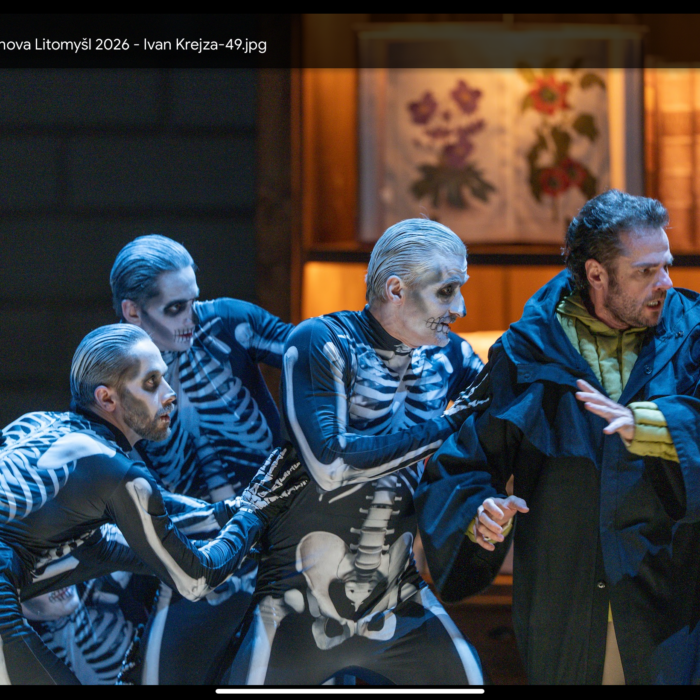
I have to say that, for me, key director decisions made a contribution in marring her performance, as exquisite as her vocal accomplishments were. In Act three she performed the aria “Ma dall’arido stelo divulsa,” where she sang of her fears surrounding her feelings of forbidden love, supposedly as she searched for a ‘secret herb’ as advised by Madame Arvidson, that will rid her of her feelings for Gustavo. Originally the libretto called for this scene to take place in a gallows field at the outskirts of town. Here, Amelia is searching in a lunatic asylum, complete with a single hospital bed, with phantom-like ‘inmates’ waving their arms at the windows behind. The bed then serves, momentarily, as a resting place where she reclines seductively during her interactions with Gustavo, at complete odds to the rhetoric she is employing in dissuading his advances, where she reaffirms her devotion and duty to the Count. Neither the setting nor the location made sense.
In “Morrò, ma prima in grazia,” Amelia pleads with her husband, begging to hold her young son one last time before she accepts the death he has sworn to inflict upon her. Here, she produces a swaddled form of an infant which she proceeds to ‘breastfeed.’ Of course, the libretto states: ‘Morrò, ma prima in grazia, deh! mi consenti almeno
l’unico figlio mio avvincere al mio seno (I will die, but first in mercy, please allow me at least to clasp my only child to my breast).’ But the use of a doll here to somehow accentuate the emotional gravity of the piece doesn’t work in my opinion. Rather than evoking greater pity, it struck me as being pitiful and gratuitous. Further, while I accept that pretty much all of opera is driven by tales of varying incredulity and often ridiculousness, the use of the representation of a baby here served to bring into focus the barbarity and inhumanity inherent in the tale; that a man would justifiably slaughter his wife and the mother of his infant child because of her infidelity or, in this case, the wrong presumption of it.
Special mention must be awarded to Rosalind Plowright OBE, portraying the role of soothsayer Madame Arvidson. She appeared from a harshly backlit interior of the setting and commanded a wonderful stage presence. Her middle register was beautiful and her upper register had great depth. She was richly deserving of her monicker, ‘legend.’
Rhian Lois added a much-needed shot of frivolity to the story as a comedic, court jester-like page and advisor to Gustavo. Her antics were almost reminiscent of an old-time music hall act. She sang with mellow sweetness and was totally enchanting.
Jihoon Kim played the role of Count Ribbing, one of the co-conspirators bent on assassinating Gustavo. His wonderfully opulent bass displayed great timbre and fine legato.
Duncan Stenhouse as Count Horn, Count Ribbing’s fellow assassinator-in-arms, performed with conviction and equal seriousness with suitable malevolence.
Baritone Benson Wilson as Cristiano, a wounded soldier who is down on his luck, but after a visit to Madame Arvidson and courtesy of some sleight of hand from the King, receives good fortune. Wilson is unquestionably one of those artists whose star deserves greater prominence. I first saw him at Opera Holland Park in Mark Adamo’s “Little Women” where he was the vocal sensation of the evening. I further reviewed him as Marcello in Robin Norton-Hale’s modern-day setting in London’s East End, for a cinema production of Puccini’s “La Boheme” where he triumphed. He has a unique richness, caressing warmth and limpidity and I believe he is deserving of greater roles and accolades.
Michael Papadopoulos conducted the City of London Sinfonia with aplomb, eliciting real beauty with Verdi’s score.
Rodula Gaitanou’s production was described in its first outing, in 2019, as “spectacular” and is currently being heralded as “Chiaroscuro meets Busby Berkeley meets Boris Karloff.” I’m afraid to say, none of those descriptive terms accorded with me where, I found much of the evenings’ production to be entirely nonsensical. The layout at the theatre, together with the stage setting and design, didn’t lend itself much to inspired creativity, and choreographer Steve Elias merely had the characters moving in simple parallel lines to the stage, performing simple sidewards line-dancing steps and at one point, in what looked suspiciously like a 1970’s Conga line.
All that said, Opera Holland Park is a remarkable venue. One might occasionally suffer a whirring helicopter or airplane drone by virtue of the partially open marquee, and the odd pigeon or winged insect will undoubtedly pop in from time to time or, as was the case on this occasion, a delightful songbird may elect to accompany the orchestra during one of its most impassioned movements, but this only lends itself to the unequivocal magic of the place.