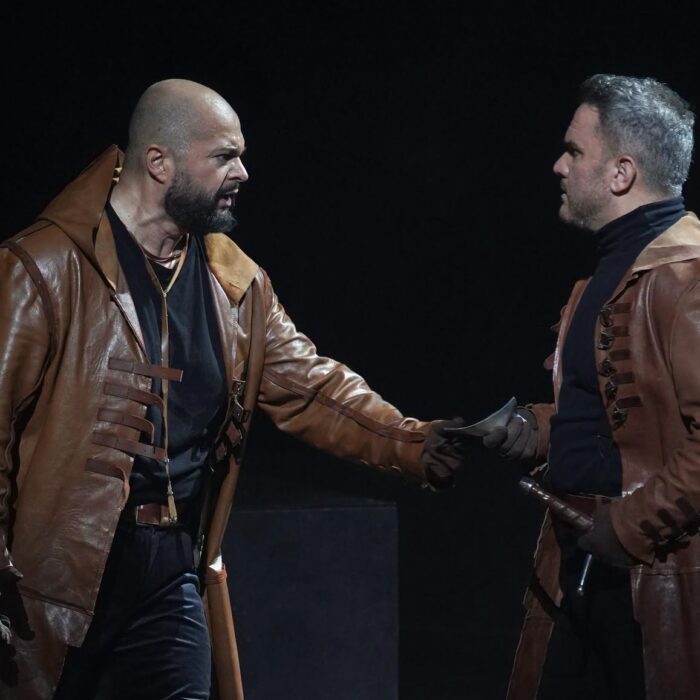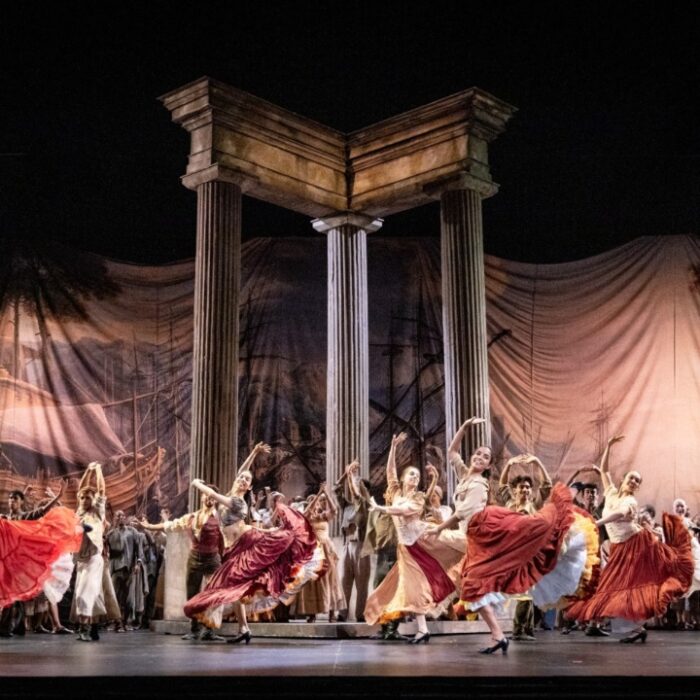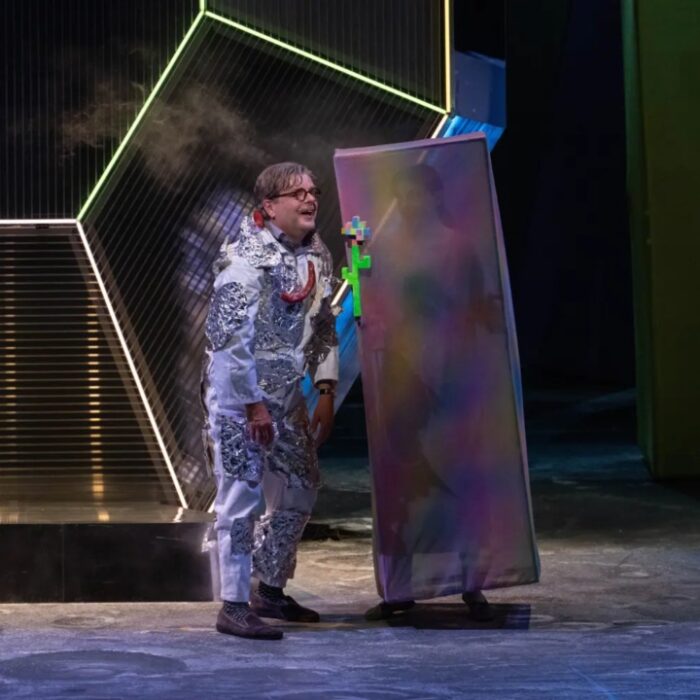
(Photo: Bregenz Festival / Daniel Ammann)
Few festivals possess an identity as distinctive as the Bregenz Festival. Founded in 1946 on the shores of Lake Constance, it rapidly became one of Europe’s most recognizable summer events through its spectacular Seebühne (Lake Stage), an immense floating stage whose colossal engineering feats and monumental scenery have become as celebrated as the performances themselves. Over the decades, the festival established an unrivaled reputation for transforming works of grand theatrical architecture—“Aida,” “Nabucco,” “Turandot,” “Carmen,” and “The Flying Dutchman” among them—into breathtaking visual spectacles for an audience of nearly 7,000 spectators. Few opera festivals have succeeded in making their venue so inseparable from their artistic identity. Audiences traveled to Bregenz not merely to hear opera but to witness the annual reinvention of the Lake Stage itself, where each production was expected to unveil another feat of theatrical engineering.
Production Details
“La traviata,” however, belonged to an altogether different category. Verdi’s most intimate masterpiece unfolded not through public spectacle but through private emotional devastation. Its decisive moments depended upon glances, hesitations and silences rather than ceremonial tableaux or vast choral scenes. The opera’s true stage was Violetta’s conscience rather than the Parisian salons she inhabited. It therefore arrived at Bregenz with an inherent disadvantage: on the immense Lake Stage, intimacy itself became the rarest special effect.
Damiano Michieletto confronted this dilemma with considerable intelligence and imagination, though not without occasional collateral damage. His production (seen August 4) was visually ambitious, theatrically sophisticated and, at its best, genuinely poetic. It also demonstrated just how difficult it remained to reconcile Verdi’s chamber drama with the monumental expectations that define the Seebühne.
(Photo: Bregenz Festival / Anja Koehler)
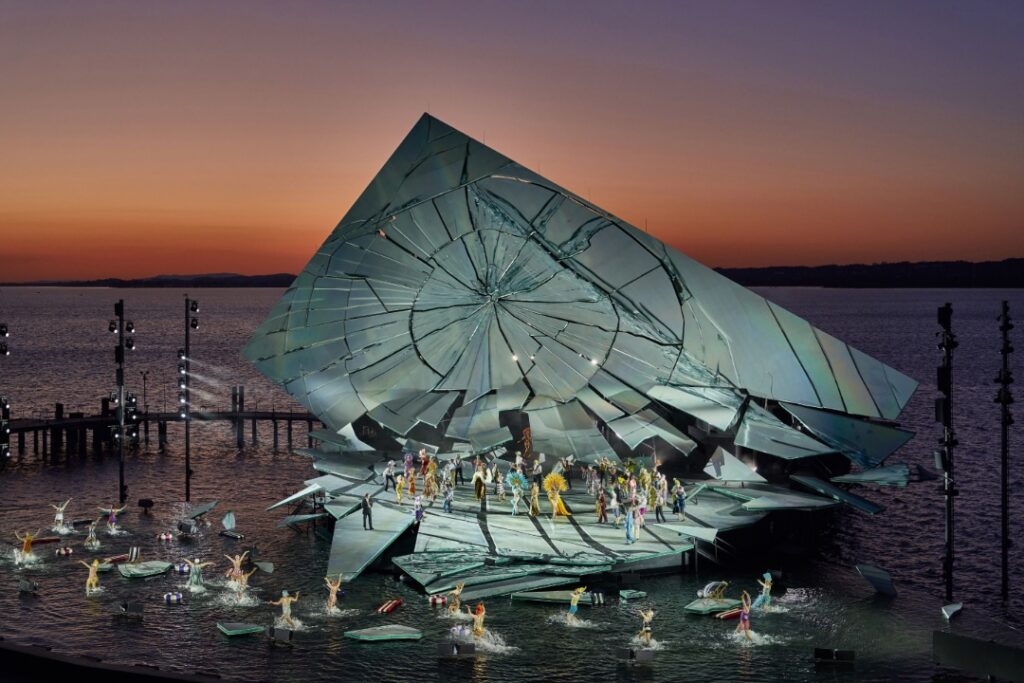
Paolo Fantin’s enormous set consisted of a shattered mirror inclined dramatically toward the sky, its countless fragments manipulated by an elaborate hydraulic system representing an investment reportedly approaching ten million euros. It was an extraordinary feat of stage engineering: less a conventional set than an architectural installation. As a metaphor for Violetta’s fractured existence, the image proved immediately intelligible—perhaps even excessively so. Likewise, the heroine’s illness was represented by a gigantic black sphere embedded within the mirror’s broken center and echoed by a dark stain that gradually spread across her white dress.
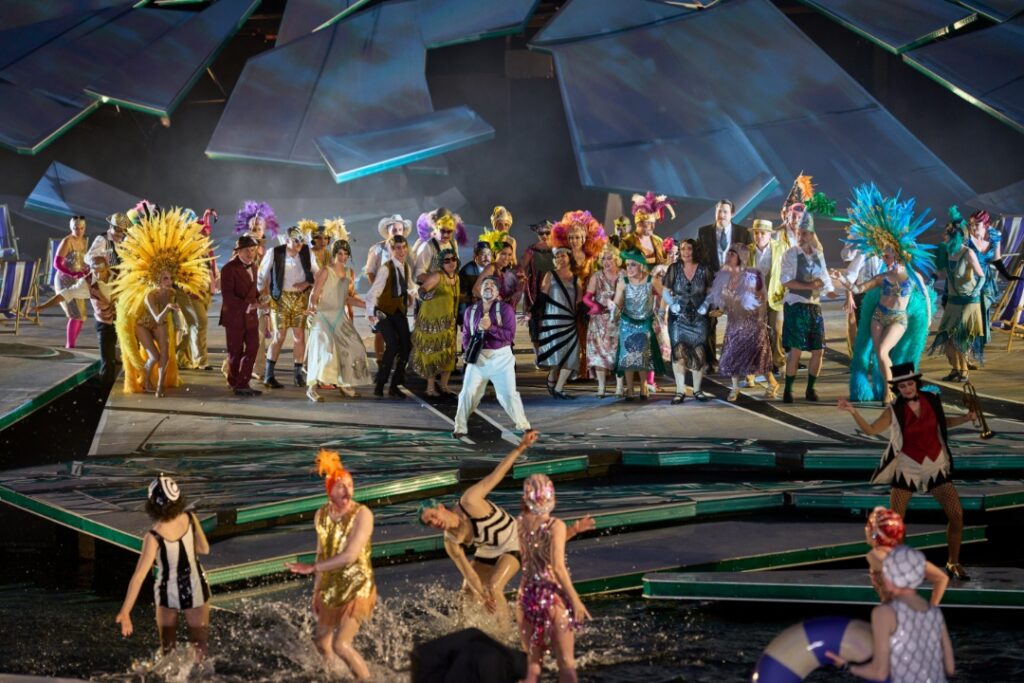
The action was transferred from Verdi’s Paris of the 1850s to the Roaring Twenties. The concept proved convincing. The Jazz Age, with its intoxicating mixture of luxury, excess and moral fragility, offered an apt equivalent to the society that first exploited Violetta and ultimately rejected her. Carla Teti’s glamorous costumes supplied the expected abundance of feathers, sequins and glittering decadence without ever descending into caricature.
(Photo: Bregenz Festival / Anja Koehler)
As expected in Bregenz, water inevitably became another protagonist. The famous aquatic choreography, complete with fountains, synchronized swimmers and dancers splashing across the stage, was expertly executed and undeniably entertaining. Yet despite its technical brilliance, it felt curiously disconnected from Verdi’s drama. Even during the Années folles, one doubted that Parisian courtesans habitually celebrated their soirées waist-deep in Lake Constance (or the Seine). The spectacle frequently resembled an extravagant Broadway revue more than “La traviata.”
One should nevertheless acknowledge the magnitude of Michieletto’s challenge. Unlike “Aida,” “Turandot” or “The Flying Dutchman,” Verdi’s tragedy offered remarkably little that naturally translated into monumental outdoor imagery. Rather than simply inflating the work into a sequence of oversized tableaux, the director attempted to externalize Violetta’s psychological disintegration through visual metaphor. Several of his ideas possessed genuine theatrical force.
The very requirements of the Seebühne, however, ultimately compromised the drama. To animate such an enormous playing area, the production constantly dispersed its protagonists across multiple levels of Fantin’s colossal mirror. Elevated chambers housed Alfredo’s apartment, Annina’s sitting room and Dr. Grenvil’s consulting office, ensuring that every corner of the monumental structure remained occupied. Annina appeared almost incessantly from her elevated room as a protective maternal presence, while Grenvil repeatedly examined Violetta’s X-rays from his office overlooking the action. Ingenious though these ideas were, they frequently diverted attention from the opera’s emotional core rather than intensifying it.
(Photo: Bregenz Festival / Daniel Ammann)
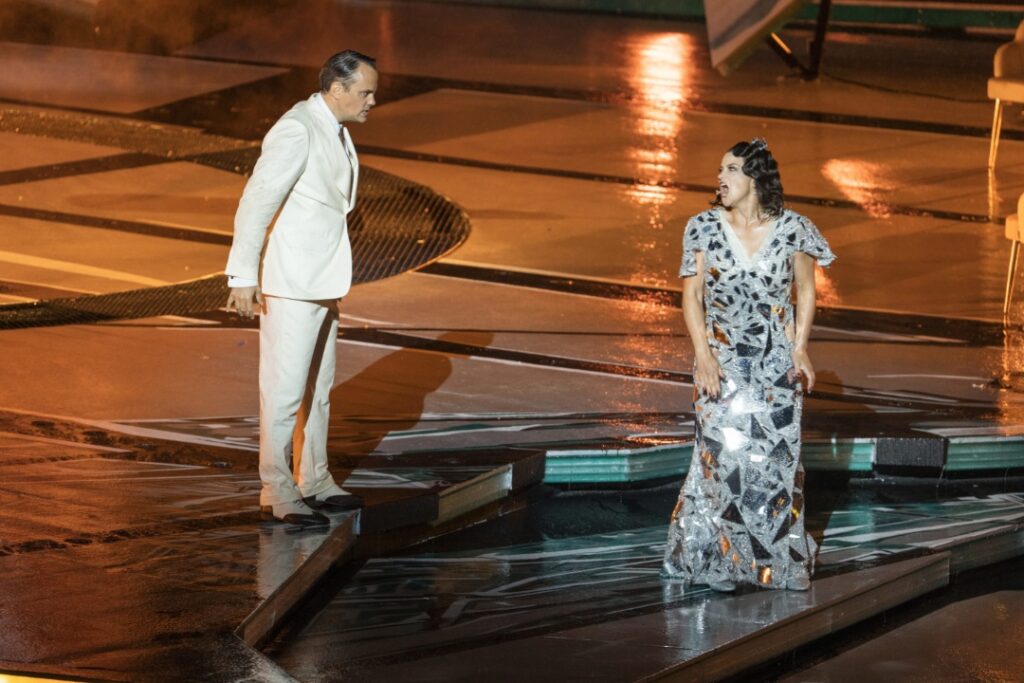
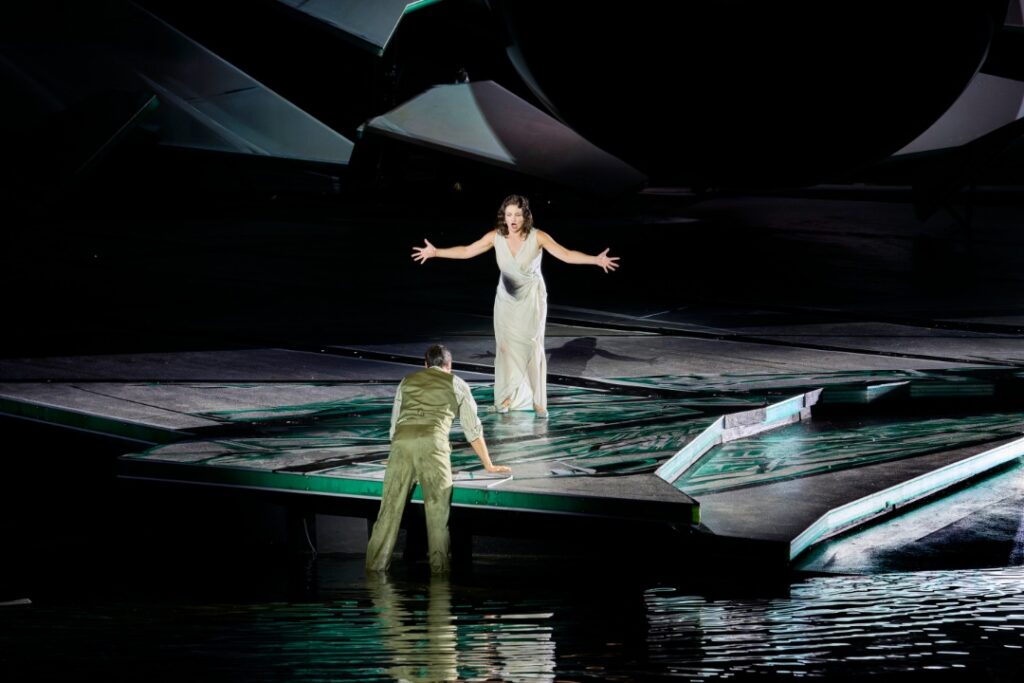
The production’s greatest weakness lay in its treatment of the central relationships. Violetta and Alfredo remained physically separated throughout much of the evening, while the confrontation between Violetta and Germont likewise unfolded across uncomfortable distances. The concept could be defended intellectually as an expression of emotional alienation, yet theatrically it proved far less persuasive. Verdi’s most devastating encounters resembled conversations conducted across a public square rather than moments of painful personal confession.
Equally damaging was the almost complete absence of furniture on the principal playing area. Without even the symbolic presence of a bed, the production sacrificed much of the sensuality upon which the lovers’ relationship depended. The audience understood intellectually that Alfredo and Violetta loved one another but rarely experienced that passion emotionally. The carefully executed video projections—showing Violetta secluded in her boudoir, burning letters, accepting lavish jewels from wealthy admirers or consuming heroin—failed to compensate. On the contrary, they presented her from the outset as a damaged and self-destructive figure, thereby weakening the opera’s carefully constructed dramatic trajectory. Rather than witnessing the gradual destruction of a woman who sacrificed everything for love, one encountered a heroine whose downfall seemed predetermined before the drama had scarcely begun.
Ironically, the gigantic mirror itself sometimes functioned more convincingly as the evening’s protagonist than any of the characters inhabiting it. One admired its endless transformations, the remarkable precision with which its fragments tilted, opened and reassembled, yet admiration gradually replaced emotional involvement. The production repeatedly invited the audience to contemplate ingenious stagecraft when it should instead have encouraged identification with Violetta’s increasingly fragile humanity.
(Photo: Bregenz Festival / Daniel Ammann)
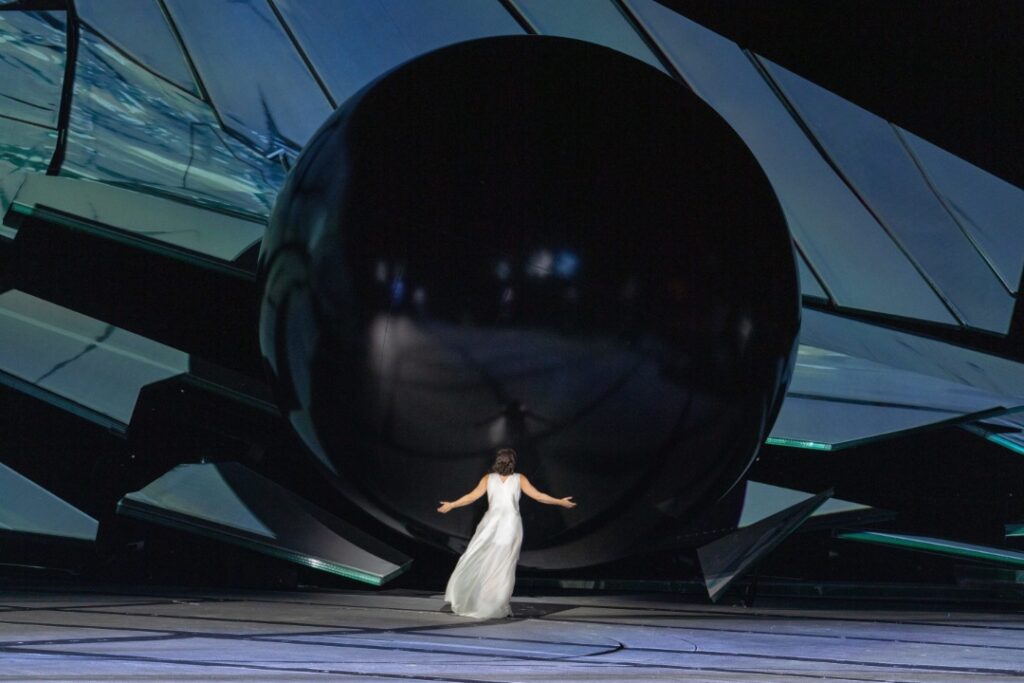
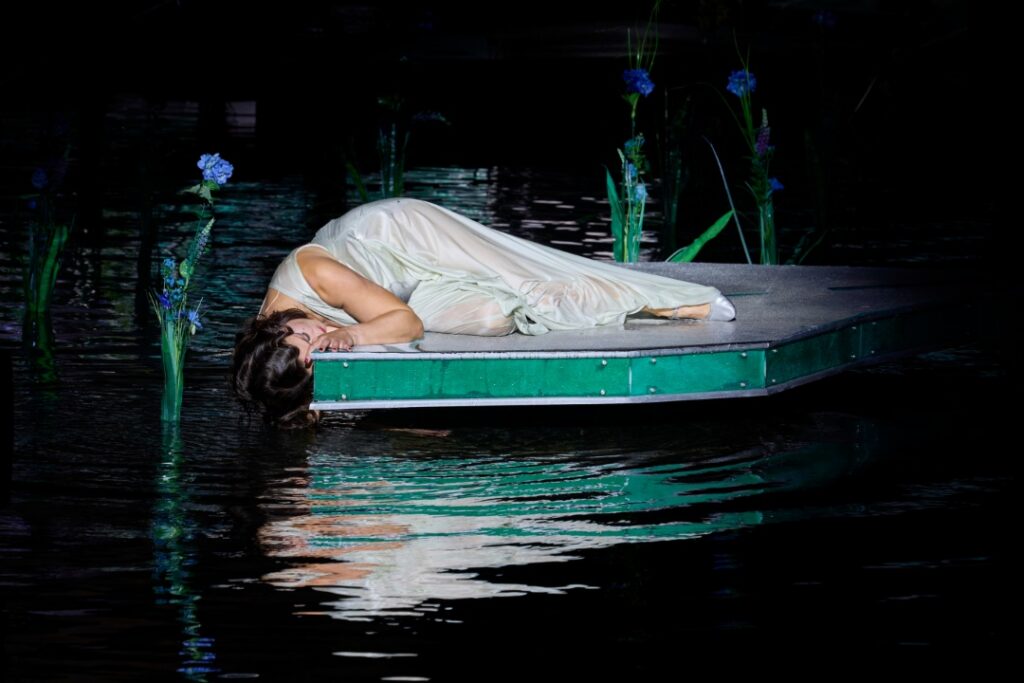
None of this, however, diminished the extraordinary impact of the final tableau, unquestionably Michieletto’s finest inspiration. As Violetta approached death, the immense fragments of the shattered mirror slowly contracted towards their broken centre, from which the enormous black sphere emerged and descended inexorably upon her. Whether interpreted as disease, mortality or the physical manifestation of the fatal stain already consuming her existence, the image possessed an unexpected poetic grandeur. Here, at last, Bregenz’s formidable technological arsenal ceased to exist for its own sake and became a genuine extension of Verdi’s drama. It was one of those rare moments when spectacle and psychological truth finally converged.
One intriguing moment came in the scene at Flora’s party in Act two, where Alfredo publicly humiliated Violetta. In the original libretto, he denounced her with the words, “Questa donna conoscete? (Do you know this woman?)” before throwing his gambling winnings at her feet as payment for her services. Owing to Bregenz’s practice of presenting the Seebühne productions in no more than two hours (without intermission), several minor cuts were made, including the episode in which Alfredo won at cards against Baron Douphol.
In Michieletto’s version, however, Alfredo forcibly removed Violetta’s coat, exposing her in a white silk dress marked by an enormous black stain that echoed the gigantic black sphere embedded in the shattered mirror’s centre, the production’s symbol of her tuberculosis. Ingenious though this visual metaphor was, it reflected appallingly on Alfredo’s character. By publicly exposing Violetta’s illness, he committed an act of humiliation arguably even crueller than the traditional gesture of throwing money at her feet. The effect was to transform a character who was already far from sympathetic into one who appeared thoroughly despicable.
(Photo: Bregenz Festival / Anja Koehler)
Musical Highlights
Musically, the evening proved considerably more satisfying than its theatrical reservations might have suggested. Kirill Karabits drew from the Vienna Symphony Orchestra playing of remarkable refinement, flexibility and expressive warmth. The Prelude unfolded with delicate transparency and quiet melancholy, foreshadowing the tragedy with admirable restraint rather than sentimental excess. Throughout the evening, Karabits maintained an ideal balance between lyricism and dramatic momentum, allowing Verdi’s melodic lines to breathe naturally without sacrificing theatrical urgency. Particularly welcome was his refusal to mistake volume for intensity. Even during the larger ensembles, the orchestra retained its characteristic Verdian elegance, preserving the score’s underlying melancholy beneath the outward brilliance of the festivities. It was conducting of intelligence, taste and considerable sophistication.
(Photo: Bregenz Festival / Daniel Ammann)
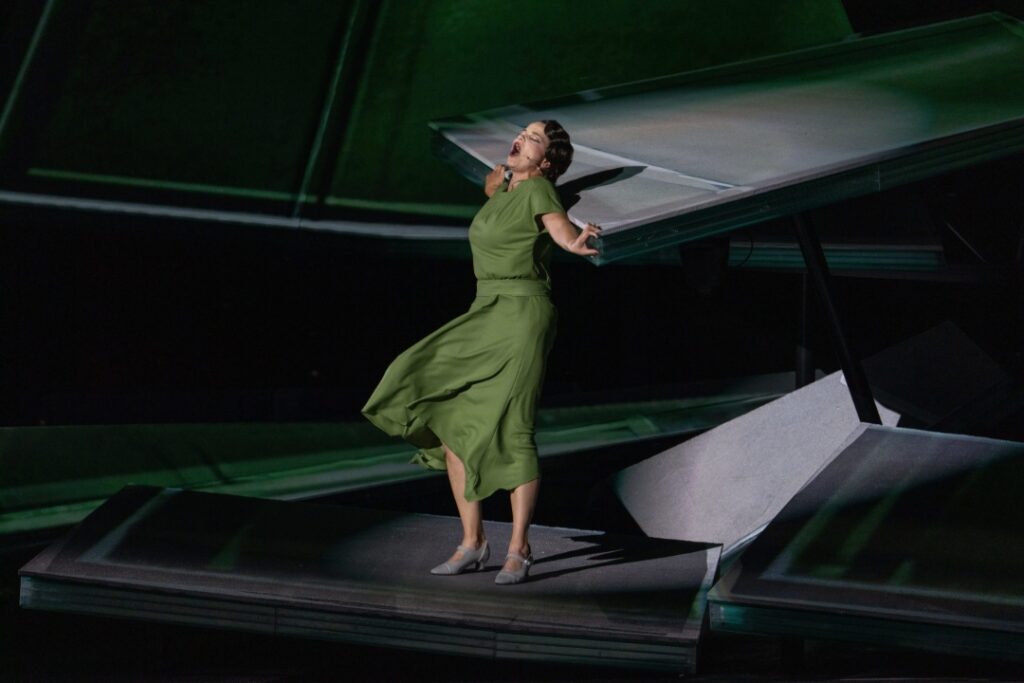
Marjukka Tepponen as Violetta
The cast likewise upheld the festival’s consistently high musical standards. Marjukka Tepponen proved an exceptionally compelling Violetta, offering a portrayal that supplied precisely the emotional immediacy the production itself occasionally denied. This was no mere exhibition of vocal athleticism, despite negotiating the formidable demands of “Sempre libera” with impressive assurance. Tepponen combined agility with warmth, lyrical radiance with dramatic conviction and technical security with unaffected sincerity. Her voice possessed sufficient brilliance for the first act while acquiring increasing richness and emotional depth as the tragedy unfolded. Above all, she succeeded in making Violetta profoundly human. Whenever the staging threatened to distance the audience emotionally, Tepponen restored the opera’s intimate heart through sheer force of personality, expressive intelligence and vocal beauty. Despite several shortcomings in the production itself, she emerged as the principal reason this “La traviata” lingered in the memory.
(Photo: Bregenz Festival / Daniel Ammann)
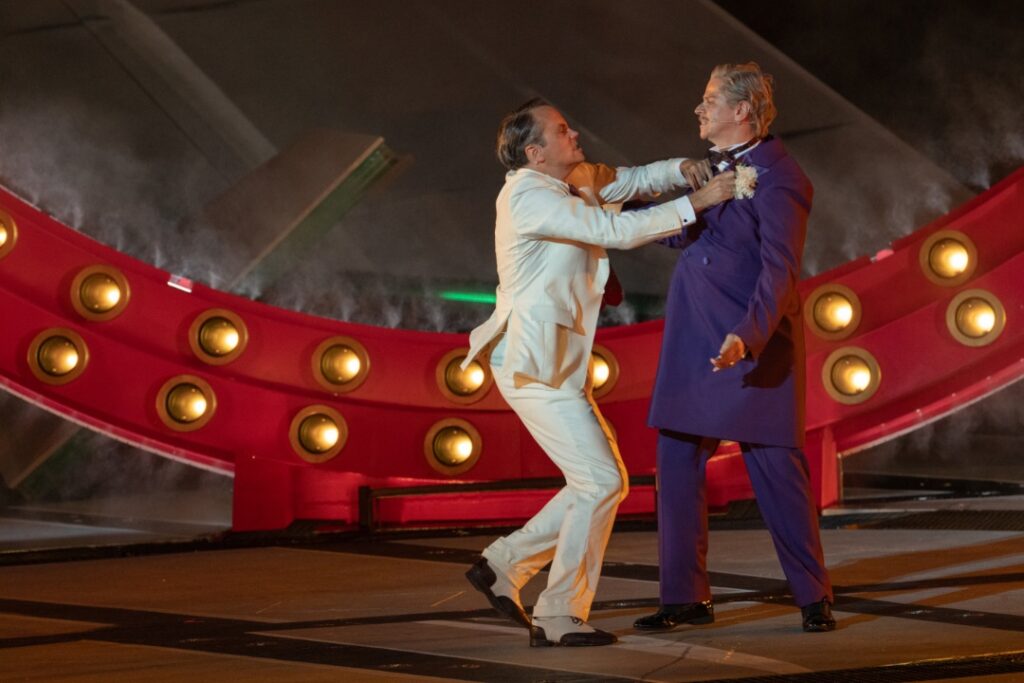
Julien Behr as Alfredo
French tenor Julien Behr, who had made such a strong impression as Jason opposite Joyce El-Khoury in Cherubini’s “Médée” at the Opéra-Comique, offered an attractive and increasingly persuasive Alfredo. His stage presence remained somewhat restrained and his opening phrases occasionally sounded effortful, but his performance gathered confidence as the evening progressed. The upper register acquired welcome brilliance and freedom, while his phrasing became progressively more ardent. At times, however, the singing relied excessively on forte and fortissimo, sacrificing nuance and dynamic variety for sheer projection, an understandable but not entirely desirable response to the demands of the vast outdoor auditorium.
(Photo: Bregenz Festival / Daniel Ammann)
Illuminating Cast
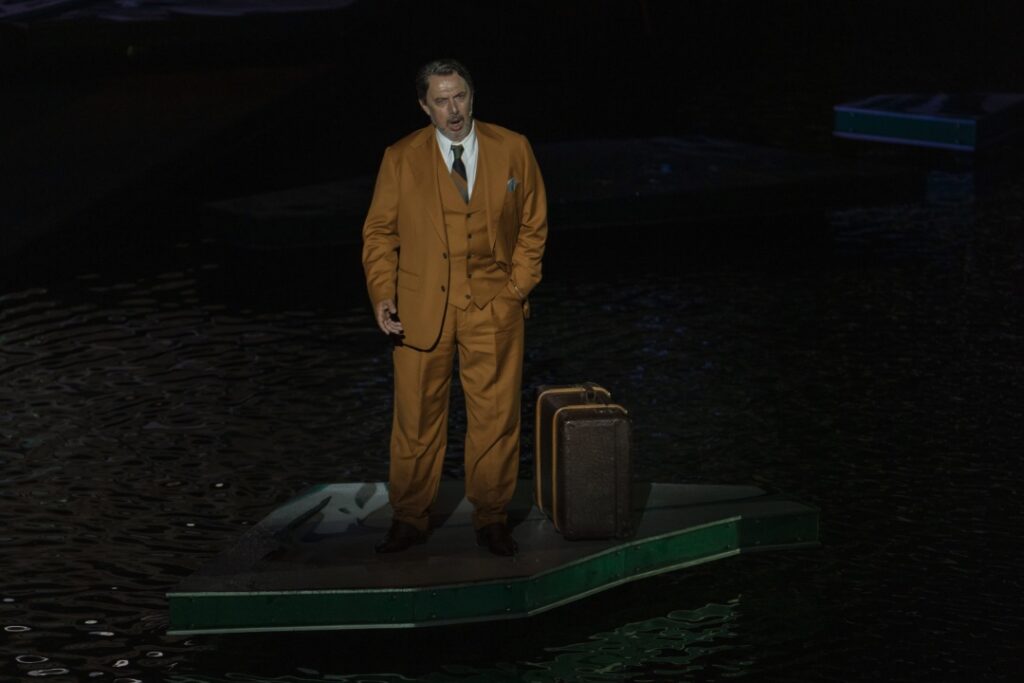
As Giorgio Germont, Vladimir Stoyanov avoided reducing the character to a one-dimensional authoritarian patriarch. His warm, sonorous baritone, impeccable legato and unfailing musical authority lent the role considerable dignity while preserving enough humanity to make Germont’s moral rigidity all the more disturbing. The supporting cast maintained the uniformly high level expected from Bregenz.
For all its reservations, Michieletto’s achievement ultimately deserved admiration rather than dismissal. He confronted what may well have been an insoluble problem: how to preserve the intimate emotional architecture of “La traviata” while satisfying the monumental expectations inseparable from the Bregenz Lake Stage. If the production remained more successful as visual theatre than as Verdian drama, it nevertheless displayed intelligence, ambition and a commendable refusal to rely on empty spectacle alone.
In the end, however, it was the musical performance that restored the opera’s emotional equilibrium. Whenever Karabits allowed Verdi’s score to breathe, whenever Tepponen illuminated Violetta’s vulnerability with disarming sincerity, or whenever Behr and Stoyanov transcended the physical distances imposed upon them, one was reminded where the true greatness of “La traviata” resided. Bregenz may have constructed an extraordinary floating monument of steel, glass and hydraulics, but Verdi required something altogether less tangible. The evening’s finest moments arrived not when the machinery astonished, but when the music momentarily made one forget it existed.
(Photo: Bregenz Festival / Anja Koehler)