Kissinger Sommer 2026 Review: Cecilia Bartoli & David Fray
By Mengguang Huang(Photo: Julia Milberger)
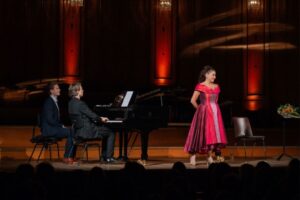
If the opening night of the Bartoli Trilogy left the audience with a lingering sense of minor omission, the second recital could only be described as a considerable disappointment. While one must naturally accommodate the inherently entertaining nature of a summer music festival in a holiday resort, a vocal program this broad demands a highly specialized keyboardist. This is especially true when considering the protagonist: Cecilia Bartoli is not a 19th-century opera diva who occasionally dabbles in the early music revival for novelty; Baroque music is her home turf, the very foundation upon which her legendary career was constructed.
Given that the Les Musiciens du Prince–Monaco provided such a tailored cushion for the star mezzo-soprano on the first evening, it remains baffling why a few core instrumentalists were not drawn from the ensemble to accompany Bartoli through tonight’s heavily Baroque program. Instead, audiences were treated to an evening with David Fray. He may well be a competent solo pianist in his own right, but his casual approach to tonight’s early repertoire left much to be desired.
Leaning back in his chair as if he were merely sight-reading during a casual run-through, Fray seemed completely indifferent, leaving one to wonder whether he found the physical demands too low or was simply detached from the music material. He certainly knew how to attract gasps from the audience—suddenly hammering out loud chords during the transitions between recitative and aria in Haydn’s cantata—but his continuo playing (if it could even be called that) was flat, uninspired, and thin in substance. The sparse chords and threadbare textures made the evening feel less like a formal concert.
From Alessandro Scarlatti and Händel all the way to Haydn, Fray wrapped the music in a domestic, early-Romantic velvet haze, giving the distinct illusion that we were listening to Schubert or Schumann lieder. Piano can indeed be used for early music, but only if the pianist offers a convincing vision. Here, there was hardly any hint of sympathetic understanding of Baroque style. If this were the era of Alfred Deller, such an anachronistic approach would be common; in 2026, one needs to forget the achievement of complete early music revival to accept that. If you are familiar with the brushstrokes of original Italian Renaissance masterpieces, and equally acquainted with the much later Nazarene or Pre-Raphaelite movements that attempted to revive that very style, you will understand exactly what went wrong tonight.
Through the opening four miniatures, Bartoli remained stable. Scarlatti’s inherently joyful, simple melodies in “Già il sole dal Gange” were delivered with poise, even if it sounded uncharacteristic of the elder Scarlatti. Moving through Parisotti’s “Se tu m’ami,” Giordani’s “Caro mio ben,” and Paisiello’s “Chi vuol la zingarella,” she utilized a highly lyrical timbre to navigate the space between reflective longing and light-hearted humor, successfully evoking the charming nostalgia of a summer evening.
However, the affection vanished when she repeated Händel’s “Lascia la spina” from the previous night. Applied with an even more sluggish tempo, the piece felt rather plain, without the freshness and vitality from her earlier era when recording the pioneering Vivaldi or Steffani albums. Fray’s impoverished accompaniment offered none of the lushness of the orchestral version, and even Bartoli’s slight acceleration in the B-section could not rescue the aria.
Fray’s solo interventions did little to remedy the situations. In the Sonata in F minor, K. 466, where the surtitle team committed an error again by projecting Domenico Scarlatti’s name as his father, Alessandro, Fray utilized an overly lyrical touch that completely romanticized the piece into a nineteenth-century piano work. His rendition of the Sonata in D minor, K. 1 fared no better. While his rapid runs were technically fluent, they were entirely rendered in a homogeneous legato.
The evening’s sole substantial centerpiece, Haydn’s “Arianna a Naxos,” proved to be uneven and a missed opportunity. In the opening longing recitative, “Teseo mio ben, dove sei?,” Bartoli’s delivery was far too linear. Throughout the initial stages of distress and hope, Bartoli remained largely polite. Her rounded timbre lacked the sharp rhythmic definition and declamatory inflection required to make a recitative dynamic. Overall, the performance lacked the dramatic contrasts and range that a chamber cantata demands, sadly robbed the plot of its urgency. It was only when Theseus’s abandonment became an absolute certainty that the performance finally ignited. Ariadne’s outburst of grief, self-doubt, and questioning was delivered with emotional intensity, but this surge of dramatic tension arrived unfortunately too late.
It was only during the final thirty minutes that the duo finally navigated into their comfort zones. The shift to Bellini and Rossini felt instantly more organic. Bellini’s “Vaga luna, che inargenti” allowed Bartoli’s vocal lines to float effortlessly, finally achieving the bel canto synergy the audience had been waiting for. Rossini’s “L’Orpheline du Tyrol” was performed with a beautifully introverted quality, while the “Canzonetta spagnuola” showcased its dramatic architecture. Driven by a progressively accelerating tempo, the piece held the audience captive. These final selections, along with the two encores, gave Bartoli the ample room she needed to unleash her signature coloratura fireworks.
Leaving the concert hall, one could not shake the feeling that tonight’s program and performance leaned heavily into treating music and artistry as a beautiful sensory commodity. Regrettably, this commodity was largely a repetition of Bartoli’s recital program with Lang Lang before, and unfortunately, a much shorter one. On the whole, it amounted to a deliberate indulgence of the audience’s expectations.