Q & A: Andrea Sanguineti on Verdi, Mozart & Korngold’s ‘Das Wunder der Heliane’
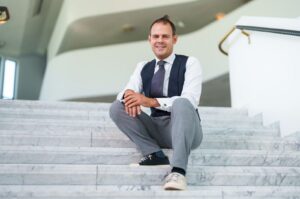
By Francisco SalazarAndrea Sanguineti is a rising star conductor currently working all over the world and performing a diverse array of repertoire.
He was appointed Music Director of the Aalto-Musiktheater and the Essen Philharmonic Orchestra and has also conducted at the Opéra National du Rhin, Opera Zurich, Deutsche Oper am Rhein, Landestheater Innsbruck, Teatro Sao Carlos Lisboa, Opéra de Rouen, and Kissinger Sommer.
His vast repertoire starts with Viennese operetta and extends to Italian, German, French, literature and contemporary music. Recently his 2025-26 season was full of Mozart, Verdi and Puccini works.
Next season Sanguineti will bring to life Korngold’s rarely performed opera “Das Wunder der Heliane,” while also conducting some Verdi and Mozart staples.
OperaWire spoke to Sanguineti about conducting such a diverse repertoire.
OperaWire: How do you balance conducting so much diverse music?
Andrea Sanguineti: For me, it is absolutely essential to work systematically on a wide range of different styles and compositions from various eras. This diversity is fundamental to achieving the right interpretive caliber and depth that each piece demands. By knowing and systematically working through different styles, I can easily find musical connections and echoes between composers who might seem close in spirit but are chronologically or geographically distant – such as Puccini and Richard Strauss, and vice versa. Therefore, working on multiple styles in parallel undoubtedly enhances my musical choices and sharpens my stylistic ideas.
OW: Is there a style that you prefer, or do you like to vary what you conduct?
AS: I deeply appreciate the contrast and actively choose to vary my repertoire. While I feel a particularly pronounced, natural affinity for Italian Late Romanticism – especially Puccini . as well as German Late Romanticism, I also feel completely at home with the dramatic architecture of Verdi and the refined nuance of Donizetti. Varying what I conduct keeps my musical mind flexible, ensuring that when I return to these core styles, I bring a renewed energy and a sharper focus to the podium.
OW: You are conducting Mozart this summer. Tell me about the challenges of “Le Nozze di Figaro” and what are some of your favorite parts?
AS: The ultimate challenge of “Le Nozze di Figaro” lies in its breathtaking pacing and transparent texture. My interpretive approach to Mozart is quite specific: I start from the historical premise that execution at the time relied heavily on spontaneity and extemporaneous expression. Because of this, I love introducing variations in the da capo sections and integrating contrapuntal lines with the fortepiano or harpsichord right into the orchestral and vocal numbers. Musically, I strive for striking sonic contrasts, marked by clear chiaroscuro textures and sharp accents. Whenever possible, I love to conduct from the keyboard simultaneously – though at Savonlinna, this won’t be possible due to technical constraints.
As for my favorite parts, the Act II finale is an absolute miracle of musical architecture, while the profound, cathartic forgiveness scene in the Act IV finale never fails to deeply move me.
OW: How do you approach the musical line when working with singers on this piece?
AS: Every singer is entirely unique. Therefore, even though my own musical and stylistic ideas are very clear from the beginning, I do not believe in imposing them rigidly. Instead, I try to guide my colleagues toward my vision by organically integrating what they bring to the table from their own unique vocal background, technique, and career experience. It is a collaborative process of shaping the line together.
OW: How different is conducting Mozart from Verdi?
AS: They are completely different worlds. When conducting Mozart, I very often choose to lay down the baton entirely. Conducting batonless immensely expands the possibilities of musical communication, allowing me to utilize my hands and express nuances down to every single phalanx. The resulting musical tension is much more attuned to the classical transparency and intimacy of Mozart’s soundscape.
With Verdi, however, the podium physical requirements shift completely. I always strive to capture that distinctive, driving pulse – the raw theatrical “groove” and drängend momentum – that is absolutely vital to making his music breathe with real dramatic passion.
OW: Speaking of Verdi, “Simon Boccanegra” is a very interesting work that feels like a transition. Tell me about this work and how you feel it compares to his other works.
AS: “Simon Boccanegra” is one of Verdi’s darkest, most melancholic, and deeply psychological masterpieces. It stands as a bridge between his middle-period operas and his late genius. But for me, this opera holds a deeply personal resonance: I am Ligurian, born very close to Genoa. This work captures the genuine, complex geopolitical reality and historical atmosphere of my homeland, colored by the historic clashes and rivalries of prominent local dynasties like the Grimaldi and Fieschi families. Unlike the direct, hit-driven melodies of Rigoletto, Boccanegra relies on a continuous, brooding symphonic texture dominated by maritime colors and political gravitas, completely intertwined with a devastatingly intimate father-daughter relationship.
OW: When did you first conduct “Simon Boccanegra” and how has it developed for you? What did you learn from it?
AS: While I have frequently conducted excerpts of Boccanegra in Gala concerts over the years, my actual debut conducting the complete opera took place just recently, leading a performance at the Dutch National Opera in Amsterdam with a truly stellar Verdi cast.
Stepping into the pit for this masterpiece taught me the immense power of restraint and dramatic scale. Over time, the piece has matured within me; I have learned to embrace its vast expanses of silence, the subtle pianissimi, and the incredible narrative weight of the Council Chamber scene. It showed me how to let the orchestra breathe like the Ligurian Sea—sometimes violent, but often terrifyingly calm.
OW: Next season you will conduct Korngold’s work “Das Wunder der Heliane.” Why are you excited for this opera?
AS: I am incredibly thrilled to conduct “Das Wunder der Heliane.” Korngold’s voice is utterly unique, and this score represents the absolute zenith of Late Romantic, post-Straussian opulence. The orchestration is ecstatic, massive, and filled with intoxicating harmonies and soaring, ecstatic vocal lines. Bringing a neglected masterpiece of this emotional and sonic magnitude to life is the ultimate privilege for a conductor. It is an overwhelming sensory experience for both the performers and the audience.
OW: Why do you think “Das Wunder der Heliane” is rarely performed?
AS: There are two main reasons. Culturally, its premiere in 1927 was overshadowed by a fierce, politicized rivalry with Krenek’s jazz-opera Jonny spielt auf, followed soon after by the tragic banning of Korngold’s music by the Nazi regime.
Practically, the work demands monumental resources. The orchestral apparatus is gigantic and requires a conductor to maintain strict structural clarity amidst a tidal wave of sound. Furthermore, the vocal roles – particularly Heliane and the Stranger – require singers of extraordinary stamina and dramatic weight who can sing over massive textures. It is an immense logistical and artistic mountain to climb.
OW: Is there an opera you want to conduct that you haven’t?
AS: My ultimate, grandest goal is undoubtedly Wagner’s “Der Ring des Nibelungen.” Having already delved deeply into the Wagnerian universe with “Tristan und Isolde,” “Der fliegende Holländer,” “Tannhäuser,” “Parsifal,” and with “Lohengrin” scheduled for my upcoming season, conquering the monumental architecture of the entire Ring cycle stands as the definitive next landmark and artistic summit I want to reach on the podium.

Stories you may also like…
Q & A: Flora McIntosh, CEO and Artistic Director of OperaUpClose, on ‘Flotsam’ & Conductorless Performances
Q & A: Phil Hagen Jungschlaeger on Digital Art & Creative Technology for Bayreuth Festival’s ‘Ring 10010110’