Q & A: Freddie de Tommaso on Recording ‘Marina’ & World Premiering a Verismo Opera
By Mike HardyIn 1888 Umberto Giordano, composer of famous verismo operas “Andrea Chenier” and “Fedora,” wrote a single act opera with which to enter a competition. Despite its moderate success, the opera was quickly forgotten and was lost to the archives.
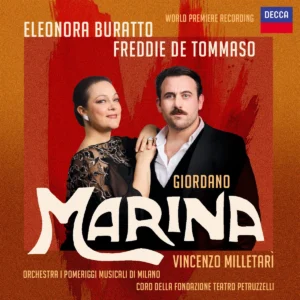
In February of this year, the unearthed opera, “Marina,” was recorded live at Milan’s Teatro Dal Verme, conducted by Vincenzo Milletarì and featuring star soprano Eleonora Buratto in the title role and acclaimed tenor Freddie De Tommaso as Giorgio.
In a review from OperaWire, the work was hailed stating, “A success that confirms the vitality of experiencing new titles which, when well executed -as in this youthful work- continue to speak to today’s audiences despite the temporal distance from their composition.”
The album, a landmark classical recording made by Decca Classics, will be released on July 31st, 2026.
OperaWire caught up with Freddie De Tommaso at the Royal Ballet and Opera where he was rehearsing for “La Boheme.”
OperaWire: Congratulations on your recording of “Marina.” Can you tell me how you came to be involved in this project?
Freddie De Tomasso: Well, this work was written by Giordano for a competition in 1888, when he was a student in Milan. Casa Sonzogno, which was one of the big publishing houses of the time, like Ricordi, that kind of company; held this competition for a one act opera.
In total, I think there were something like 73 entries, including entries from Mascagni, Puccini and of course, Giordano. Mascagni won with “Cavalleria rusticana.” “Marina” came sixth. Puccini’s “Le Villi”came seventh, so that’s the kind of standard this work was viewed as. It’s incredible to think that these guys were in their early 20’s writing this insane music.
OW: I agree. So how come “Marina” became a forgotten work, having been judged with such appreciable acclaim in the competition?
FdT: Well, Sonzogno then had the manuscript and added it to their archive and forgot about it. Sonzogno doesn’t exist anymore; their archive was bought by Yale University in the States. And then during the pandemic, this chap, Andreas Gies, a musicologist, he was looking through this archive, and he found this work and thought;
“Hang on a second, this is cool. We should do something with this. This needs to be in the world.”
So Gies then transcribes and prepares a new edition of “Marina.” I don’t know the exact links between him and the I Pomeriggi Musicali orchestra; I don’t know. I think maybe he might have just got in contact with them because they are historically the home of Verismo. The theater, ‘Teatro del Verme’ in Milan, is where Verismo operas were born, whereas ‘La Scala’ was Verdi and Bel Canto. “Pagliacci”, works of that nature, were premiered in ‘Teatro del Verme’
OW: So how did you become involved? How did you get offered the opportunity?
FdT: So, then conductor Vincenzo Milletarì got involved, and somehow my agent Maria became a part of the conversation and knew how keen I would be to be a part of the project. Of course 100 percent I wanted to do this and the orchestra were in absolute agreement, so then I was on board.
Then, obviously, because I’m a ‘Decca’ recording artist, this was a great opportunity for them to record it. This was a world premiere of a verismo opera…..a huge deal…..and Decca, I don’t think needed much convincing.
OW: How difficult was it for you to learn the role? I mean, you have no recordings and no previous point of reference? I can’t imagine it was a simple process.
FdT: Yes. It was hard. We had nothing to compare. Basically, I got my coach here, Jonathan Papp, a fantastic coach. He’s the guy that runs the ‘Solti Academy’ in Tuscany and he made me a learning track. I sent him the score, and he played the score on an audio file and put in my part for me to learn it that way because I’m an auditory learner. I can sit at a piano and kind of bang out my line, but I’m not a pianist. I can’t really understand the musical texture and everything by myself, so he helped me with that. If it hadn’t been for him, I would have been in real trouble studying it. The fact that I have been able to be a part of a world premiere recording is really cool, I’m absolutely delighted to have had the opportunity. The idea that now anyone who now wants to listen to or study this opera will listen to ours and only our recording really does make me very pleased, and proud.
OW: So, a world premiere verismo opera. Can you outline the plot of “Marina” for us?
FdT: There’s a fictitious war going on between Serbia and Montenegro. Marina, the title character, and her brother Daniele, and her brother’s friend and Marina’s compatriot Lambro are all Montenegrins, and I play the role of Giorgio, a Serbian. The opera begins with the chorus singing about a battle in which I get injured. I flee the battlefield and find shelter in a building where Marina nurses me, even though she realizes I’m an enemy soldier.
Like all Montenegrins, she takes pride in looking after travelers and strangers in their land. And so she helps and cares for me and, as is the case in such classic opera, 10 minutes later, we’re in love. Her brother and her brother’s friend come back from the war. Her brother’s friend Lambro is actually betrothed to her. Cue another classic opera moment where I have to hide in a cupboard, where I get discovered, thrown into prison and Marina gets denounced and outcast. Then essentially, we both get executed at the end, kind of together. We kind of go in a kind of “Andrea Chenier” way to our deaths together.
OW: Well, it definitely ticks the verismo boxes! Tell me about the cast. Have you worked with them before?
FdT: Marina was sung by Eleonora Buratto who’s absolutely incredible. She really did such a great job. And then the baritone was Mihai Damian, this young Romanian who, again, is absolutely incredible. He is with the same agency as me, a brilliant singer.
And then, one of my best friends, Nick, Nicholas Mogg, an English baritone; so, to do this recording with one of my best mates in it, was awesome. The whole thing was such a fantastic experience. We were there for a week. We did loads of rehearsals. They recorded all the rehearsals so they got as much recording data as they could in order to make the recording as good as possible.
We did two recorded performances with a live audience. The whole thing was an extremely exciting entry for me into that repertoire. Because Giordano’s music is truly veristic, we all know his most famous one, “Andrea Chenier,” and Marina has plenty of that “Chenier” sound in it, despite his young age at the time of writing. I will debut Chenier in a few years, so it was nice to have done this as an initiation, a first step.
OW: It begs the question, given its apparent success and favorable reception, will the opera now be staged and who will stage it?
FdT: Oh, they have to, surely? It would be amazing to put it with “Cavalleria Rusticana” because the three characters, vocally, are super similar. The tenor, the soprano, and the baritone are all perfect to go with the soprano, tenor, and baritone of “Cavalleria Rusticana.” Obviously, written by two friends who were at similar ages at the same competition. The whole story is perfect.
OW: So, what’s next for you? I know you’re pretty busy right now?
FdT: Yes, so, I’ve got “La Boheme” here now, and then a few things over the summer, concerts around Europe, and then I go to the Met for “Macbeth” for the new season opener. And then I’m preparing “Forza” for my debut of that in Berlin next spring, and plenty more exciting things I’m not allowed to talk about yet!