Göttingen International Handel Festival 2026 Review: Deidamia
By Mengguang Huang(Photo: Alciro Theodoro da Silva)
As the final opera of George Frideric Händel, “Deidamia” (1741) has long occupied a minor space in the composer’s canon. Often viewed as a weary departure from the high-octane heroism of his Royal Academy years—a view infamously codified by Winton Dean’s somewhat dismissive assessment of Händel’s operatic swan song—the work, as the core production of Göttingen International Handel Festival 2026, reveals itself to be something far more intriguing. In this co-production with Wexford Festival Opera, Petrou achieves a natural synthesis of his artistic identities, pulling double duty as both stage director and musical director. The result is a meticulously conceived, aesthetically superior, and highly gripping production.
A Vivid and Efficient Stage World
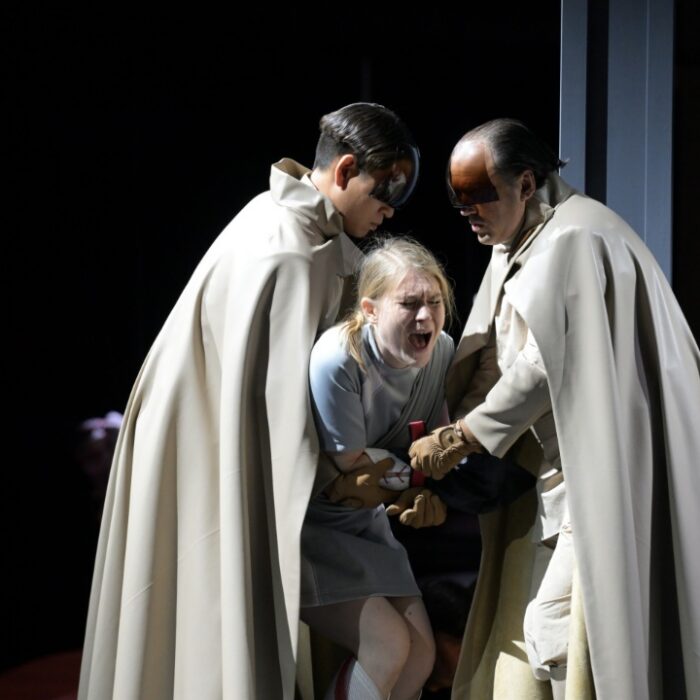
The brilliance of Paolo Rolli’s libretto lies in its meta-theatrical play with gender and identity, centered on the myth of Achilles hidden in female attire on the island of Scyros. While 18th-century audiences might have found the lack of a traditional heroic center unsettling, modern sensibilities are perfectly tuned to the opera’s pervasive irony. The most striking directorial stroke is Petrou’s fidelity to Händel’s original dramatic architecture, paired with an engaging parallel narrative element: the introduction of a chorus representing a contemporary tourist group on a Greek holiday. Existing entirely in a parallel reality, these modern onlookers arrive on the island, bask on the beach, sketch outdoors, tour the archaeological museum, and sample the local tavernas and folklore. They never directly intervene in the 18th-century plot, but are constantly affected by the invisible epic characters around them—occasionally serving as unfortunate targets for the heroes’ sudden outbursts of rage, or being astonished as a taverna prop is suddenly struck by a mythological arrow. This clever staging evokes a parallel-world spatial awareness reminiscent of the film The Others (2001), creating an enchanting friction between the epic past and the mundane present. The heroic world is simultaneously distant and immediate.
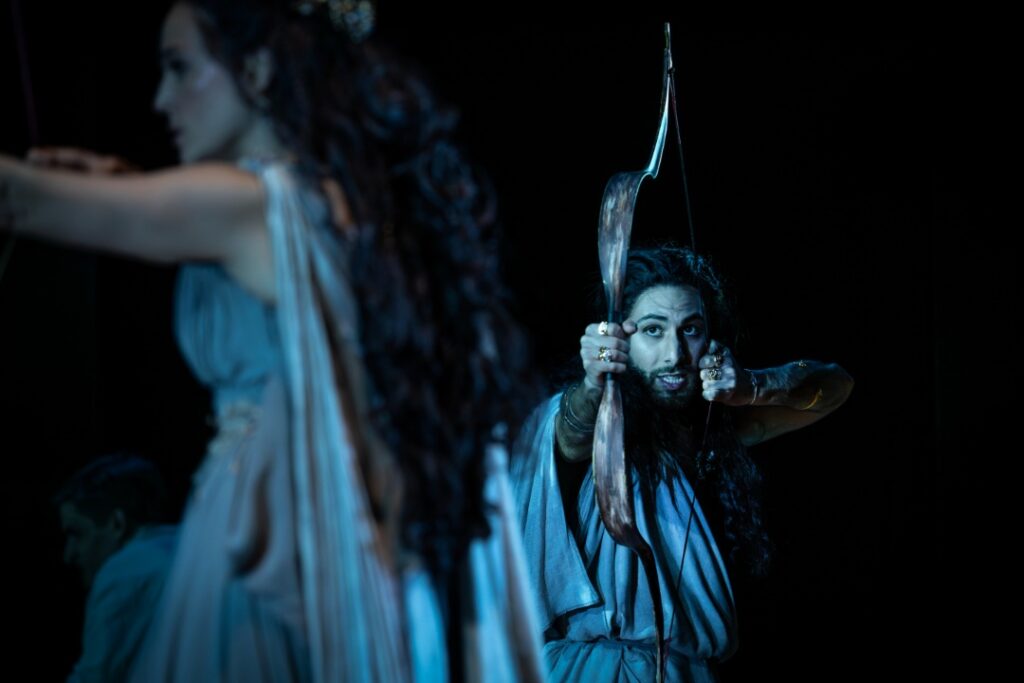
(Photo: Alciro Theodoro da Silva)
Giorgina Germanou’s set and costume design provides a concise, highly efficient visual framework. The production relies heavily on digital projections to map out the turbulent emotional landscapes, effectively conjuring the turbulent sea and employing imagery like meteor showers during the opera’s most volatile moments. The staging is visually distinct and swift, cycling through clear, immediately recognizable locales: the opening beach with a stranded Greek vessel, Deidamia’s intimate bedchamber, a rustic taverna, and the crystal display boxes of an archaeological museum. The costuming and lighting were universally impressive. For instance, Achilles’ female disguise was beautifully executed, and all cast’s elegant Greek-clothing and hair styling allowed the audience to instantly identify each character’s role and status within this complex web of deception.
However, the pace of the set changes occasionally felt hyperactive, with certain environments lingering for only a few minutes before being swept away; during these transitions, the curtain twice failed to drop completely. Furthermore, while the digital projections offered a highly creative twist during King Licomede’s hunting scene—transplanting a terrestrial hunt into an underwater aquatic sequence—the digital asset loop felt somewhat thin. Over the course of the long aria, the audience had to watch repetitive footage, a minor technical issue that happened occasionally in the evening.
Vocal Masterclass and Psychological Depth
This production’s casting deserves the highest praise; every singer was aligned with their role. Sophie Junker delivered a title-role performance of searing intelligence and vocal beauty, once again proving her mastering for Händel’s idiom. Her vocal projection was direct, clean, and utterly devoid of superfluous gesture. Junker masterfully captured the character’s deep, protective love for Achilles, her subsequent spikes of jealousy and fury under the scheming Greek visitors, and finally, the shattering grief of realizing her lover is destined to depart. In the Act one finale aria, which being closely shown with the “bird” imagery of the libretto, was a masterclass in supple agility and vocal grace. Later, her outbursts in her Act three aria, “M’ai resa infelice; che vanto n’avrai,” provided a thrilling example of creating dramatic contrast. Her da capo ornamentations were handled with fine taste, if not radically individual. Paired with her charming Greek costuming, she anchored the show with immense emotional engagement.
As Achilles (disguised as female Pyrrha initially), Bruno de Sá navigated a fascinating vocal and dramatic journey. Successfully balancing the character’s feminine appearance with an unvarnished longing for masculine glory, de Sá’s extraordinary sopranist range felt completely natural, relaxed, and free of any jarring artifice. He was nothing short of astonishing in the heroic coloratura movements, particularly during the Act three scene “Ai Greci questa spada sovra i nemici estinti “ where Achilles must choose between feminine jewelry and warrior weapons. Standing next to the seasoned, calculating Ulysses, his Achilles was a portrait of fearless, confident youth, openly eager to win honor.
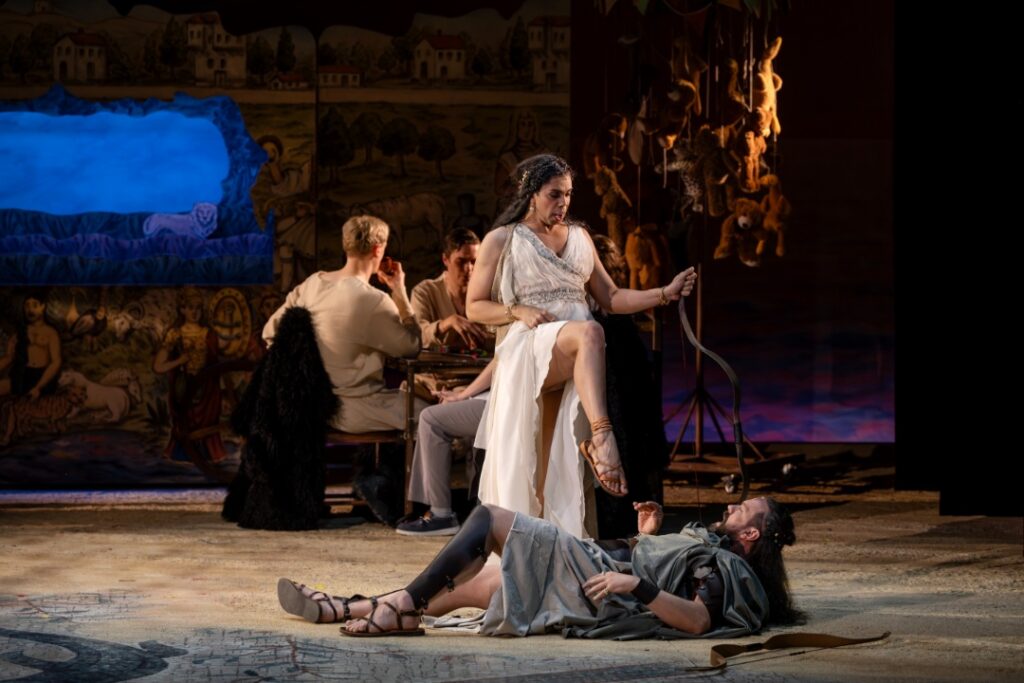
(Photo: Alciro Theodoro da Silva)
Nicolò Balducci as Ulisse was equally convincing. Beyond Ulisse’s signature persuasive charm and razor-sharp observational character, Balducci brought out a rarely explored dimension of the Greek strategist. When confronted by Deidamia, who boldly questions the morality of a war fought over a single woman, this Ulysses—himself a traveler far from family in service of Greece—became profoundly solemn and agitated, delivering his lines with a raw, heartfelt sincerity. Vocally, Balducci and de Sá formed a dazzling, brilliantly resonant match that filled the house with exceptional luminance.
The supporting players added rich texture to this epic world. While being remained a loyal companion to Deidamia, Sarah Gilford as Nerea was a spirited, skeptical foil to both Achilles and Fenice, her voice boasting an elastic, glittering shine, particularly in her radiant upper register. Petros Magoulas as Licomede anchored the older generation with a resonant, paternal warmth, his performance marked by a deeply moving sense of introspection and an unshakable loyalty to his duty to protect Achilles. Finally, Rory Musgrave brought a sturdy, robust baritone and martial gravitas to Fenice—the ideal masculine soldier, even if he found himself occasionally outmatched by the quick-witted Nerea.
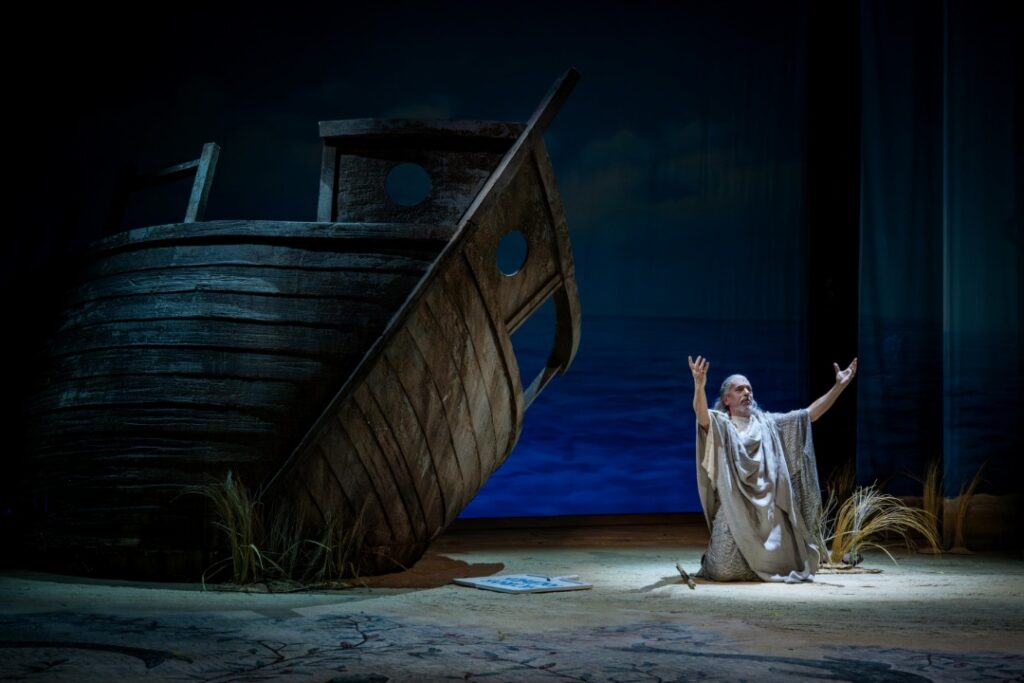
(Photo: Alciro Theodoro da Silva)
Orchestral Vitality and Final Reflection
The instrumental playing is equally aiming for a clear & direct communication. Under Petrou’s baton, the Festspiel Orchester Göttingen performed with its trademark masculine vigor, bright tempi, and a rhythmic vitality.The overall articulation was relaxed and organic. The basso continuo was particularly inventive; rather than merely driving the tempo forward, the low strings frequently employed striking suspensions that locked the audience’s attention and heightened the underlying tension of the music. Supplemented by the Kammerchor der Universität Göttingen, the performance captured both the intimacy of the Scyros court and the grand, looming shadow of the Trojan War.
This production soundly challenges the historical narrative that Deidamia was the uninspired whimper of Händel in his twilight. Through vivid scene painting, psychological depth, and a stellar cast, Händel’s swan song emerges as a masterfully bittersweet meditation on the human cost of heroic myths. It is a work that speaks to the modern world precisely because it refuses to provide easy answers, choosing instead to find its final, lingering truth in the silence of a woman left behind on the shore, while the heroes are ready to sail away to a war that is, for her, already lost.
From this perspective, the choice to project a black-and-white film depicting devastating air raids at the very end felt like a misstep. By explicitly tying the ending to the tragedies of our modern, turbulent world, this particular choice shattered the delicate, haunting distance between the epic and the contemporary that had made the rest of the performance so captivating.