Maggio Musicale Fiorentino 2025-26 Review: The Death Of Klinghoffer
Guadagnino’s Masterful Direction Overcomes Long-Held Criticisms of Adams’ Controversial Opera
By Alan Neilson(Photo: Michele Monasta)
John Adams’ “The Death of Klinghoffer” is never too far away from controversy. The opera is based upon the Palestinian 1985 terrorist hijacking of the cruise ship ‘Achille Lauro’ in the Egyptian port of Alexandria, which is now remembered primarily for the savage and brutal murder of a 69-year-old Jewish American gentleman in a wheelchair named Leon Klinghoffer, who was shot dead and his body thrown overboard. Dealing with such an inflammatory topic as the Palestinian-Israeli conflict in any form is almost certain to raise tensions, and Adams’ opera was no exception; protests have followed the opera in the cities in which it has been performed, with claims that it glorified terrorism and gave a voice to terrorists. Following its US premiere, the composer responded judiciously by altering a scene that protesters labeled as antisemitic. With the current situation in the Middle East, it was therefore hardly surprising that the Maggio Musicale Fiorentino’s new production also provoked protests. However, on this occasion, it was pro-Palestinian protesters who objected to the opera’s “biased” treatment of the events.
Adams and his librettist Alice Goodman thus seem to be trapped, with both sides in the conflict finding fault in their representation of the participants and the events. They have even received criticism for not taking sides by imposing a moral equivalence upon an incident that can either be seen as a vicious atrocity or a necessary act of resistance, depending on which side of the chasmic divide one stands.
The director for this production, Luca Guadagnino, however, appears to have broken the logjam with a sensitive interpretation that subsumed the very human dimensions of the drama beneath its historical and moral framework of the conflict. He refused to play up the religious and national identities of the participants, at least no more than made necessary by the text, and swerved any use of stereotypes. The murder of Klinghoffer was presented as an unambiguously atrocious act with horrific consequences, but on a personal level. The act was portrayed clearly within the context of a long history of war, in which judgements are less certain and motivations often difficult to understand. The terrorists were presented as fairly normal people who had been caught up in the heat of the conflict, containing a mixture of the idealistic, the misled and the bad. There was a sense that the murder itself, as brutal and painful as it was, was no more than a minor event within the greater forces that move the history of nations forward. What is more, it was a reading that proved to be a perceptive and finely tuned response to Adams’ music and Goodman’s libretto.
A Dominating Performance by the Chorus
It is the chorus that lies at the center of any production. In fact, rarely does an opera give such a significant role to the chorus as Adams and Goodman have done for “The Death of Klinghoffer.” There are seven large-scale choral pieces, each with historical, moral and philosophical observations that help define the Israeli and Palestinian positions and underpin the forces that drive the narrative. In the opening scene, the two groups each outline their longing for their homeland, free from violence. The Chorus of the Maggio Musicale brilliantly captured their desires to the extent that it was easy to sympathize with both parties, even if both outcomes are not simultaneously possible; thus, the basis for the conflict was clearly set, and the audience was drawn into the intractable nature of the situation.
The other choruses are placed at significant points throughout the piece so that Klinghoffer’s human tragedy is being continually reinforced within a deeper context. For example, “The Desert Chorus” from Act two conjures up an image of the desolate waste of the Arabian desert and its indifference to Man’s existence, but which, through God’s intervention, is able to provide sustenance, thereby drawing parallels with the desolation caused by war and Man’s ultimate reliance on the divine.
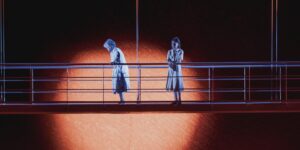
How a director decides to treat the choruses is therefore fundamental to how any staging is likely to be perceived. Rather than downplaying the distinctions that exists between the choruses and the tragic personal drama of Klinghoffer, Guadagnino decided to separate them almost completely; rarely did they interact directly with each other. The chorus was presented as an outside agency. It was not clothed in costumes of the period, unlike the solo singers; instead, they were dressed in neutral designs that did not relate to any period. It was a static, deliberately distant presentation that gave the impression of an eternal, higher voice operating in a different dimension.
The performance of the Coro del Maggio Musicale Fiorentino under the direction of the chorusmaster, Lorenzo Fratini, was excellent. Not only did it sensitively capture the strength and nuances of the emotions and energy of each chorus, but the clarity and articulation of its English diction ensured that it was unnecessary to become distracted by the surtitles.
The impression was augmented by Ella Rotschild’s wonderful choreographed dance routines that appeared to operate on the same plane as the chorus, which it sometimes accompanied. The dancers evoked a sense of anxiety and dislocation through well-coordinated routines, including jerky, erratic, spasmodic movements that were at odds with the general direction of the dance but that were always in step with the music and the tenor of the drama and brilliantly brought potentially static scenes to life.
A Clearly Presented Narrative
With the necessary ballast and contextual background supplied by the excellence of the chorus and dancers, the soloists were free to focus on the drama of Klinghoffer’s murder, which allowed the pace of the drama to be maintained; the passengers and terrorists on board the Achille Lauro were therefore free to act out the latest episode in a conflict going back thousands of years. Moreover, he made full use of the stage to manage the tensions on board: while one of the soloists was delivering a monologue, for example, the terrorists would be threatening and abusing the passengers at the rear of the stage. But, on other occasions, they would try to calm the passengers.
Guadagnino, who was also responsible for the scenography, decided upon a realistic staging, set clearly on board a ship. The area was divided into two or three levels with a rail around the upper deck, which could be easily altered, as necessary, by raising or lowering the set to reveal the cabins and larger rooms below deck. The choral sections were played out on a largely empty stage.
The costumes, designed by Marta Solari, were deliberately easily forgettable, allowing them to blend perfectly with our image of 1980s tourists and Palestinian terrorists. The lighting designs of Peter van Praet were beautifully managed, both for the choral parts and the drama, to create just the right atmospheric impressions.
Despite the occasional awkward scene change, the staging came together well to create a successful presentation with the drama weaving its way through the choral blocks, to create a seamless melding of the dramatic narrative within its wider contextual background.
Stellar Cast Highlights
All the singers produced fine acting performances that brought out their individual characteristics. There was no reliance on stock movements, emoting or lazy characterizations. All the protagonists were living, nuanced creations that allowed the audience to react to them beyond the usual negative and/or positive associations of their roles and thus provided the drama with a convincing degree of realism, which was most clearly seen in the depiction of the four terrorists.
The leader of the terrorist group, Molqi, was interpreted by Roy Cornelius Smith as a vicious idealist, who took a practical, fairly unemotional approach in which his killing of Klinghoffer and the terrorizing of the passengers were depicted as little more than a necessary action.
On the other hand, Rambo was a very different type of character. Seething with hatred, he reveled in the possibilities of inflicting violence upon the defenseless passengers and crew. The nasty, sneering tone that he employed left no one in doubt as to intentions.
The only female terrorist, Yazmir, was given a layered portrayal by mezzo-soprano Marvic Monreal. Clearly committed to the cause, she nevertheless was not without a sympathetic side. While she was happy to use her full-sounding, juicy-toned voice to indulge in a violent assertion of her cause, she was also sympathetic to the plight of Mrs. Klinghoffer.
Baritone Levent Bakirci produced a sensitive interpretation of Mamoud, whom he presented as a reflective, idealistic yet humane individual genuinely concerned about his actions and carrying strong doubts about what they had become involved in. At one point, he left the stage and strolled through the audience, pleading for their understanding, which his clear, articulate and sensitive phrasing impressed.
The drama’s two main characters, Leon Klinghoffer and his wife, were given expressive, touching interpretations.
Baritone Laurent Naouri expertly captured both the fear and courage that drove Leon Klinghoffer. While displaying an external calm and defiance in the face of the extreme threat and intimidation, he still managed to convey the fear lying not far below the surface. His sensitive rendition of his soliloquy, “The Falling Body,” beautifully captured its psychological layers and metaphorical meanings, which was followed by the “Day Chorus,” in which his submerged body was dismembered.
Soprano Susan Bullock created a moving interpretation of Marylin Klinghoffer. The underlying frailty of the voice that occasionally showed itself allowed her to capture the emotional devastation she suffered in experiencing the death of her husband, particularly in the final monologue that brought the opera to an end. She performed Adams’ melodies with a beautiful vocal quality.
Bass-baritone Daniel Okulitch was a strong, authoritative and morally correct Captain, who showed off his interpretive qualities to good effect. His monologues enabled him to successfully present his reflective, thoughtful and courageous nature.
His First Officer was given a forthright, forceful and passionate reading by bass Andreas Mattersberger.
Mezzo-soprano Janetka Hoşco produced an amusing and suitably off-the-wall interpretation of the British Dancing Girl, who sounded as if she had just stepped off the stage of a West End musical.
Mezzo-soprano Marina Comparato convinced with two clearly defined characterizations as the Swiss Grandmother and the Austrian Woman.
The Orchestra del Maggio Musicale Fiorentino under the direction of Lawrence Renes produced a dramatically sensitive reading that was synchronized neatly to the staging. The dynamics, momentum and expressive force were expertly managed to control the degree of intensity and urgency of the music, which fluctuated widely over the course of each act, and generated the necessary atmosphere and levels of tension. It was the wonderful, detailed textures, however, that Rees elicited so clearly from the orchestra that really impressed me.
One criticism one often hears of “The Death of Klinghoffer,” with its large number of choruses and sometimes static scenes, is that it is more like an oratorio than an opera. Guadagnino’s imaginative staging proved otherwise! His handling of the choruses allowed the drama to find its own dramatic space, and without downplaying the role of the choruses. What was particularly noticeable was that the treatment of the Palestinians and Israelis could have easily been replaced with the combatants in many other wars; the same themes are often relevant, and atrocities, such as the killing of Klinghoffer, are more widespread than many countries would like to admit.