Book Review: Opera Wars
By Patrick SauerThe 2008 financial collapse led to the 2009 bankruptcy of the Baltimore Opera Company, so 24-year-old hometown soprano Caitlin Vincent decided to take matters into her own hands. Flush with $2,000, she started The Figaro Project to give herself and friends a way to keep performing. By any measure of the indie opera scene, the scrappy upstarts had a successful five-year run, staging multiple operas and staying afloat. In 2013, The Figaro Project launched its most ambitious production, “Camelot Requiem,” a new work about the aftermath of the JFK assassination. It was Vincent’s first libretto, and she starred as Jackie in two near-sold-out shows that got stellar reviews… and drained nearly all the company coffers. The group would grind out one more season highlighted by a week in Virginia Beach with actual pay and accommodations.
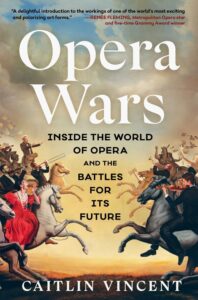
The Figaro Project saga is central to “The Company,” my favorite chapter in Vincent’s “Opera Wars: Inside the World of Opera and the Battles For Its Future.” Her description of that final roadshow as “simultaneously triumphant and bittersweet” serves as a fitting summation of her sharp new book itself.
Step by step, “Opera Wars” goes into every battle that must be fought to get a production mounted – from score to stage to singers to show to a career to the very culture of a centuries-old artform that often seems to be as desperate and dying as Mario Cavaradossi.
Just this month, the New York Times ran “The Met Opera’s Desperate Hunt for Money,” acutely detailing the perilous financial situation of the biggest theater on the planet. And then of course there was “Chalametgate,” which, if nothing else, had media and creative folk talking about opera for once. Instead of “no-one cares,” what if Timmy had been a little less dickish and said “very few care?” Would anyone have even noticed? Would it just be a statement of fact?
While the conversational “Opera Wars” is not a diatribe, Vincent does not shy away from the realities of how and why the artform – for our purposes, in the American model – is in a doom spiral of its own devising. Vincent has a long list of bona fides credits, but she does not bog down “Opera Wars” by being overly prescriptive. She wants readers to come to their own conclusions about opera’s past, present, and, if there will be, future. However, Vincent makes an overall compelling case that in a country repelled by the very notion of funding homegrown fine arts, the only way to “keep this thing alive” is a top-to-bottom soul-searching rethinking of how shows, companies, and seasons are put together.
At the heart of the matter is money, of course, but also how cold cash correlates to the canon. Or THE CANON, for those of the MAGA (Maintain Arias Geriatrically, Amen) wing of opera fandom, the oft-name-on-the-wall big ballers who just want their perennial familiar hits, featuring the same type of staging and casting they are used to, at the expense of anything else. Fair enough; most of us love “La Bohème,” but Puccini died more than a century ago. It should not be “Tosca” or nada – a main reason why Vincent admits to a love-hate ambivalence towards opera herself. She no longer sings and now lives and teaches in Melbourne, Australia, so the time and distance physically away from being in the scrum gives her a valuable insider-outsider perspective. She bolsters her “Opera Wars” thoughts by effectively peppering in short, punchy interviews on specific industry shortcomings that should have been done away with half a century ago, such as Opera Australia performing “Turandot” in “traditional” yellowface in 2022!
One intriguing facet is it feels like the book was written less for the diehards, or at least not the donor class, and more for the dilettantes (like me). For instance, I was unaware that “Toi, toi, toi” is “an onomatopoeic expression that evokes spitting three times to ward off evils spirits” or that Wagner’s grandsons staged radical avant-garde version of their grandfather’s works as a means to disassociate from Adolf Hitler in what is now known as “Regietheater.”
Beyond the fun facts and choice anecdotes, Vincent aims to reach progressive 40-and-under occasional opera-goers, the same ones who saw “Sinners,” “One Battle After Another,” and yes, even “Marty Supreme,” in the theaters. Obviously, “Opera Wars” is not advocating for companies to kick “Carmen” to the curb – that would be financial suicide. But maybe the main character could be played by a plus-sized woman? Like the wonderful mezzo-soprano Jamie Barton, who told Vincent she has never been offered the part because audiences “automatically think of a petite woman with long curly hair and luscious boobs… We’re not at a place where everyone is ready for a curvy Carmen.”
As someone who barely averages a show a season, I am part of the problem – but as someone who goes at all, Vincent has steered me towards being part of the solution. “Opera Wars” had me thinking a lot about the New York shows I have seen over the years, and it is the original productions that stick. When it comes down to it, it means not being afraid of the new – not beholden, just not afraid. This has paid off in three of my most memorable shows: the City Opera’s spiritually-nourishing “Dead Man Walking” from 2002, with its brilliant chain-link prison set, and two from the last couple of Met seasons. The old-cum-new sea shanty “Moby-Dick” left me in tears, while the adaptation of “Fire Shut Up in My Bones” had me enthralled by two things I never thought an opera would deliver: percussive Black fraternity step dancing and a lyrical ode to “puuuuussssssyyyyy.”
For what it is worth, those two recent Met shows had younger, chicer, more diverse audiences than any of the canon productions I have seen. General Caitlin Vincent has called us to arms and “Opera Wars” is an important shot across the bow. But true victory will only come through fully infiltrating the other side.
Categories
Reviews