Curtis Opera Theatre 2025-26 Review: La Passion de Simone
A 75-Minute Opera With No Story Shines in the Hands of Curtis Institute Artists
By Chris RuelPhoto: Wide Eyed Studios
On February 26, 2026, Curtis Opera Theatre presented something that was… unique. Finnish composer Kaija Saariaho (1952–2023) deliberately stripped away the familiar scaffolding of opera—no heroes, no villains, no tidy narrative arc—and replaced it with something closer to performance art with a score. Sung in French with English supertitles, “La Passion de Simone” is a 75-minute, no-intermission work that left me genuinely perplexed. In the best way.
“La Passion de Simone” doesn’t want to be figured out or even interpreted. Once I stopped fighting my inner voice demanding meaning, something shifted. I stopped watching and started feeling. That surrender may be the only honest way in. Resist it, and you risk walking out asking, “What did I just watch?” Lean in and be immersed.
Who Was Simone Weil?
The opera’s subject is Simone Weil, a relatively obscure French philosopher and mystic born in Paris in 1909. She taught at a girls’ school in the 1930s, worked on factory floors and farms by choice, and fought alongside anarchists in the Spanish Civil War. She was not famous or a troublemaker who grabbed headlines. Even by 2006, when “La Passion de Simone” premiered in Vienna, her letters and journals remained unpublished.
In Saariaho’s program note from the opera’s premiere, she wrote of being captivated by “the combination of Weil’s severe asceticism and her passionate quest for the truth.”
Suffering as spiritual practice is what the opera is built around.
Do I Have Your Attention?
Weil called her guiding principle “attention:” fully immersing oneself in the lives and suffering of others, willingly giving oneself in the process. She didn’t just theorize it. She lived it. At six years old, she gave up sugar to empathize with French soldiers during World War I. During the Nazi occupation, she restricted her own food intake to match the rations imposed on the French—an act of solidarity that, alongside tuberculosis, contributed to her death in 1943 at just 34.
Contemplation Stations
Saariaho and librettist Amin Maalouf structured the opera as 15 stations—deliberately evoking the Stations of the Cross—each offering a glimpse into Weil’s philosophical reflections and inner life. The pacing is swift, almost counterintuitively so for a work this contemplative. There’s little breathing room between meditations. But that may be the point: not every station will resonate equally, and the structure lets each viewer find the moments that do.
The Look and Feel
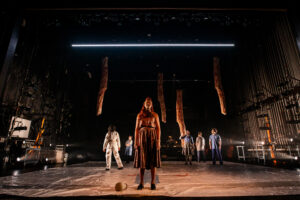
Director Marcus Shields and scenic/lighting designer Frank J. Oliva seemed to have shared a concept for the production that relied heavily on visuals—though not projections or eye-popping sets. (There wasn’t a set or sets, but scenes with props.) They kept it spare, using light and a smoke machine to create atmosphere, rather than a place. The duo did an excellent job. These simple elements turned the stage into an amazing, ethereal space—a place where mysticism and otherworldliness resided. It invited the audience not necessarily into Weil’s mind, but their own.
Before a note was played, soprano Nikan Ingabire Kanate made her entrance from the rear of the stage, moving past the orchestra at her own pace before taking her place at stage right. The walk was pure poise and confidence. She remained in place through the pre-show announcements, in no hurry. The anticipation filtering through the audience was felt and shared.
As the performance began, a projection screen lowered. An introductory video played, featuring chorus members and soprano Jeysla Rosario Santos, who performed the role of the Reader, reciting brief excerpts from Weil’s writings. This prologue set the tone.
The stage was covered in a white plastic tarp, with splotches of blood here and there. Early on, Santos’s Reader character smeared blood across her face, leaving handprints and stains on her clothing. These were then concealed beneath white coveralls, a gesture that read as a transformation.
As the opera neared its end, the tarp was drawn beneath the stage through a trapdoor, as if being sucked down. With the tarp gone, a solitary beam of blue light shot upward from the trap, filtered through smoke. The stage felt dreamlike in its strangeness. As did the conclusion, during which the Reader leaves the mystical space behind by walking into a square tunnel, lit greenish-blue and gauzy with mist. To where…? I can’t tell you because I don’t know. This is but one example of how the opera poses questions it never answers. Answers, I believe, were left to the audience to ponder, not deduce meaning.
Can I Get a Witness?
The most memorable visual moment came when slabs of “meat” were lowered from the fly space. Dehumanization in wartime? A nod to Weil’s years of physical labor? It’s another example of abandoning meaning and replacing it with contemplation.
Shields writes in his program notes: “We created a visual and spatial environment that allows the audience to inhabit the act of contemplation itself.” Listening, he adds, becomes “a form of witnessing.” The meat-chopping scene—complete with a pre-cut chunk separating from the slab and spattering blood as it hit the floor—made that “witnessing” visceral.
If you watched, you paid attention, and for Weil, attention shouldn’t stop when things are unpleasant; it should still be given.
As Weil put it: “Attention is the rarest and purest form of generosity.”
The Performers
Kanate carried the full 75 minutes as the Narrator, singing without interruption from start to finish. Her stamina was remarkable, her tone clear and bright throughout. With Shields and Oliva building a living atmosphere through light and smoke, Kanate’s striking voice was the constant—the element that held it all together.
Santos, as the Reader, performed in pantomime and spoken word. In a more traditional opera, she might have played the lead role. Here, there are none. Santos deserves praise for delivering an excellent performance in this key role.
The chorus—Maya Mor-Mitrani, Carlyle Quinn, Henry Drangel, and Sebastian Wittmoser Herrera—took on the most physically demanding work while singing, including tying up the Reader and Mor-Mitrani chopping the “meat” with maniacal, bloodthirsty gusto.
Saariaho’s original program note puts it plainly: the chorus and orchestra “create the world.” They did.
The Orchestra
The Curtis New Music Ensemble played Saariaho’s demanding score with real skill and feeling. Leading them was conductor Marc Lowenstein, who has also performed as a tenor in roughly 25 operas. That background showed. For example, with the ensemble positioned at the rear of a deep stage, striking the right balance between the orchestra and the singers was tricky. Too loud and the singers disappear; too soft and the score loses its edge. Lowenstein got it right. The score had to shine through him and his band. It did. Unequivocally. These were professional-grade instrumentalists, and they never let you forget it as they negotiated a difficult score.
To close, I’ll return to Shields’ remarks in the program notes: “This is not music driven by story. It simply asks us to be present.”
That’s exactly what it did, if you let it.