Teatro alla Scala 2025-26 Review: Lady Macbeth of the Mtsensk District’
By Bernardo Gaitan(Photo: Brescia e Amisano | Teatro alla Scala)
Composed between 1930 and 1932, when the young Dmitri Shostakovich had not yet turned thirty, “Lady Macbeth of the Mtsensk District” represents one of the boldest and most radical moments in the entire operatic output of the twentieth century. Riccardo Chailly described the work as “an opera of radical modernity.” At its premiere in 1934, the work enjoyed overwhelming success both in the Soviet Union and abroad, before being brutally banned in 1936 following the infamous editorial published by the Soviet newspaper Pravda, which denounced it as “Chaos instead of music.” This article -published, ironically, in a paper whose name in Russian means “Truth”- marked an irreversible rupture between the composer and the Stalinist regime.
“Lady Macbeth” is not merely a political opera in the historical sense of the term; it is also an extraordinarily feminist work. It offers a ferocious critique of a patriarchal and violent system that annihilates female desire, freedom, and identity. At the center of the drama stands Katerina Izmailova, a woman trapped in a sterile marriage, oppressed by the male authority of her father-in-law, and deprived of any personal freedom. Drawing on the story by Nikolai Leskov, Shostakovich and librettist Alexander Preis transform the protagonist from a simple criminal into a victim of an inhuman social context, offering one of the most radical and disturbing female portraits in the history of opera.
Risking their Lives
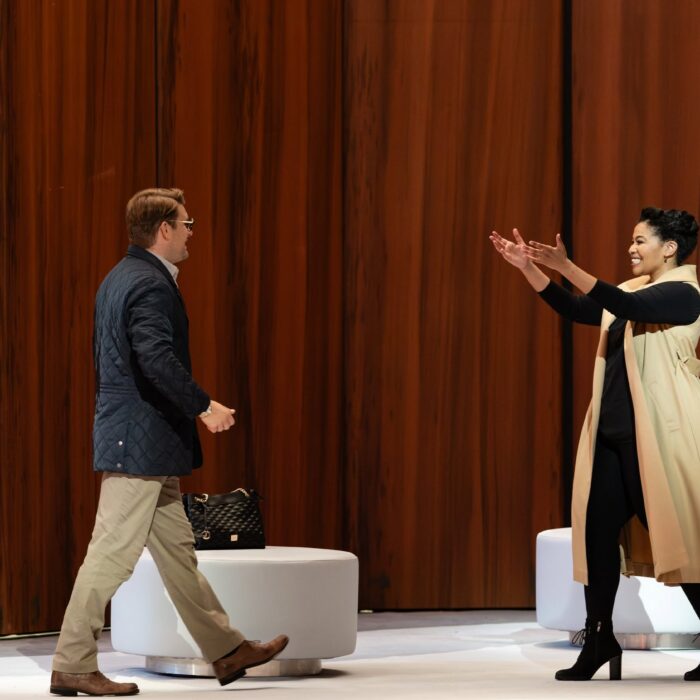
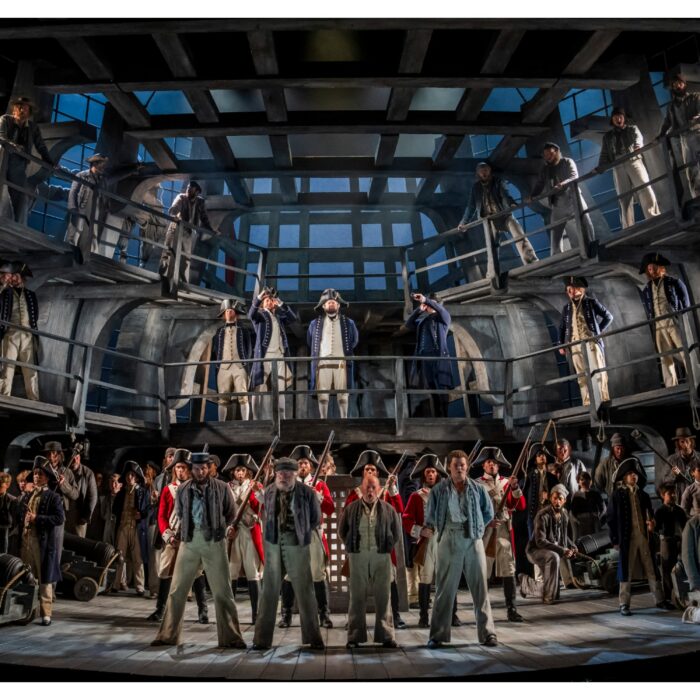
Opening the 2025-2026 season of Teatro alla Scala with this strikingly topical title proved to be a decision of considerable artistic and symbolic weight. Far removed from the traditional repertoire, this masterpiece by the Soviet composer continues to interrogate audiences with unsettling force. The new production was staged by Vasily Barkhatov, who approached this legacy with full historical and political awareness. Born in Moscow in 1983, Barkhatov chose to set the action in Stalin’s Soviet Union, superimposing Katerina’s fate onto that of the opera itself and its creator, thereby underscoring the omnipresence of state control. The dramatic framework unfolds during a police interrogation, shifting between two temporal planes: the present of the interrogation and the past, reconstructed through the re-enactment of events. This is a highly ingenious concept, as these flashbacks function seamlessly and without confusion for the audience. The director has stated that “Lady Macbeth is simple and extremely difficult at the same time; it is a delicate balance between violence and clarity, where every superfluous gesture on stage risks tipping into vulgarity.”
Zinovy Margolin’s set design constructs a highly symbolic theatrical space, playing on the contrast between the elegant bourgeois façade of a restaurant frequented by the social elite and the degraded, suffocating, almost prison-like interiors where abuse, violence, and repressed desires are enacted. Barkhatov’s visual language highlights the imposing power of the Soviet system while avoiding any folkloric indulgence, focusing instead on the psychological and political dimensions of the drama. The violence in the staging is explicit and highly visual; despite this, it never descends into grotesque or offensive territory, notwithstanding the abundance of sexual actions depicted.
Undoubtedly, the most daring and decisive moment of Barkhatov’s production lies in his decision to replace Shostakovich’s original ending with one that is conceptually similar but far more spectacular for the occasion. In the original plot, Katerina throws herself into icy waters together with the prisoner who has stolen her lover, dying frozen. Barkhatov proposes the complete opposite: Katerina douses herself in gasoline and sets herself on fire alongside Sonetka. Witnessing both women on stage engulfed in flames at temperatures exceeding 1112 °F (600 °C) leaves the audience literally breathless – not only for the audacity of the idea, but because the heat can be physically felt from the stalls. Special mention must be made of stuntwomen Beatrice Del Bo and Marie Schmitz, who quite literally risk their lives at every performance to achieve this extraordinary effect.
Bringing it to a Close
Another undeniable highlight was Riccardo Chailly’s presence on the podium for what marked his final season-opening appearance as Music Director. His interpretation stood out for its supreme analytical clarity, capable of holding together the multiple souls of the score: modernist harshness, sonic brutality, grotesque satire, and an intimate, deeply painful lyrical dimension. Chailly avoided any form of expressionistic indulgence, instead building the drama through sustained tension, clearly revealing the opera’s formal structure and its relentless narrative progression. The Milanese conductor himself has confessed that he cannot comprehend how Shostakovich was able to conceive such an orchestration at the age of twenty-four to twenty-six. His work on this title was nothing short of extraordinary. It is worth recalling that on December 10 he was unable to complete the performance, having suffered a cardiac episode at the end of the second act that required emergency hospitalization and the cancellation of the evening. Remarkably, he was discharged the very next day and was back in the pit for the performance on December 13.
The Orchestra of Teatro alla Scala responded magnificently to Chailly’s demands in a truly outstanding performance. The brass and percussion sections were spectacular, conveying the violence and frenzy of Shostakovich’s writing with moments of genuine apotheosis, yet always under control. The strings abandoned any trace of their customary Puccinian melancholy to create a soundscape of desolation and alienation. Tempo management was particularly effective, with ferocious accelerandi alternating with sudden pauses that amplified the sensation of oppression and claustrophobia. The Teatro alla Scala Chorus, prepared by Alberto Malazzi, also performed at the highest level, functioning as a true collective character within the opera, capable of embodying social brutality and hypocrisy with impressive unity and precision.
Heart & Soul
At the heart of the production stands the commanding performance of Sara Jakubiak as Katerina Izmailova. The American soprano takes on one of the most demanding and punishing roles in the twentieth-century repertoire with remarkable technical assurance. Her voice, broad and well projected, maintains consistency throughout the entire range, navigating effortlessly between dramatic outbursts and moments of more introspective lyricism. Jakubiak constructs a profoundly human portrait of the protagonist: her Katerina is never monstrous or caricatured, but rather a lonely, resource-deprived woman trapped in an asphyxiating environment. Her mastery of phrasing, attention to expressive detail, and command of the Russian language make her interpretation one of the most accomplished currently heard in this role.
Alongside her, Najmiddin Mavlyanov offers a vocally solid and scenically ambiguous Sergei. The Uzbek tenor avoids any superficial heroism, instead emphasizing the character’s opportunistic cynicism and predatory sensuality through a robust, well-centered timbre. The result is a Sergei fully aligned with the director’s vision: not a romantic lover, but a catalyst for Katerina’s destruction.
Alexander Roslavets also stands out as Boris, a true axis of the opera’s first half. The Russian bass impresses with the power of his instrument and his commanding stage presence, embodying a violent, oppressive, and morally corrupt patriarch. His dark, incisive voice forcefully conveys the character’s brutality without ever slipping into caricature. Roslavets transforms the villainous father-in-law into a constantly threatening presence, a potent symbol of masculine and social power crushing Katerina.
The female supporting roles are equally strong: Ekaterina Sannikova delivers an effective and clearly defined Aksin’ya, while Elena Maximova portrays a venomous and calculating Sonetka, vocally secure and theatrically incisive. The remainder of the cast, including the numerous secondary roles, contributes with professionalism and precision to an implacable and complex theatrical machine.
At the curtain call, the audience responded with enormous ovations for the entire ensemble, particularly for Chailly and Jakubiak, the central figures behind the success of this Lady Macbeth. Most convincing of all was the sense that, as the curtain fell, Shostakovich’s idea resonated with the audience just as it had nearly a century ago: artistically unsettling them through its timeless denunciation of power structures, repression, and institutionalized violence.