Teatro Municipale di Piacenza 2025-2026 Review: Stiffelio
By Bernardo Gaitan(Photo : ©Gianni Cravedi)
When “Stiffelio” premiered in 1850, Giuseppe Verdi was going through a period of transition: he had left behind his so-called “galley years” yet had not fully reached artistic maturity. It is precisely in this phase that “Stiffelio” emerged, revealing itself as a bold experiment: deeply modern in its approach to human conflict and, at the same time, dangerously provocative for the moral and political climate of the Italian Risorgimento.
The conflict proposed by the composer and librettist Francesco Maria Piave was pure dynamite for censorship. The protagonist: a married Protestant pastor, wounded by his wife’s betrayal and forced to preach forgiveness from the pulpit; touched three extremely sensitive nerves for the authorities of the Papal States and for theaters under clerical surveillance. On the one hand, the presence of a religious minister as the central character, displaying jealousy and human frailty, was deemed intolerable. On the other, explicit adultery, with a clearly identified lover and visible moral consequences, exceeded what was considered theatrically acceptable. But the greatest scandal lay in the final scene: a sacramental act transformed into an operatic climax.
Censorship reacted harshly, as expected, forcing Verdi to alter names, professions, and locations, thereby distancing the work from its original meaning. In some productions, Stiffelio was even stripped of his identity as a pastor and turned into a generic nobleman, while the final church setting was replaced with a neutral space. “I couldn’t even tell you what happened to Stiffelio! No sin, absolutely no sin; every trace has been erased” protested an older, indignant Verdi to Giulio Ricordi. For a time, the opera circulated under imposed titles such as “Guglielmo Wellingrode,” with the protagonist transformed into a German prime minister; an unconvincing solution for Italian audiences unfamiliar with Germanic settings. Its lukewarm reception led Verdi to undertake a profound revision, resulting in “Aroldo” in 1857, with an added fourth act and the action relocated to the Middle Ages.
The history of “Stiffelio” was thus interrupted for more than a century, lost amid mutilations and incomplete editions. Only in the late 1960s, following the discovery of two original manuscripts: one of “Stiffelio” and one of “Guglielmo Wellingrode” in the Library of the Naples Conservatory, was it possible to reconstruct the work as Verdi had conceived it. To open the 2025-2026 season, the Teatro Municipale di Piacenza, in co-production with the Teatro Comunale Pavarotti-Freni of Modena and the Teatro Municipale di Reggio Emilia, chose to inaugurate the new season with this Verdi title.
Production Details
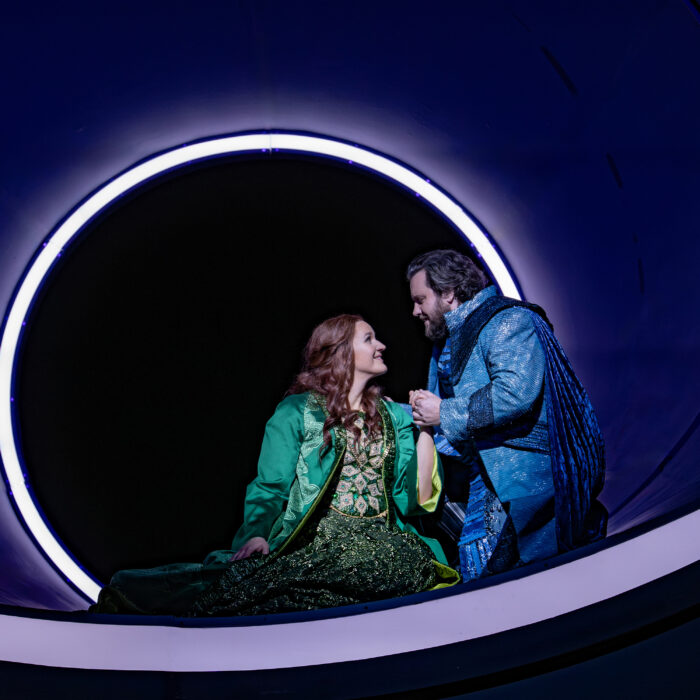
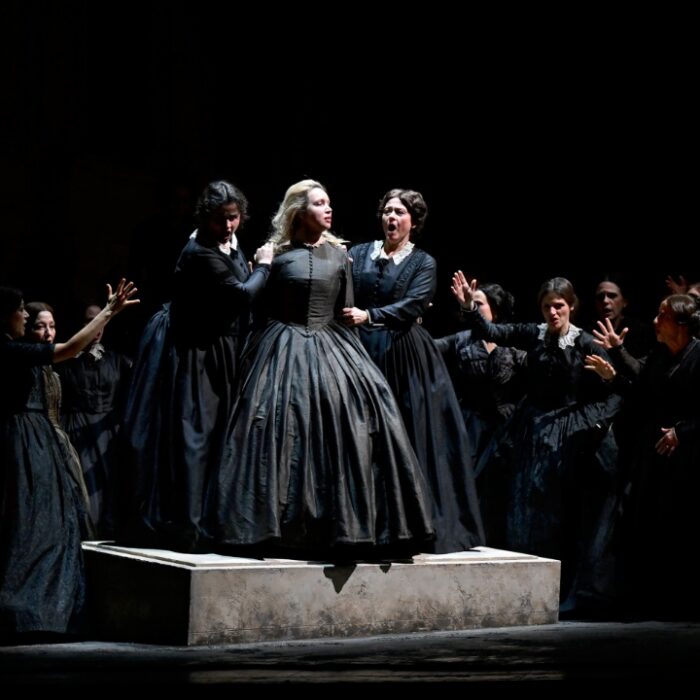
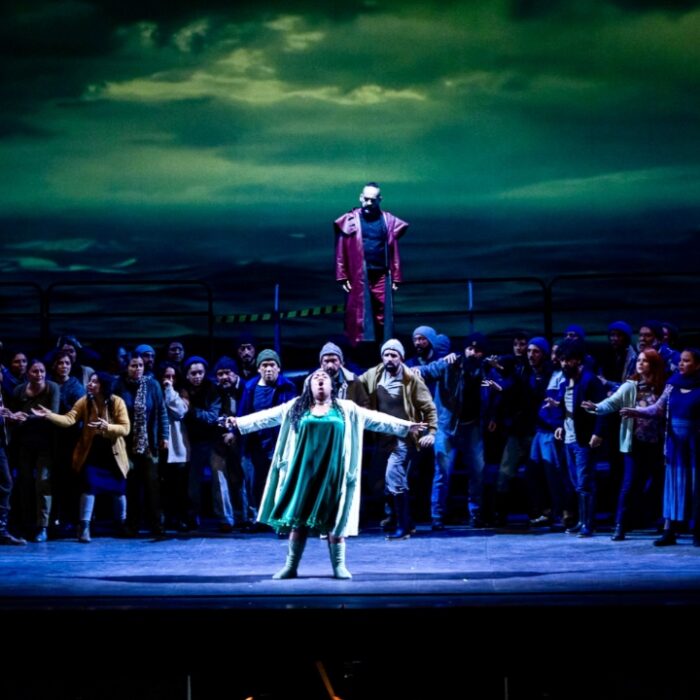
The artistic conception was entirely the work of the legendary Pier Luigi Pizzi, who at 95 years of age signed the stage direction, set design, and costumes with the genius, elegance, and distinction that define his career. The psychological portrayal of the characters was treated with extreme care, and the three protagonists delivered performances of a very high level thanks to Pizzi’s vision. The Milanese creative proposed a traditional staging of exquisite taste, set on a sharply inclined stage that enhanced both visibility and the impact of all scenic elements. Thanks to Matteo Letizi’s video editing, the final tableau took on a hyperrealistic character: a giant screen covering the entire back of the stage created the illusion of immense depth, complemented by lighting effects that simulated sunlight entering the space in a spectacular way. In key moments, such as the finales of Acts two and three, Massimo Gasparon’s lighting design proved essential in creating a cinematic, dramatically focused effect.
Musical Highlights
The Orchestra Toscanini dell’Emilia Romagna performed in the pit with extreme precision, responding superbly to conductor Leonardo Sini’s indications and dynamic demands. The 35-year-old conductor demonstrated a natural affinity for Verdi’s style. His expressive and elegant gesture was fully understood by the musicians, who under his baton played with rigor and a strong theatrical sense. Sini offered a rich and nuanced palette of colors, fully aware of Verdi’s Romantic atmospheres, executing them with mastery while providing the singers with attentive accompaniment. From the expansive and beautiful Sinfonia onward, the varied and well-calibrated dynamics and colors anticipated the balance and refinement found throughout the performance. The Chorus of the Teatro Municipale di Piacenza, prepared by Corrado Casati, despite its limited participation, more than met expectations, standing out particularly in the finales of Acts two and three.
Casting Gregory Kunde in the title role was a major success, as he made his debut as Stiffelio on this occasion. The legendary American tenor offered a minister who was scenically ideal by Verdi’s standards: a mature man, experienced both theatrically and vocally. His high notes remained imposing, ringing, and well placed; though at times less comfortable, they are never intrusive. Inevitably, Kunde more than compensates with a monumental dramatic interpretation. His register remains beautiful and metallic, solid, with an irresistible timbral sheen; diction and phrasing are exemplary. Most impressive is the artistic intelligence with which he places his instrument at the service of the character. Despite being a debut, his Stiffelio is assured, fully embodied, endowed with great moral stature and, at the same time, profound humanity.
Lidia Fridman as Lina, a wife crushed by moral pressure and by the weight of her husband’s role, delivered a solid stage performance. The soprano’s timbre was clear, transparent, and agile, with a pleasing color and natural flexibility. Her top notes were powerful, and the middle register was respectable. In the great aria of Act two, she stood out for her long fiati, sustaining a quality legato and an attractive timbre; the cabaletta was delivered correctly, if without dazzling brilliance. The endings of her arias carried notable dramatic intensity. It must be noted, however, that her Italian pronunciation was very poor, to the point of being almost incomprehensible.
In the role of Stankar, Lina’s tormented father, Vladimir Stoyanov portrayed the aging colonel with expressive intelligence. His interpretation was authoritative when required, yet also deeply human, proving more effective dramatically than strictly musically. With solid Verdi experience, the baritone fulfilled the role competently. His Act three aria was sung with vigor, careful attention to nuance, and strong momentum in the cabaletta, “Oh gioia inesprimibile,” though he tended to overemphasize the beginnings of phrases, rendering their endings nearly inaudible; nevertheless, his performance was well received.
As the noble Raffaele, tenor Carlo Raffaelli stood out for his radiant voice and distinctive color, qualities that made him particularly effective. The rest of the cast in secondary roles performed more than adequately. The elderly minister Jorg was portrayed by bass Adriano Gramigni. Lina’s cousins, Federico di Frengel and Dorotea, were sung by Paolo Nevi and Carlotta Vichi, respectively.