Lincoln Center Theater 2025-26 Review: Amahl and the Night Visitors
The Joyce DiDonato-Led Production is a Tender & Intimate Experience for All Audiences
By Francisco Salazar(Credit: Julieta Cervantes)
Gian Carlo Menotti’s “Amahl and the Night Visitors” has become a staple of the Christmas holiday ever since it premiered on TV in 1951. While it was the first opera specifically composed for television, the work has since become a holiday staple for many of the major opera houses across the United States of America.
This year, for the first time, Lincoln Center Theater is presenting the work in association with the Metropolitan Opera, hoping to bring a new tradition to New York audiences.
Directed by Kenny Leon, Lincoln Center has succeeded in creating an intimate experience for audiences of all ages.
Intimacy
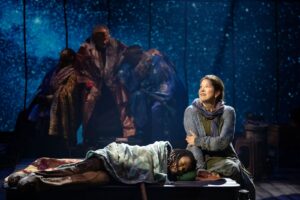
The opera, which was inspired from Hieronymus Bosch’s “The Adoration of the Magi,” is being performed at the Newhouse Theater, which seats about 299 audience members. The theater is shaped in a semi-circle that allows for everyone to get an intimate and direct look at the action on stage. Scenically the circular stage is also open and minimal with a wooden bed at the center, a few boxes upstage and a door. It is also surrounded by an animated backdrop that presents the winter blue sky and a few projections like the star of Bethlehem, which appears at the end of the opera.
Singers, a clarinet player, and chorus members enter through various parts of the theater, creating the feeling that the audience is part of the production. The intimacy is also created by the lack of an orchestra and instead was replaced by two pianos and the aforementioned clarinet player, giving the work the feeling of chamber piece. That was furthered by the closeness of the stage to the audience.
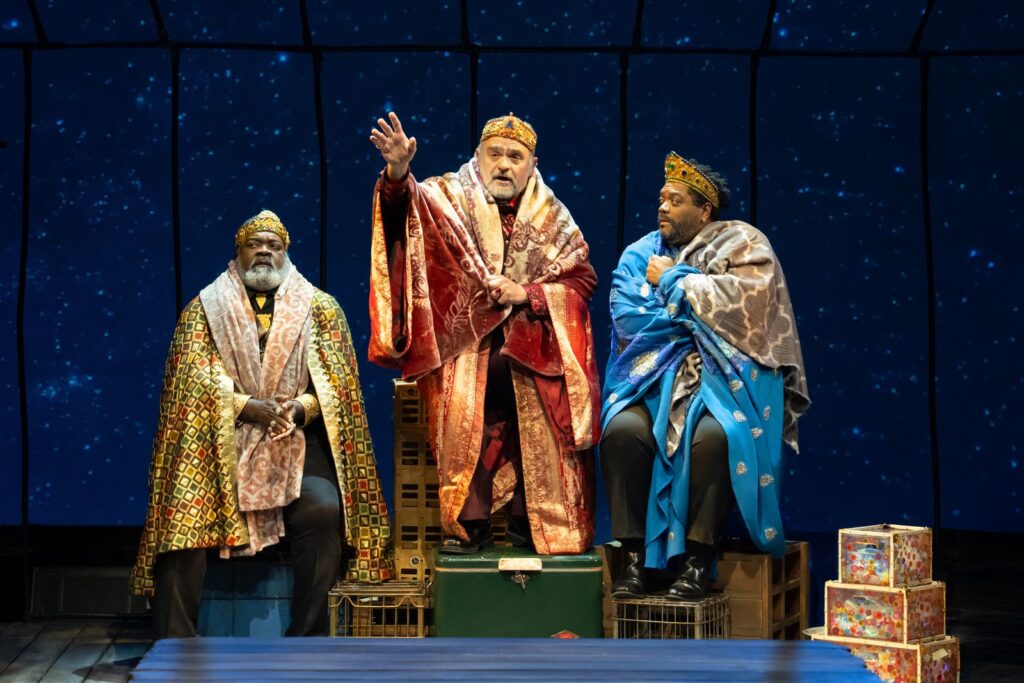
Credit: Julieta Cervantes
Musicality and Charm
Joyce DiDonato headlined the production in the role of Amahl’s mother, showcasing a distraught and unbelieving woman that transforms into one of hope. The mezzo, who has become well-known for her warmth and charismatic persona, was perfect for the role as she showcased tenderness in her duet with Amahl, “Don’t Cry, Mother Dear.” DiDonato scaled down her vibrant voice to match with Albert Rhodes Jr.’s sweet soprano. The two blended beautifully as they closed the piece with a gorgeous piano sound. During her aria, “All that Gold,” the mezzo showed pathos as she longed to give more to her poor son, each word sung with expressivity and heartbreak. In her farewell exchange with Amahl, “Do you really want to go?,” DiDonato sang with a mix of sadness and hope and once again paired her voice with Rhodes Jr. to perfection.
Speaking of Albert Rhodes Jr., the child singer was a marvel as Amahl, giving youthful energy to the production and showcasing an innocent gentleness to his vocal abilities. There was purity in his first interaction with DiDonato and then a sense of wonder in his questioning of the Magi in his ensemble “Are you a Real King?” Toward the end of the opera, after his Mother attempts to steal gold, Rhodes Jr. showed defiance, strength, and desperation in his “Don’t you Dare.” And then in “I Walk, Mother,” Rhodes Jr. was full of joy, running around the stage and dancing as he sang each line. In all, Rhodes Jr. showed promise as a young star.
As the Three Magi, Bernard Holcomb, Todd Thomas, and Phillip Boykin were well-matched in their trio, “From far Away we Come.” Holcomb’s Kaspar had some comic exchanges throughout the evening, especially in his aria “This is my Box.” He also showcased an agile tenor. Meanwhile, Todd Thomas’ Melchior displayed nobility in his baritone, especially toward the end during “Oh Woman, you can keep the gold.” Boykins’ Balthazar had a resonant bass sound that provided great support to his counterparts.
Jonathan McCullough played the Page following the Kings’ every move and always safeguarding the gifts. His baritone shone in his small but crucial exchange “Thief! Thief!”
Jesse Barrett played the oboe part with a golden tone, while pianists Nathaniel LaNasa and Riko Higuma accompanied the soloists with precision and freedom under the direction of conductor Steven Osgood.
Dancers Manuel Palazzo and Bryanna Strickland led a virtuosic “Shepards’ Dance,” while the choral number of Amahl’s Neighbors was sung with vigor.
Overall, this was an unforgettable evening that will hopefully become a tradition for every holiday season in Lincoln Center.