Teatro La Fenice 2025-26 Review: La Clemenza di Tito
Strong Cast Delivers Compelling Musical Performance
By Alan Neilson(Photo: Michele Crosera)
Venice’s Teatro La Fenice opened its 2025-26 season with a new production of “La Clemenza di Tito,” widely considered to be the least popular of Mozart’s mature operas. Its premiere in 1791 at the Estates Theatre in Prague received a lukewarm reception, with the Empress herself complaining that “nearly all of us fell asleep.” Albert Einstein’s assessment was that Tito “is nothing but a mere puppet representing magnanimity” and that opera seria, which had all but been overtaken by Gluck’s reforms and the movement towards Romantic opera, was a “moribund form.” In comparison to Mozart’s other mature operas, it is often seen as backward looking. Over the past half century, however, a substantial reevaluation has taken place, and many commentators now view the opera in a more positive light, praising the quality and variety of its musical numbers; even its simple narrative has been reappraised, with attention being drawn to its themes of justice, ambition, compassion and the conflicts between private and public life. Nevertheless, many opera enthusiasts still see remain to be convinced.
With conductor, Ivor Bolton, and director, Paul Curran, two Mozart specialists committed to promoting the reputation of “La Clemenza di Tito,” supported by an excellent cast of singers, Teatro La Fenice’s production offered the perfect opportunity to judge for oneself the merits and demerits of the opera.
Certainly, the opera’s simple narrative, based on a 1734 text by the premier librettist of the high baroque, Pietro Metastasio, does little to disabuse people of its negative impression. Set in antiquity, with its promotion of princely virtue and values and its strict representation of the social hierarchy, it may prove difficult for modern audiences to accept. Even the revised version of the text by Caterino Mazzolà, aimed at sharpening the musico-dramatic impact, leaves the underlying narrative unchanged.
The Emperor Tito, portrayed as a decent, thoughtful ruler, has decided to marry Servilia, much to the displeasure of Vitellia, who also has eyes on the position and thus seeks vengeance. She thus encourages Sesto, who loves her obsessively, to murder Tito, who also happens to be his friend. Servilia, however, tells the Emperor that she is in love with Annio and does not want to marry him. Being the just and wise despot that he is, Tito immediately accepts Servilia’s situation and decides to marry Vitellia in her stead. But it is all too late. Sesto is on his way to carry out the deadly deed. Fortunately, the Emperor survives the assassination attempt, and Sesto confesses his actions but, loyal to the end, does not implicate Vitellia. Eventually, the full truth is revealed, and Tito, rather than seeking retribution, shows clemency and pardons them all, in a way only a wise, just and magnificent ruler can.
It is hardly a tale to set the pulses of a 21st century audience racing.
A Brave Attempt To Inject Momentum Falls Slightly Short
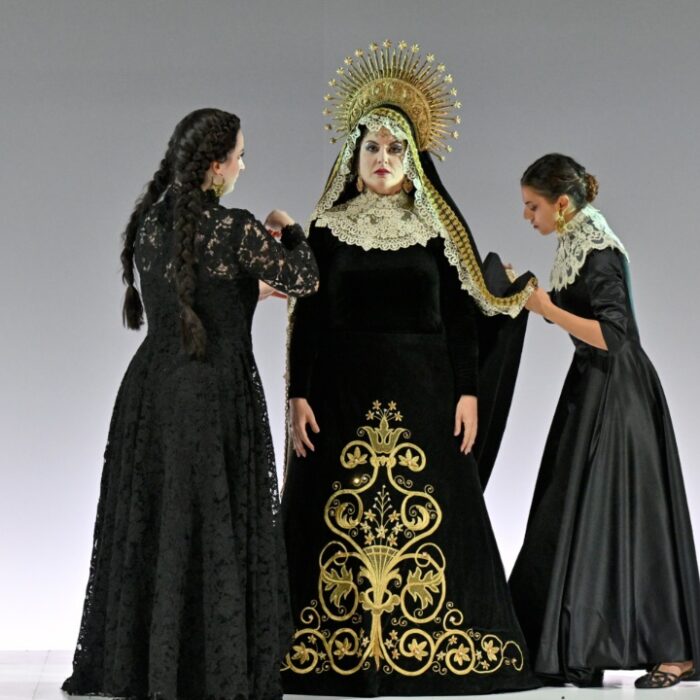
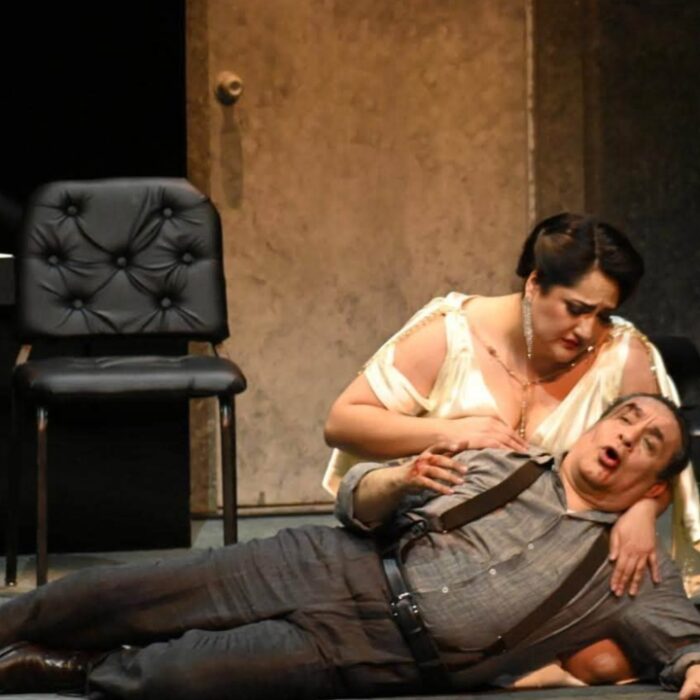
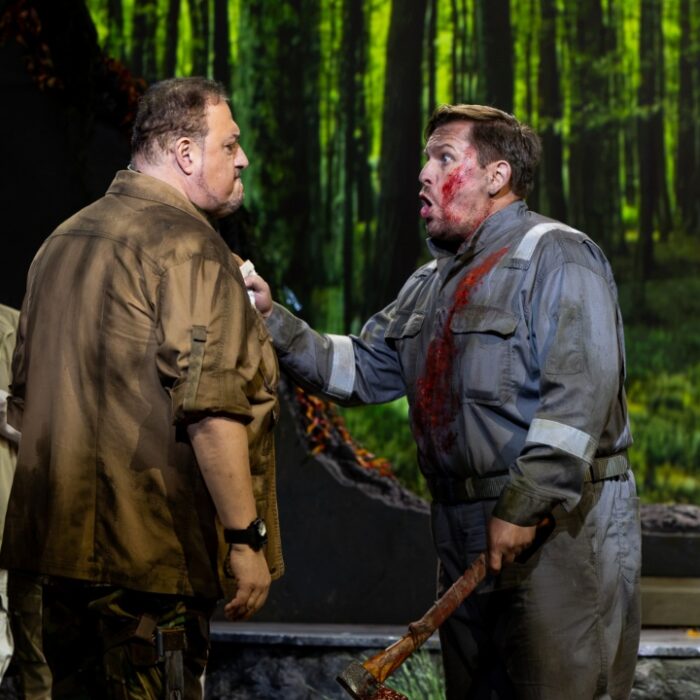
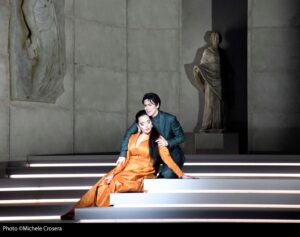
Curran’s valiant attempt to make the work more palatable was partially successful. Rather than fixing the presentation in the first century AD, his use of colorful, modern-day clothing, designed by Gary McCann, gave the staging a more contemporary flavor to distinguish it from classical antiquity. Tito, for example, was dressed in a white suit, while Sesto was attired in a bland, darker-colored, more casual costume. While the status of the characters was thus distinguishable from a modern perspective, there was no pomp or decorative insignia surrounding the emperor, which successfully created a greater sense of equality, if not necessarily democracy. Tito’s clemency was thus an individual act rather than something specifically associated with princely behavior.
McCann’s single set was suitably ambiguous. On the surface, its white walls with classical statues and reliefs, while giving the appearance of a building from classical Rome, could also be taken as a typical neoclassical structure used for public buildings in the modern western world. Thus, the link between the ancient and modern was neatly constructed so that the audience was not alienated by the values of the, now outdated, late baroque. The introduction of modern equipment, such as Tito’s hospital bed with its electronic monitors or the bomb that Sesto used to blow up Tito’s palace, rather than a knife to assassinate the emperor, further helped position the drama in the 21st century and thereby allow the audience to relate to the situation.
In fact, Curran’s management of Tito’s attempted assassination, which is actually only reported in the libretto, was imaginatively exploited. As Act one drew to a close, Sesto appeared on stage with a bomb, and a digital clock counted down the seconds towards its detonation on a transparent curtain across the front of the stage in big red numbers. The tension and sense of expectation this created was quite powerful. As the counter hit 00:01, everything went dark. After the interval, the second act opened with the palace in ruins.
Overall, however, Curran was unable to inject a compelling momentum to carry the drama forward, nor could he build tensions that stretched across the two acts; the libretto simply does not offer this possibility. Instead, he focused on instances which could be exploited successfully and on developing the characters themselves, whom he convincingly portrayed as layered, deeply conflicted individuals, notably so in the cases of Vitellia and Sesto. Also, he managed to downplay the moralizing and glorifying aspects of the libretto.
Mazzolà’s revision of Metastasio’s text created a framework for Mozart to provide a wider range of musical forms than is found in a typical 18th century opera seria as written by, for example, Händel or Vivaldi. Rather than the usual structure of a series of arias divided by recitatives, “La Clemenza di Tito” includes numerous ensemble pieces that add a more dramatically satisfying dynamic and provide a greater degree of interesting textural and harmonic variety, albeit there is nothing within the work that compares to the scope of invention found in Mozart’s Da Ponte operas, not least the fabulous finales from Act two and Act four of “Le Nozze di Figaro,” which can easily lead to “La Clemenza di Tito” being seen as a backward step.
Bolton Brings Out the Quality of Mozart’s Score
On the musical side, Ivor Bolton, conducting the Orchestra del Teatro del Fenice, produced a sensitive, balanced reading that not only brought out the textural beauty of the score but also expertly captured the emotional depths experienced by the characters, notably so in Sesto’s famous aria “Parto, ma tu, ben mio,” but also in the other arias and ensemble pieces, thus successfully affirming the musical quality of the work. He was not, however, able to overcome the lack of dramatic momentum of the narrative, which ultimately detracted from the appreciation of the opera as a whole.
Certainly, one of the problems with “La Clemenza di Tito” is the role of Tito, which rarely rises above an emperor that simply wants to be nice. The reality of managing power does not seem to concern him at all. Hard decisions are reduced to deciding on which option is the nicest. Although his friend’s attempt to assassinate him might have caused him heartache, the nice solution is to forgive him, which he duly does. Tenor Daniel Behle, cast in the role, was reflective and thoughtful and did his best to provide depth to the character, but it was impossible to take this beyond the personal; clemency, being the nice option, was always going to be the outcome of his deliberation. Having Tito arrive on stage in a hospital bed after the attempt on his life, however, did help, as it gave the impression that he was concussed and thus not able to think properly.
Behle presented Tito as a decent, caring individual, and at times he even came across as king-like. His singing was imbued with a sense of balance and reflection, which added to his magnanimity. He possesses a resonant, secure voice with a pleasing tone and delivered solid renditions of his arias. It was his lengthy recitatives, however, that allowed him to show off his ability to bring expressive depth to his characterization, notably in the accompanied recitative “Che orro! che tradimento!” in which he was able to voice his pain and anger at Sesto’s portrayal and the mental anguish of deciding whether or not to sign his death warrant.
Bartoli & Molinari Dominate with Layered, Insightful Characterizations
Soprano Anastasia Bartoli’s confident demeanor and ability to convey strong emotions were perfect for portraying the violent extremes of the power-hungry Vitellia. In her opening scene with Sextus, she immediately established her manipulative and venomous nature, which she successfully built upon in her aria “Deh, se piacer mi vuoi;” playing with Sesto’s feelings, Bartoli sensitively caressed her lines, mixing threat with the possibility of love, which had Sesto completely under her spell.
As the opera draws towards its close, Vitellia’s conscience awakens, to which she gives voice in an extended passage of accompanied recitative, “Ecco, il punto, o Vitellia,” which she followed with the aria of self-recrimination, “Che del ciel, che degli Dei,” for which Bartoli produced expressively compelling interpretations. The recitative was sensitively crafted using colored and dynamic accents, successfully revealing the depth of her guilt, while the aria was sung with a delicate emotional intensity that conveyed the honesty of her feelings. It was also delivered with a beautiful lyricism that captured its delightful melody.
Sesto is the opera’s most complex and layered character. Motivated by his strong passion for Vitellia, he is easily manipulated into carrying out a heinous crime, yet he is deeply conflicted and suffers greatly due to his actions. Yet such was mezzo-soprano Cecilia Molinari’s wonderfully nuanced characterization that it was possible to sympathize with Sesto; the good side of his character was always in evidence, even when largely submerged by his less than honorable motivations.
Molinari, as expected, produced an animated, nuanced acting and musical performance, one perfectly moulded to highlight Sesto’s inner conflicts, the complex relationship with Tito, as well as his love for Vitellia. Recitatives were brilliantly crafted and arias delivered with emotional depth, subtlety and expressive sincerity. Her rendition of the opera’s most famous aria, “Parto, ma tu, ben mio,” in which Sesto pleads with Vitellia to forgive him for his initial reluctance to carry out the murder of Tito, was given a superb reading that captured Sesto’s weakness in beautifully crafted lines coated with his desperation, which transformed into assertive determination as he swore to avenge Tito’s insult, allowing her voice to show off her vocal flexibility and ability to deepen her characterization through neatly placed emotional accents, colorful contrasts, and her dramatically fashioned coloratura.
Although a fairly passive character, Annio actually finds himself in the eye of the storm. Steadfastly loyal to Tito, he is also a good friend to Sesto and deeply in love with Servilia, who has been chosen by Tito for his bride. Often, the character can come across as passive and weak, but this was not the case with soprano Nicoló Balducci, whose emotionally strong portrait of Annio convincingly captured his conflicted feelings; at times, he was earnest and loving, protective and loyal, yet he could also be hot-headed and feisty and suffered from bouts of anxiety. His underlying good-nature, however, was never in doubt. His two arias and recitatives were delivered with a passion and expressivity that raised Annio above that of a docile onlooker.
Soprano Francesca Aspromonte produced a tidy performance as Servilia, in which she convincingly conveyed her love for Annio and determination to withstand Tito’s intention to marry her. She depicted Servilia as honest, open and strong-willed. Her duet with Annio, “La perdona al primo affetto,” left a clear impression that Servilia’s love was sincere and steadfast, while her aria “S’altro che lacrime” allowed her to show off her attractive, sensitive phrasing in a delightfully rendered A section, which she contrasted with a forceful, even slightly angry B section as she attempted to convince Vitellia to help Sesto. Her delivery of the recitatives was fresh, lively and expressive.
Bass Dominco Apollonio produced a clearly delineated, fairly unpleasant representation of Publio, successfully revealing his suitably suspicious and cynical nature.
Members of the chorus were dressed in modern, dark colored clothing, giving them the appearance of present-day proletarians. They engaged fully with their role, and successfully added to the dramatic context, singing with energy, precision and passion, while adding to the harmonic texture of the opera.
This was a performance that made a compelling case for “La Clemenza di Tito,” at least on the musical side. It is an opera that contains plenty of high-quality, emotionally charged music with many memorable melodies. As a piece of drama, however, it is not particularly gripping. Sure, it has its moments, and some of the characters are expertly drawn, especially in the cases of Sesto and Vitellia, but the role of Tito, upon which the opera rotates, is flat and does not convince. Curran’s direction made a reasonably good attempt to overcome its shortcomings, but it is never going to convince to the same extent as Mozart’s other mature operas.