Wiener Staatsoper 2025-26 Review: Dialogues des Carmelites
Dramatic Production Featuring Stellar Cast Proves Riveting & Unforgettable
By Matt Costello(Photo: © Wiener Staatsoper / Michael Pöhn)
Before I get to the performance in question for this review, “Dialogues des Carmelites,” I have a few words about the setting.
Though reasonably well-travelled, somehow I never went to Vienna. I did attend Salzburg for the festival. And Munich as well, for a shattering Janacek’s “From the House of the Dead”.
Paris, London, Verona… also for many memorable performances.
But not Vienna. So, a couple of weeks ago, I was finally there to review a performance in the Gustav Mahler Hall. And I knew (and could feel) that this was operatic ‘sacred’ ground, in a city that was legendary on so many artistic fronts—from painting, and music, and architecture, to even the wonder of the irresistible Sachertorte.
It was a heady place to be for the first time, and to experience the sublime opera house. I left thinking about the beautiful city, the Staatsoper, the art, and yes, the food…
And now—about the opera.
Musical Highlights
Let me begin with the overwhelming end. The final section of “Dialogues des Carmelites” is absolutely masterful, especially with the gripping music of the “Salve Regina” accompanying every nun being brought to the guillotine to meet her fate.
Poulenc’s often ravishing music is at turns beautiful and exciting, with a full palette of emotional colors. And in the case of the Staatsoper’s production of the opera, all elements—musical, acting, and design— were, from the start, of the very highest order.
The leads brought an intensity, commitment and vibrancy to their roles, no matter the content of what was being discussed or debated.
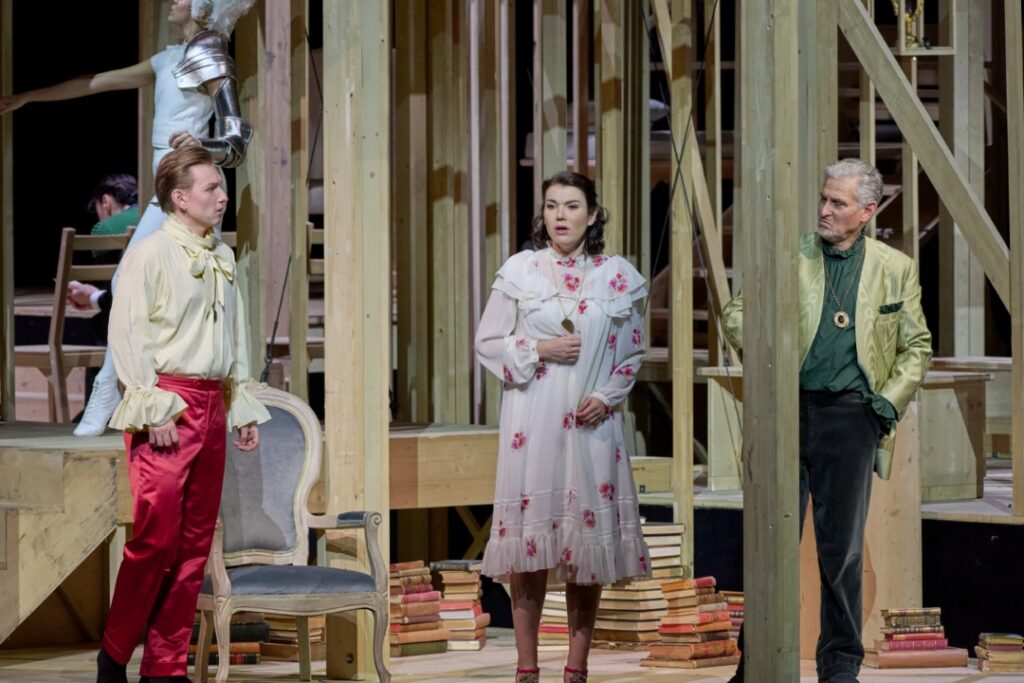
Anchoring the opera was Olga Kulchynska as Blanche, who so desperately wants to leave her home to join the Carmelite order. Her singing was sweet yet fully moving, with all the force needed in the early acts of the opera. She powerfully conveyed the emotional journey of getting what she desired—and then facing where it ultimately leads.
Bogdan Volkov as The Chevalier was very strong yet gentle in his brotherly love for his sister, Blanche. Not really understanding or approving of her passion to do what she was committed to, he brought a clear, ringing tenor—a voice to support and protect the sister he loves.
He was joined in, well, perhaps consternation but also deep love, by Blanche’s father, The Marquis, who in his informed state now must witness what he likely views as madness from his daughter. Michael Kraus was wonderful in the role, his baritone providing a grounding of sensibility that he might likely hope could sway the determined Blanche.
All three of the above roles remind one that this unusual opera is also a family tragedy set during the historic Reign of Terror.
But “Dialogues” is also largely an opera about this group of devoted Carmelites. All the main leads made each sister stand out as distinct, each interacting with the obsessed and excitable Blanche differently.
(Photo: © Wiener Staatsoper / Michael Pöhn)
More Cast Details
Sylvie Brunet-Grupposo as the flinty, aged, yet quite strong Prioress, who must deal with this young woman who wants to join their number, conveyed not just that battle but as she edged closer to dying, revealed her rage and anger. Her fate perhaps, but also what may be coming to the innocent nuns in her charge.
As her replacement as the convent’s prioress, Madame Lidoine, Maria Motolygina commanded the stage, infusing the nunnery with a sense of hope—even as the sense of it and their lives is soon to spiral out of control.
Special mention must be made of Maria Nazarova, who was delightful as the bubbly Sister Constance. Her soprano voice perfectly captured her character’s impulsive nature, presenting such a sharp contrast to the rest of the nunnery…as events close in on the nuns who all resolve to face their end together.
Illuminating Production
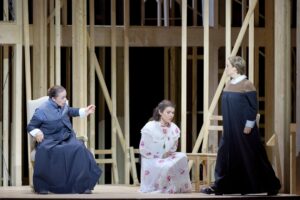
The production presented an effective and creative way to make the most of the various dynamics at play. The set was a large, open-frame wooden construction of rooms and stairs. It revealed, as warranted, different parts of the convent, the Marquis’ home, and other locations—all at the same time.
This masterful design by Monika Biegler made scene changes seamless and, with no walls, one could feel the lines of connections between all the characters at each moment of the opera.
The director Magdalena Fuchsberger clearly made the most of this remarkable set, with direction and staging that used the design to show the flow of emotions and events, all leading to the overwhelming finale.
The combination of the set design and acting meant that one never forgot where this was headed.
The music seemed like a revelation to me. While I saw the opera at The Met many decades ago, I was struck, this time, by the power and beauty in Poulenc’s music.
Conductor Robin Ticciati masterfully and exuberantly navigated the changing and moody dynamics of the rich score, with confident and moving conducting making that music soar.
The opera, not performed that often, could not have asked for a stronger production to make its case and tell its powerful tale.
But as expected, it was the ending that one walked away remembering most.
The staging of the doomed nuns who have taken their vows of martyrdom, initially rejected by the terrified Blanche who ultimately returns to join them, was positively riveting and completely moving, as it should be.
That powerful scene was matched with truly striking music from Poulenc: the sound of each nun being guillotined was echoed by the orchestra. While on the stage in this production, each nun—now magnificently arrayed as if ready to transition to heaven—literally fell away from those remaining alive.
Until there was one.
And then there were none.
It is something unmatched in opera.

(Photo: © Wiener Staatsoper / Michael Pöhn)
Challenging Work
But while this is a thoughtful and powerful work—it is also occasionally problematic. Until one gets closer to the end, the drama can appear somewhat underpowered, especially with the first half’s primary concern with Blanche’s insistent passion to join the convent and retreat from the world.
And, of course, all the time, the audience is well aware, since it is justly famous how this opera is based on a true story, it ends for all the nuns…and Blanche as well.
Especially when it it is staged and performed so powerfully, as it was done here.
But while I might question the opera’s story structure and balance, I also have to wonder: could that amazing ending have been as chillingly effective without all the interactions we had seen before…from the impulsive Sister Constance to the new Prioress leading her brave nuns to their execution?
I am not sure, and that is something I will be thinking about.