Opéra-Théâtre de Metz 2025-26 Review: Elektra
By Andréas Rey(Photo: © Philippe Gisselbrecht)
On Friday, November 7, and Sunday, November 9, Richard Strauss’ opera “Elektra” was performed at the Arsenal in Metz in concert version. As the Metz Opera House is undergoing renovation for the next two years, its productions are being staged outside the building during the works.
Elektra is the young sister of Salome, from whom she seems to draw in part for her narrative structure, and even some scenes such as the wait before the execution, the opera is more direct than that of Salome. For example, the confrontation between the Greek princess and her sister and mother before the king’s execution is a key scene in “Elektra,” whereas the rift between the Babylonian princess and her mother is only implied in “Salome.” Similarly, the fall of the tetrarch’s family is hinted at but not acted out. What Lachmann indicates, Hofmannsthal shows.
The Metz Grand Est National Orchestra once again demonstrated the quality of the balance between its sections, which remains its distinctive feature. Its sections are clear, frank, and direct. Its conductor, David Reiland, uses a clean and clear, almost luminous conducting style, illuminating the sharp edges, breaks, and fractures of the score. The broken, sharp and unhealthy world surrounding the Greek princess is fully present here. While the orchestration of “Salome” is Dionysian, the orchestra gradually exceeded the narrative framework of the scenes. Reiland emphasized the Apollonian nature of “Elektra” by insisting on the harsh and dry atmosphere of the opera. After a very good “Scheherazade” and a more than respectable performance of Mahler’s Third Symphony, conducted by Reiland earlier this year, including an excellent performance of Ravel’s “Pictures at an Exhibition” under guest conductor Adrian Prabava, the Orchestre national de Metz Grand Est once again proved its ability to adapt to the repertoire of the 20th century.
What a shame that the concert hall is so cruel to voices…
This is evident from the sextet of the maids, who struggled to be heard above the shrill yellow tones of the orchestra.
(Photo: © Philippe Gisselbrecht)
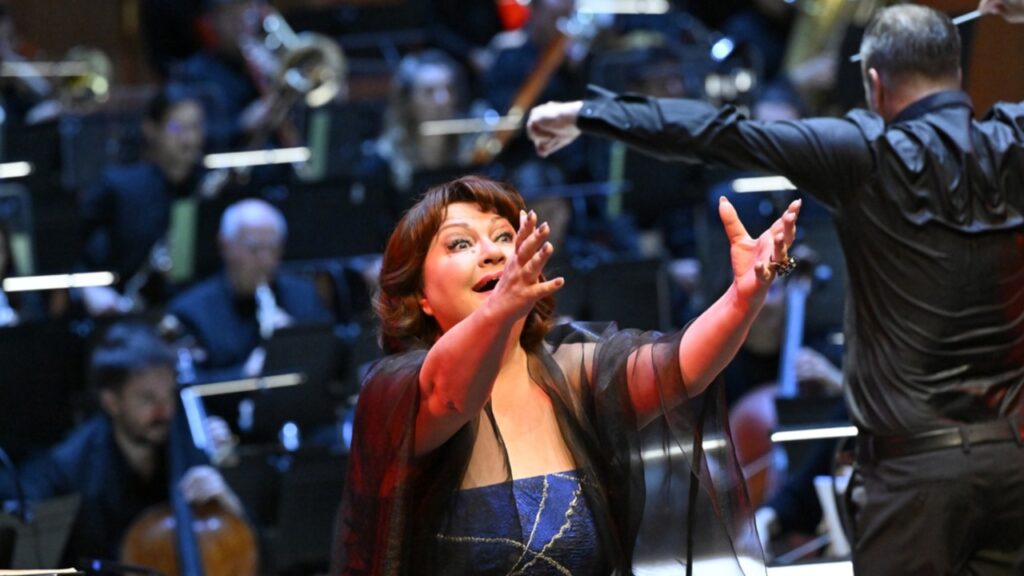
Elena Pankratova, who lived the title role rather than embodying it, struggled to make herself heard, due to the orchestra being too prominent. Yet she seemed made to be the Greek princess, as she is undoubtedly made to be the Babylonian princess, not only thanks to her inspired acting but also thanks to her ease in the high notes, as evidenced by the rare moments when she was heard. The audience trembled during her solos. She danced with joy at the death of her mother and Aegisthus. She swung an imaginary axe when she realized she had forgotten to give her brother his father’s murder weapon. She softened her tone to convince her sister to join her in killing the royal couple. And above all, she let out an excruciating cry when she finally recognized her brother. Her voice followed the drama, which is the definition of embodiment.
Unfortunately, the audience swallowed up both female duets in the same way, as if they were nothing: the one between Elektra and her sister Chrysothemis, “Ist mein Gesicht dir so verhasst?” (“Do you hate my face that much?”), a confrontation between life and death, and the very tragic one between Elektra and her mother Klytämnestra, “Was willst du? Seht doch, dort! so seht doch das!“ (”What do you want? Look closely!“)the soprano Hedvig Haugerud as Chrysothemis strained her voice dangerously to be heard. This removed all gentleness and trace of flexibility from this character who only wanted to give life: “Eh ich sterbe, will ich auch leben! Kinder will ich haben, bevor mein Leib verwelkt, und wärs ein Bauer, dem sie mich geben, Kinder will ich ihm gebären und mit meinem Leib sie wärmen in kalten Nächten, wenn der Sturm die Hüttezusammenschüttelt!” (“Before I die, I want to live. I want children, before my life rots, and, even if they give me a peasant, I want to give him children, and in my flesh will I give them warmth in cold nights, when the storm shakes huts.”)
It is also regrettable that mezzo Ana Ibarra as Klytämnestra retained such a strong accent and sounded as if her vocal projection was obstructed. But above all, her laughter, after Elektra strongly suggested that she committed suicide, did not resonate in the auditorium.
Tenor Kristian Benedikt as Aegisthus was also barely audible. He did not seem particularly interested in this king, who is soon to be assassinated. He failed to bring him to life during the few minutes he had left.
On the other hand, baritone Birger Radde as Orestes, sounded dark, cavernous, deep, and haunted by the death of his sister. He was striking. He seemed to come from far away, if not from hell, then at least from the depths of oblivion into which his mother and stepfather had thrown him. Their dialogue was an opening onto an abyss. “Die Hunde auf dem Hof erkennen mich und meine Schwester nicht?” (“The dogs in the courtyard recognize me, and my sister not?”) While some Orestes point to a future dictator, others to a veteran, this one was a tired, exhausted survivor who sought revenge.
Once the Metz opera house has been restored, it would be nice to see a staged production of “Elektra,” after last year’s very disappointing “Salome” in French. And why not also revive “Salome” in its original language?
Categories
Reviews