The Person Behind The Opera, Pt. 4: St. Alban
By John VandevertIt is rather easy to find operas dealing with religious persecution, ideological conflict, and personal struggles. From well beloved 20th century examples like Messiaen’s “Saint François d’Assise” (1975-79), Britten’s “The Prodigal Son” (1968), and, my personal favorite, Poulenc’s “Dialogues des carmélites” (1956), to revolutionary works like Strauss’ “Salome” (1905), Hindemith’s “Sancta Susanna” (1921), and Schoenberg’s “Moses und Aron” (1932), the theme of religion has come to take a panoply of forms. Looking earlier, into the Romantically-inclined 19th century, one finds a completely different view all-together: one hallmarked by works like Meyerbeer’s grand opera, “Le prophète” (1849), and Berlioz’s moralistic “La Damnation de Faust'” (1846).
If one lurches into the 21st century, one yet again finds a completely different perspective. In this landscape, religion has been not only stripped of its premodern innocence but now deconstructed to such an extent that religion itself becomes a backdrop for the interrogation of human relations and the complexities of virtue. From reintroductions to known historical events like the Salem witch trials (“Obeah Opera”) to critiques of controversial topics like Christian missionaries (“Das Grosse Feuer”), religious themes in opera have come a long way. One of these new directions includes explorations of how religious and non-religious people interact.
For part four of The Person Behind The Opera, a new five-part series explores five operas based on real-life figures who all faced different forms of opposition and hardship during their time, we will explore the harrowing life of St. Alban (Albanus). He is considered to be the first martyr (or protomartyr) of Great Britain, and was executed during the 3rd or 4th century: a victim of the increasingly aggressive persecution of Christianity in the Roman Empire. The exact date of his execution has been debated, with some arguing it occurred during the early 4th century Diocletianic Persecution and others connecting it to the persecutions under early 3rd century Emperor Septimius Severus. However, there is now a developing consensus that his martyrdom occurred around the mid-3rd to early 4th century. Whatever the case, over the centuries and across various manuscripts, including “De Laude Sanctorum” (4th century), “Passio Albani” (5th century), “Vita Germani” (5th century), and “Ecclesiastical History of the English People” (8th century), the life of St. Alban and his martyrdom has been reinterpreted in many ways.
Alban was born in Verulamium (present-day Hertfordshire). Much of his life is unrecorded and it has even been speculated that the very personage of St. Alban was the imaginative construction of Bishop Germanus of Auxerre. Nevertheless, the act for which Alban is best remembered is his valiant protection of St. Amphibalus, a Catholic priest who is regarded as responsible for Alban’s ownconversion. As the story goes, having come across Amphibalus fleeing from persecution, Alban agreed to covertly house him. However, news of this illegal harboring made its way to the Roman emperor and guards were dispatched to reclaim Amphibalus.
However, upon their arrival, Alban offered himself instead. Brought before a pagan priest, he was threatened with torture if he did not comply with pagan rites. Naturally, he refused to engage and, having endured tortures in divine bliss, he was to be beheaded. Once again, this did not shake his faith. What followed was a series of miracles and dramatic events including a river drying up to permit Alban to pass, a spring erupting at his feet to slake his thirst, and the miraculous conversation of his first executioner to Christianity. St. Alban was beheaded by a second executioner whose eyes fell out the moment the sword fell so that he could not see nor revel in the saint’s death.
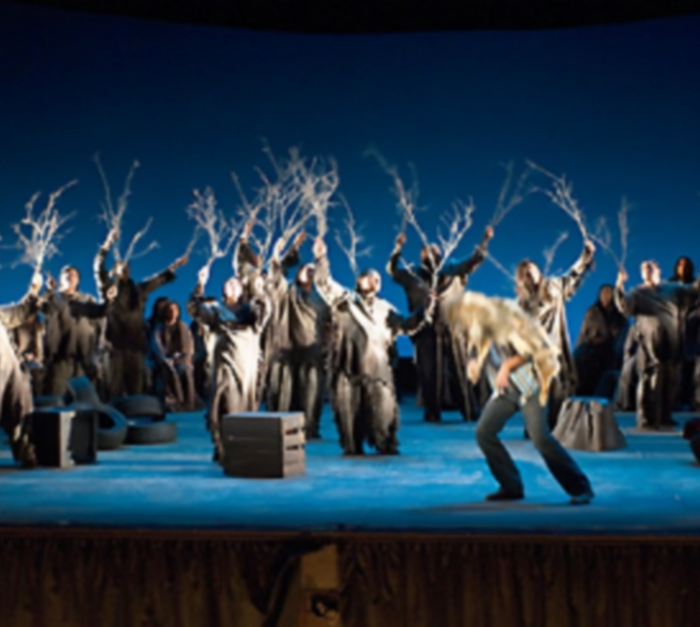
In the spring of 2009, St. Alban received his operatic incorporation. Composer Tom Wiggall, commissioned by St Alban’s Cathedral, created the opera, “Alban,” where the life of the saint was dramatically conveyed in collaboration with local choirs in an accessible manner. While the opera has never been performed again following its premiere, by all accounts it was a popular event. In an online interview, Wiggall shared some details of the project.
The opera’s musical material was inspired by a mixture of Modernism and late Romanticism, from Benjamin Britten and Michael Tippett to Vaughan Williams and Jean Sibelius. Given the opera was for a mixed performer base, Britten’s ‘Noye’s Fludde‘ (1958) was used as the model for the work’s structure. In Wiggall’s words,
As the work had a large community component, I wanted to ensure that there were recognizable cultural touch points for all participants and audience members and these took the form of popular hymn melodies and Anglican psalm chants.
Additionally, the opera was conceived of as a tapestry or puzzle, with many different parts coming together to form the work’s form. The task was “to draw the picture, one piece at a time” through the different elements. Writing the opera began on the level of local research, libretto work, and then finally composition. As the project went on, however, “the more the project became a case of what the music needed to be for the character.” Thus, the music became a reflection of the character’s internal dynamics and developments, exemplifying their struggles and challenges. While his only opera, the work proved to be a wild success with the community and critics alike.
– – –
Thanks to Todd Wiggall for providing information and the opera’s poster for this article.
Categories
Special Features