Opera Meets Film: The Dramaturgy of an Operatic Life in Alan Crosland’s ‘Greater Than Fame’
By John VandevertIn the body of opera-oriented films, from contemporary works like ‘The Moon and the Stars‘ (2007), and ‘Florence Foster Jenkins‘ (2016), to earlier icons like ‘Fire at the Opera‘ (1930) and ‘Champagne Waltz‘ (1939), the ways opera and operatic life is conveyed on screen is highly diverse. However, go far enough backwards and one will find a way of conveying the operatic body which seems all together foreign to use today, a way which forces us to engage with the idea of opera from a different direction. I’m talking about the silent era, an epoch of cinema roughly lasting from the late 19th century to the 1920s (i.e., the talkies), although silent and sound film grew together.
Many of the first operas using Richard Wagner’s music come from the silent film era, one example being a film I’ve alluded to in earlier articles, D. W. Griffith’s film, ‘The Birth of a Nation‘ (1915). Interestingly, after this, two more silent films (albeit with synchronous musical scores) would be released, the final one being Luis Buñuel’s 1929 film, ‘Un Chien Andalou,’ his first foray into cinematography. Early silent films, including opera extending into the 1910s, another famous case, and one previously explored, was Samuel Goldwyn’s 1917 commercial failure, ‘Thais,’ featuring lauded American soprano, Mary Garden.
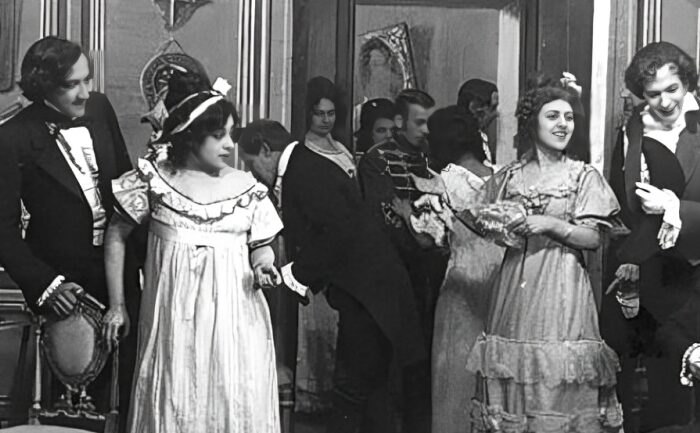
By the early 1930s, the silent film era of operatic cinema had effectively ended, with sound films being a global phenomenon, from Poland (‘Niebezpieczny romans‘) and the Czech Republic (‘Tonka of the Gallows‘), to the USSR (‘Road to Life‘), India (‘Alam Ara‘), and China (‘Singsong Girl Red Peony‘). But let’s step back in time to 1920 and look at one one of the few silent films about opera known to history, Alan Crosland‘s film, ‘Greater Than Fame.’
Among the earliest depictions of opera on the silver screen, Crosland’s film conveys a rather realistic, albeit dramatic, side of the operatic career, namely the fight for recognition and opportunity. Starring two of the most highly esteemed film artists of their generation, Elaine Hammerstein and Walter McGrail, the film tells the story of a young woman, Margaret Brooke, whose vocal training and pursuit of fame leads her into troubling predicament.
What makes a film about opera without words so sensational, however, is the way the body and music must bear the responsibility of telling the story rather than lines. This then requires the performers to embody their characters on a fundamentally deeper level and as a result, the film seems to convey the pursuit of fame and true love in an almost transcendental fashion.
It is unknown whether the film still exists but, if understood in context, this film was among the first wave of cinematic projects dealing with the topic of opera on a far more meta level. While opera-based silent films were not in short supply during the 1920s, a few examples being King Wallis Vidor’s “La Bohème“ (1926), Ernst Lubitsch’s “Rosita“ (1923), and Forest Holger-Madsen’s “The Evangelist“ (1924), what made Crosland’s film unique was its original story co-written by the prominent playwright and female suffragist Katherine S. Reed.
Rather than base its plot on existing material like an opera or written story, Reed and Crosland devised a story seemingly at home in our contemporary world where career, morals, ethics, and the pursuit of true love seem to fight each other at every turn. Hence, the real dramaturgical power of the film comes not from the acting per se but from the potency of the story’s applicability at a time when post-war life seems endless and capitalism’s impact upon communal relations was being dealt with in vastly disproportionate ways.
If anything, Crosland’s ‘Greater Than Film’ deserves to be remembered as an early symbol of the costs of singing, not just financially (as of 2020, extremely precarious), but psychologically and interpersonally. It’s rather well-known that the pursuit of an operatic career holds the potential to generate various degrees of anxiety. More frightening, however, is the nature of the industry which, as others have shown, include everything from blatant ageism to downright nepotism. The film, released during a time when opera was in its post-Romantic Silver Age (the ‘Golden’ connected to the long 19th century), had successfully become an industry, but not one whose place in society was affixed nor inaccessible. Instead, as first wave jazz culture began overtaking the world, opera was (still) there, but now it had become something Modern, a free and creative medium for innovation.
And yet, at the end of the day, operatic auditions remained the dominant form of “getting your foot in the door,” and even once your foot was in the door, one had to always watch themselves closely. In the German 19th century, the fach system was born, a controversial tool which was intended to make casting easier.
In operatic history, 1920 is best remembered as the year when Erich Wolfgang Korngold’s third opera, “Die tote Stadt,” was premiered, following shortly after with the premiere of Sergei Prokofiev’s “The Love for Three Oranges” (1921). But for operatic cinema, the year was replete with silent, opera-based features, Béla Balogh’s ‘Under the Mountains‘ and Karl Otto Krause’s ‘Gypsy Blood.’ marking a quickly closing chapter and the emergent birth of a new one. In fact, opera would become a recurrent theme in Crosland’s work, popping up throughout the 1920s (Under the Red Robe, 1923 and Don Juan, 1926). While his legacy is generally defined by his controversial 1927 film, ‘The Jazz Singer,’ he deserves to be remembered for co-authoring one of the more realistic depictions of life as an opera singer, where one’s pursuit of love and career growth ultimately tests one’s ability to stay true to themselves.
Being one of the earliest features to include opera at a time when both the cinematic and non-cinematic worlds were undergoing exceptional change, ‘Greater Than Fame,’ while lost, demonstrates something quite profound. Realism and depictions of life can carry as much drama as fiction does, reflecting our lived challenges right back to us. Often times, real life is the most operatic thing we can find, so why not make a film about it?