Opera Meets Film: Strained Relations and Non-Endings in Sebastian Fagerlund’s ‘Autumn Sonata’
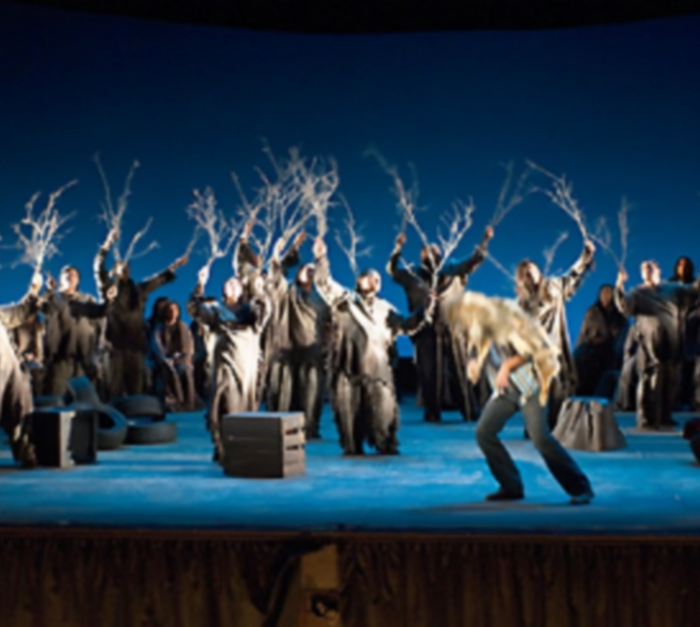
By John Vandevert(Photo: Sakari Viika/Finnish Music Quarterly)
Throughout operatic history, family difficulties are among the most widely utilized themes by composers, with the more recognizable feuds seemingly being children and their (step) mothers. From Pamina and her mother (“Die Zauberflöte”), Hansel, Gretel, and their stepmother (“Hansel and Gretel”), Lucette/Cinderella and her stepmother (“Cendrillon”), and Elektra and her stepmother (“Elektra”), there is something to the relationship which suits opera.
In recent cinematic works like the 2017 film, “The Genius and the Opera Singer,” starring Angelina Jolie, the mother/daughter relationship is explored in a faux documentary approach, where mental illness and uncomfortable truths eventually destroy a once-blossoming relationship. In the contemporary opera world, works like Martin Levy’s “Mourning Becomes Electra” (1967) show the disastrous effects jealousy can have on the dynamic between the mother and daughter. Battling both time and family, the mother wishes to be the daughter.
And while there is a torrent of written articles on bad mothers and misunderstood mothers, projects like Opera Lafayette’s “Opera and the French Revolution” (2016) have tried to transcend the binary all together. However, it cannot be denied that operatic repertoire has not helped in the slightest in engaging with the relationship of the mother and daughter in anything other than generic, eccentric, and wildly anti-intellectual ways. Yes, there are operas like “Jenůfa” where the daughter/stepmother (Jenůfa/Kostelnička) relationship is incredibly complicated, not to mention Azucena and her mother (“Il trovatore”), whose relationship justifies a vicious cycle of revenge.
But what happens when the cycle is broken and the binary gets dismantled and replaced instead with a candid look at the relationship between mother and daughter on the level of individuals no longer operating in the same world, on the same wavelength, in the same headspace? In Finnish composer Sebastian Fagerlund‘s second opera, “Autumn Sonata” (2016-17), this theme is explored. The opera is based on the eponymous film by Swedish director Ingmar Bergman from 1978 which explores the last fringes of a once robust relationship between an internationally-celebrated concert pianist mother and her two daughters, each less cosmopolitan than she is.
A Clash of Worldview and Pursuits
Bergman’s 1978 film foregrounds many dichotomies all at once. From one’s contentment in quiet simplicity vs. pursuit of professional success, individual focus vs. duty-bound service to others, and individuality vs. familial legacy thinking, to expectations vs. realities, the desire for understanding vs. acquiescence to incongruency, and even visible vs. invisible mental illness in a way. Spanning a little over one and a half hours, both the film and the opera feature an incredibly small cast, although the latter features only five and the former features 11.
At the center of the story is Eva and her mother Charlotte, the former inviting the latter to visit their country home, where she lives with her husband Viktor and her disabled sister, Helene, after seven years apart. This proves to be the family’s undoing, however, as the differences between Eva, Helene, and Charlotte, are so great as to be insurmountable as the film demonstrates. In that time, Charlotte has traveled the world as a pianist, pursuing her professional aspirations while simultaneously revolving between husbands on her own terms. Almost the opposite has transpired for Eva. Stuck in a relationship of respect, not love, she is not only bound to a husband but has also lost her son and is responsible for the care of Helene given her mother is out of the picture. Burdened with responsibilities, she’s relinquished her freedom in more ways than one.
This ultimately sets up the film’s main problem, the divergent lives of Eva and Charlotte, the former having little ability to understand the damage she inflicted upon Eva during her childhood and adolescence having been almost entirely absent as a mother. It’s later revealed that she was forced to have an abortion whilst in a relationship with a man she actually loved. The film straddles between Charlotte’s apathetic inability to control her emotions and conceptualize her culpability in the relationship and her desire to rectify the broken relationship, yet as the film’s ending shows, there’s great ambiguity in what the outcome actually was.
There is another batch of themes present throughout the film as well, namely grappling with human mortality, the unassailable linearity of life as a human, and the fact of death. Eva and Charlotte deal with these themes in their own ways, whether by ignoring them completely and choosing to live or living a life where they are all too present, ultimately consuming one’s thinking and becoming life’s purpose.
Charlotte grapples with them by achieving her goals and doing her best to rebel against motherhood and the parental role itself despite her children. Eva embraces the role as quasi-parent of both herself and her sister. Having to sacrifice her life for others, shelving her aspirations for the sake of others, Eva ignores ambition for the sake of being there for others as her mother was not there for her. Yet, the very act of inviting Charlotte home signals that she’s attempting to salvage the relationship but as the film shows, perhaps the obstacles are just too great?
At the center of the film is Frederic Chopin’s piano prelude no. 2 (Op. 28) which is set in a doleful A minor, with its nickname, “prelude to death,” signaling one of the film’s many themes. In the film, Eva sits down to play this but is overtaken by her mother, who plays it more convincingly and emotionally, signaling yet another layered theme, namely the oppressive impact of one-upping. The fact Charlotte feels the need to continuously prove herself to Eva through skill-based actions reflects yet another group of themes, namely personal insecurity, culling of remorse and shame through achievement, and parental narcissism. These themes, combined with the meditations of death, life, and mortality–Eva and Charlotte’s relationship seems doomed.
Conveying The Confliction
Speaking with Pekka Hakko of the Finnish National Opera, Fagerlund stressed that he sought to play with time, going back and forth between the past and present, specifically giving voice to Charlotte’s past lover. But an essential part of “Autumn Sonata” is the focus on the solipsistic tendency of Charlotte, with the chorus being the manifestation of Charlotte’s simultaneous delusions of grandeur and ambiguous inferiority/superiority complex.
As he stated, “Later on…it infiltrates the reality of the parsonage and the other characters, who begin to communicate with the choir, too.” So strong is the chorus, or the voice of Charlotte’s self-affirming complex, that even Eva begins to note only see them but converse with them as well. In this complicated affair between mother and daughter, the opera gives an agentic individuality to Helene who’s caught in the crossfire, involuntarily dependent upon Eva and yet loathed by Charlotte, robbed of a mother and a real life of her own. And yet, as the opera presents, her inner world is richer than anyone else in the family, “the only completely pure and beautiful element of the entire opera.” The question of whether he took a ‘Scandinavian’ approach was not lost on him,
There may be strong emotions, but one also has to dare to keep some distance.
Fagerlund brings to the fore another key theme, fate. He noted that the daughter and mother held noble goals but their eventual alienation from each other was prefigured and unescapable in the end, “In the end, their inability to take the last, crucial step makes change more difficult.” Later, commentators stressed the film’s central theme being about forgiveness despite the devastating impact of miscommunication and misunderstanding, Fagerlund was unambiguous in stating his opera’s core theme. As he stated to Hakko in 2017,
“Höstsonaten – ‘Autumn Sonata’ is about the interaction between human beings, the importance of caring for each other and taking into account other people’s needs and feelings.”
Ultimately, what one takes from “Autumn Sonata” depends on how one views it, hears what it says, and sees themselves represented in the story that unfolds on the stage/screen. While humility, altruism, and empathy seem to be essential components, blindness, deafness, and apathy are also there, lurking just behind the shadows. Despite being family, what Bergman and Fagerlund demonstrate is that this is not enough to assure a relationship. If there is no ability to communicate as equals, then there is no ability to relate to each other. The lifespan of this opera is ultimately unknown given its last performance was in 2019 but hopefully, there’s much more in store.
Watch