Why Lawrence Brownlee’s Russia Cancelation Matters
By David Salazar(Credit: Zakiyah Caldwell Burroughs)
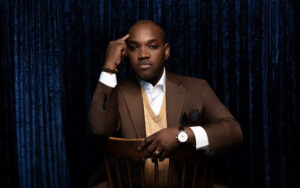
September 8 would have been a day of infamy for tenor Lawrence Brownlee.
The American tenor, who in addition to his immense talents as a singer, has also been a bright light as an activist for promoting Black composers, inclusivity, and his work with civic groups around the opera world, was primed to make one of the most questionable decisions of his career.
OperaWire reported back on August 18 that the tenor was the headliner in a season-opening event at the Zaryadye Hall in Moscow. The Zaryadye Hall is not only state-funded by the Russian regime of President Vladimir Putin, but was among the venues to sign a letter in support of the country’s invasion and “denazification of Ukraine.”
Brownlee’s initial response to OperaWire was questionable at best with the tenor noting that his performance in Russia in no way demonstrated supporting the authoritarian regime and went on to create a false equivalence with doing the same in the United States where arts organizations, rather than being state funded as they are Russia, are very much under attack by the current administration as it guts the resources of the National Endowment of the Arts. While singing in a state-funded venue in Russia is essentially taking money from Putin’s regime, performing at a theater in the U.S. would actually support it in its attempts to overcome what is fast-becoming one of the most challenging landscapes for art overall in the country.
Thankfully, the tenor reconsidered his stance and decided to withdraw from the event. And it seems that his withdrawal toppled the entire enterprise with the event outright canceled, per the Zaryadye Hall’s own website (see below). It isn’t even listed on the website’s schedule.
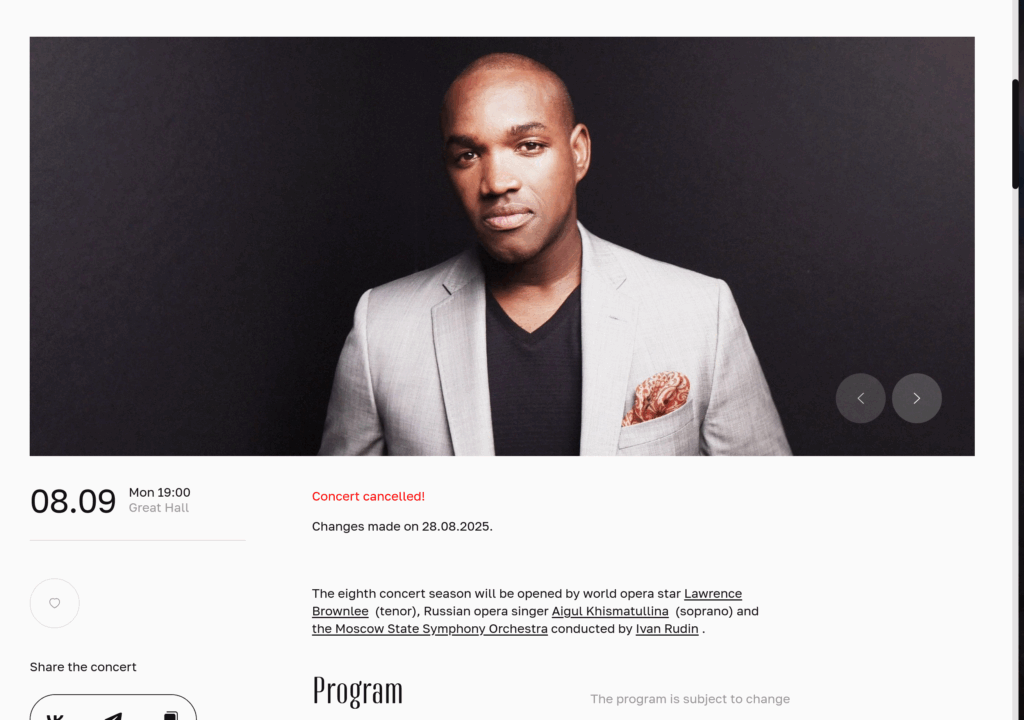
The fact that the event couldn’t go on without him, even when Russia is teeming with local tenors and other artists willing to jump in without any worry about the consequences to their European or New York careers, should not be lost on anyone. Cancelations by individual artists are common in the opera world. But it’s rare to see a singer drop out of a performance and for the entire event to simply get shut down RIGHT AWAY. The obvious question that comes to mind is – Why?
Brownlee was poised to be the first major American star headed to Russia since the country invaded Ukraine. His appearance there would have served the regime as a means of broadcasting its welcoming nature as Putin continues his attempts to clean up his image worldwide. Other prominent European artists, such as Vittorio Grigolo, Ambrosio Maestri, and Ferruccio Furlanetto have already accepted their invitations, but to this point, no American opera singer in the prime of their career or renown had made an appearance. Brownlee would have been a major coup for the propaganda machine. After all, why would an American need to go to Russia? The answer – because Russia is willing to pay for it.
At that juncture, Brownlee’s appearance would establish that anyone can be bought because Russia, which is profiting heavily off its slaughter of Ukrainians, has the power and the financial muscle to make it happen. And that brings us to the precedent this would set. If the tenor, scheduled for two Met Opera productions, did his concert and then went to the Met, where its General Manager has repeatedly spoken out against Russia but acted in ways that can best be described as mixed messaging, without repercussions, what would it have signaled to other American artists looking for jobs in an industry where money is increasingly tight? Would they have seen that action as the overture to a Russian return and the big payday that would signal? And what would it then mean to see dozens of high-profile American artists taking state-funded stages in Russia? Would other European artists follow as well? And if all of these artists are suddenly willing to take blood money, does opera, the bastion of artistic unity and human empathy, even matter anymore when its main ambassadors have no moral compass?
Thankfully, that’s no longer even a conversation to consider as Brownlee’s decision and the concert’s capitulation slams that door shut, hopefully until Russia returns the land it has stolen from Ukraine.
Also important in all this is what Brownlee said in his statement regarding the cancelation.
“To all my fans, friends, and supporters: I have chosen to withdraw from the upcoming performance at Zaryadye Hall in Russia. Thank you to those of you who have voiced your thoughts on the situation – I have taken time to listen to your reactions, and I hear you.”
In a world where leaders and role models can seemingly double down on morally dubious decisions without care for anyone else’s opinions, Brownlee’s statement shows a willingness to listen and reflect, something that has been a benchmark of Brownlee’s activism in recent years. The tenor could have canceled and said it was for “personal reasons” and called it a day. But he decided to express openly his reflection after listening to the reaction of his community.
One can debate why the tenor and his management ever thought it was a good idea in the first place, but the fact that he took the conversation around his participation seriously and put his community first speaks volumes. Others should take note.
Categories
Special Features