Wexford Festival Opera 2025-26 Review: Der Zwerg
Chris Moran’s Staging Rescues Compromised Musical Performance
By Alan Neilson(Photo: Padraig Grant)
As well as its featured operas, the Wexford Opera Festival also puts on an array of other events, including performances of its “pocket operas,” that is, short works or abridged versions of larger works, sung to a piano accompaniment, presented in the smaller Jerome Hynes Theatre, rather than on the theatre’s main stage.
One of the “pocket operas” on offer at this year’s festival was a production of Alexander Zemlinsky’s one-act work “Der Zwerg” that premiered in Cologne in 1922, but which, after a brief period of success, fell into a period of neglect. It then had to wait until 1996 for a further fully staged production, since which time it has received only the occasional performance.
Based on Oscar Wilde’s fairytale, “The Birthday of the Infanta,” adapted for a libretto by Georg C. Kalman, the story is an emotionally pained tale of vicious cruelty that can leave an audience drained. The Spanish Infanta is excited by the preparations being made for her birthday party and by the gifts that she will receive. However, it is the gift of the titular Zwerg (“dwarf” but in this review we will refer to him as little person, since he has no name in the opera) from the Sultan that attracts her attention, whom she views as a figure of fun, to be mocked and ridiculed. The little person, being a happy-go-lucky, naive fellow, however, takes no offense and joins in with the party atmosphere and quickly falls in love with the Infanta, who at one point sends everyone away so she can be alone with the little person and even presents him with a white rose. Later, as he muses on his good fortune, he glances into a mirror and for the first time in his life sees himself as he appears to others. Shocked and horrified, he collapses into a state of desperation and despair, and when the Infanta returns to play with him, he falls dead in front of her, much to the contempt of the court. The Infanta, unperturbed, dances off, hoping that next year, she will receive a toy without a heart.
The Musical Balance Compromised by Overly Loud Tenor
There are only two main roles, namely the Little Person and the Infanta. The other characters have relatively small parts, meaning that the success of any production depends largely on the quality of the two principal singers, particularly the tenor cast as the Little Person. For this production the role fell to Charne Rochford, who boasts a growing reputation as one of Britain’s most prominent young heldentenors with a raft of Wagner roles already under his belt, including Siegfried in both “Siegfried” and “Götterdämmerung” at the Longborough Festival.
Unfortunately, he misjudged the size of the venue and possibly even the strength of his own voice. While he may sound good in a large hall with an orchestra, that was not the case in the restricted confines of the Jerome Hynes Theatre with only a piano as accompaniment. His voice was ear-splittingly loud, which made it very difficult to engage with his character. It was so overwhelming that it was almost impossible to hear any nuance in his singing and the musical balance with the other singers and the piano was unfortunate. He appeared to make no attempt to adapt his voice to the conditions, and it made for an unpleasant experience. It was ultimately impossible to move beyond the sheer volume of his voice in this instance.
Soprano Eleri Gwilym playing the beautiful Infanta Donna Clara arrived on the set with her face covered by a fan, which she fluttered gently. When she pulled the fan away, it unexpectedly revealed her to be uncommonly ugly, which she supported with a compelling characterization that reflected her immature and vicious demeanor. She was selfish, easily bored, childlike and treated everyone with a dismissive contempt and clearly communicated her feelings of disgust for the little person. It was an excellent acting performance! However, it would be inaccurate to say that Gwilym’s singing was particularly attractive; rather, she chose to opt for an expressive reading that played up the Infanta’s unpleasant personality, which was reinforced by the role’s high tessitura that added to the impression of the Infanta’s instability.
Soprano Charlotte Baker produced a sympathetic reading in her role as Ghita, the Infanta’s attendant. She successfully communicated a maternal interest in the little person through her expressive and sensitive moulding of the vocal line.
Baritone Ross Cumming played the role of the Infanta’s fawning chamberlain, Don Estoban, who was always at her beck and call. He possesses a pleasing, resonant and expressive voice, which he used successfully to develop his character; his grotesque parody of the little person, which he acted out to entertain the court was cleverly executed to reveal his own shallow nature.
The three maids, who acted and sang as a group, were played by mezzo-soprano Erin Fflur and sopranos Victoria Harley and Olivia Carrell. All engaged with their parts enthusiastically and sang well. Likewise, the four friends of the Infanta, essayed by soprano Cerys MacAllister and mezzo-sopranos Heather Sammon, Eleanor O’Driscoll and Camilla Seale, acted in tandem and produced animated, energetic readings.
Pianist Christopher Knopp created the perfect musical backdrop, capturing the energy and movement of the drama as well as its emotional tensions with a clear, lively and precise interpretation. For most of the performance, he was able to create a pleasing balance with the singers, but unfortunately this was not always the case given the overly loud volume of the tenor.
Chris Moran Oversees a Convincing Staging
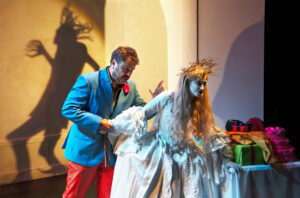
The director, Chris Moran, and the set and costume designer, Lisa Krügel, working with a relatively low budget, did an excellent job in bringing “Der Zwerg” to the stage. Together, they produced a clear telling of the narrative that ensured that it was easy to follow and to engage with the little person’s plight. The Infanta and her court were presented as grotesque in contrast to the open, wide-eyed and good-natured character of the little person. Their costumes and makeup could best be described as ghoulish; their faces were painted white with black lipstick and black eye coloring, and their costumes had a 17th century Spanish-cum-gothic look about them, while the little person was dressed in modern, unfashionable, bold-colored clothing that drew attention to his unselfconscious naivety. Thus, it was the little person who was attractive, not the Infanta or the court, who appeared as self-indulgent, immature and grotesque.
The single set was very simple, consisting for the most part of an open space with arches across the back of the stage, above which a screen was occasionally unveiled, displaying significant texts as if from a silent movie in order to fill out the narrative. There was a throne on a small dais, which was used to reinforce the status of the Infanta, and a couple of tables with a few birthday gifts. There were a few minor changes along the way, but the basic set remained throughout, successfully allowing for the fast movements of the cast, as well as acting as a framing device for its more static moments.
Moran’s handling and positioning of the cast was imaginative and insightful. Everything was done to socially isolate the little person from the court even while he was standing next to them. Often the friends and maids would gather in a huddle behind the Infanta to bolster her position. There were also occasional insertions of comedy, such as having the maids riding around on broomsticks like the witches they resembled. The birthday scene was childish, which was both amusing and indicative of the court’s cruel mentality, and their pointed party hats reminded one of the Inquisition. There was never a dull moment!
The narrative was well-presented with its underlying message about what constitutes beauty and ugliness clearly conveyed, and surprisingly, given Rochford’s immoderate singing, there was still much to enjoy on the musical side.