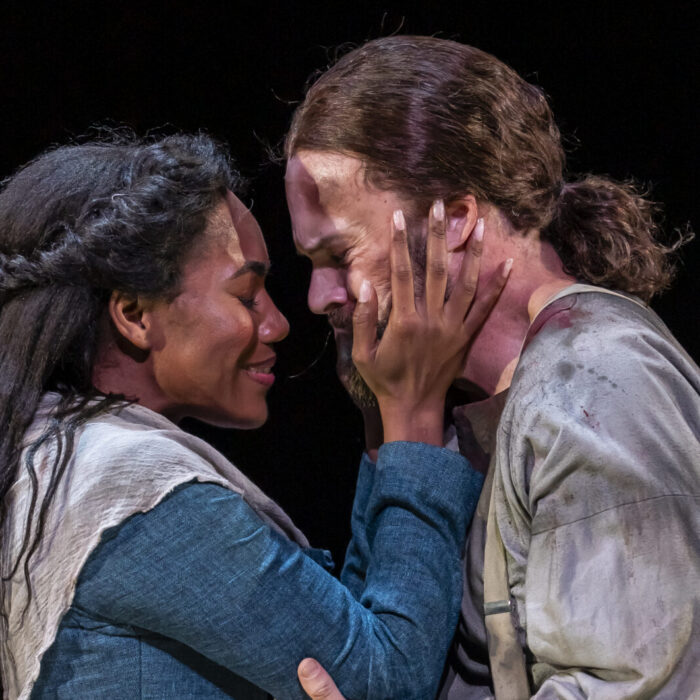
Virginia Opera 2025-26 Review: Aida
By Sabrina Matthews
Those accustomed to the grandeur of larger houses like the Metropolitan Opera might approach a performance at the Virginia Opera with moderated expectations, but the company proves such caution unnecessary. While the scale may be smaller and simpler, Virginia Opera consistently delivers excellent vocal talents and imaginative stagings that make the most of their admittedly limited budget. This season’s production of Giuseppe Verdi’s “Aida” is no exception.
The production had recently been announced as a planned opera in concert, which seemed particularly likely after the withdrawal of the NEA grant that was earmarked to support the 2024-25 season world premiere of their brilliant commissioned work, “Loving V. Virginia.” Happily, the company was able to raise enough money for a staged production. With the agreement and commitment of the artists, “Aida” came together in less than two weeks of rehearsal, or a grand total of 240 hours, give or take the time people may or may not have taken to sleep. The carefully embroidered characters each singer brings utterly bely the short rehearsal time they shared, and their coordinated performances far exceed what one might expect from a longer time frame.
If Virginia Opera is the little engine that could, then Artistic Director Adam Turner is the engineer as well as the (Chief) Conductor. Turner’s artistic compass is eternally set to the Virginia Opera motto, “Where voice rules.” He doesn’t just put their money where their mouths are, he knows which mouths to bet on. VA Opera alumni Indira Mahajan, Jonathan Burton, Grant Youngblood, and Ricardo Lugo are joined by two company debuts as the Egyptian royal family: Sergio Martinez as the king, and Deborah Nansteel as Amneris. Smaller singing roles are filled admirably by two of this year’s Herndon Foundation Emerging Artists, Maggie Kinabrew and Daniel Esteban Lugo. The orchestra is provided by the Richmond Symphony, whose highly skilled members have no problem bringing a definitive and rousing performance of the score.
Production & Musical Highlights
The performing arts world’s most stunning paean to Stockholm Syndrome (apologies to Álex Pina and Esther Acebo), “Aida” is the story of an Ethiopian princess, Aida, who is enslaved to an Egyptian princess, Amneris. Both are in love with the Egyptian Captain of the Guard, Radames; Radames returns Aida’s love while spurning Amneris’ advances. As Egypt and Ethiopia tear each other apart on nearby battlefields, Amneris, Aida, and Radames burn it down within the Egyptian palace through a variety of calculated, incidental, and just plain stupid decisions. The tension and interactions between these characters, who are simultaneously remote and relatable, are set to a blistering score that ranges from the fiercely immense to the mortally intimate.
The opera opens with the high priest Ramfis, played by Ricardo Lugo. As was so in his recent performance of the Commendatore in Virginia Opera’s vibrant, light staging of “Don Giovanni,” Lugo’s mighty bass commands attention and obedience. Let fools beware his strong and clear voice, silencing those who might chat at the back of the temple. The role seemed to do double duty, silencing audience members who might have dared whisper over the overture.
Sergio Martinez as the King of Egypt was equal parts charming and supreme, a ruler clearly used to getting his way through one capacity or the other. If one thing is true of great opera, it is that, when properly cast and executed, everything one needs to know is right there in the score. One need listen no further than the authoritative basso of both Martinez and Lugo to know that Egypt is mighty indeed if its leaders are any indication. It almost makes one wish that Aida and Amneris preferred gentlemen with lower voices: since Ghislanzoni contends the men of northeastern Africa have to chase down every thought that crosses their minds, at least there are enough basses to go around. That version of “Aida” would be a comedy of errors, though, robbing us of the sweet sadness of Act four. But let’s not get ahead of ourselves.
It has been remarked that Verdi was tempted to call the opera “Amneris.” Whether fact or operatic folklore, it pays homage to the reality that the talents of the two leading women must be balanced; Indira Mahajan as Aida and Deborah Nansteel as Amneris made a fine matchup. Mahajan’s top-notes were particularly pure, and the thoughtful, pleading “mai più,” of her lower register in “O patria mia,” did not fail to break hearts. She shone brightest in ensemble moments, however, ringing easily above the crowd of male voices surrounding her in “Su! del Nilo al sacro lido” to accentuate Aida’s beauty and isolation. Opposite Nansteel in “Fu la sorte dell’armi a’ tuoi funesta,” she brought her textured range to bear, swinging easily through all of the emotional extremes demanded while she was being misled, confused, and just generally worked by her petulant mistress.
Aida is a casualty of fate, and the audience is bound to root for her, but Amneris is offered the greater character arc. If the mezzo-soprano is prepared to take the trip, one shares the mythic temptation to call the opera “Amneris.” Deborah Nansteel was just such a mezzo. Fresh off her Met role as confounded but supportive mother to Nadine Sierra’s Sonnambula, Nansteel commited to portraying all the fiery rage and harsh clarity Amneris experiences, plus the emotions in between. Nansteel’s powerful voice easily filled Norfolk’s Harrison Opera House, and her rich tones were shaded to express the nuance of the princess’s shifting emotions. Nansteel’s Amneris was as prepared to own her complicity as to relish her wealth and power.
Illuminating Cast
But what of the apex of this love triangle? Radames is a bewildering character, and Jonathan Burton embraced this fearlessly. The tenor has ample power and precision to play Radames as a straight-up hero, but leaned into the duality of the character. In a pre-show announcement on opening night, Adam Turner begged the audience’s indulgence on behalf of Burton, who performed while “under the weather.” He did appear a bit short of breath, specifically under the early demand of “Celeste Aida,” but rather than struggling against his vocal constraints, he measured his voice to place emphasis on words of the opening aria which are not always highlighted. Leaning into the storytelling allowed Burton to draw attention to Radames’ deep, internal love for Aida even as the text expresses bold descriptions of the regal and divine. Rather than burning out to get through his “big number,” Burton paced himself to last, perhaps even improve, over his opening night performance. By the second performance of the Norfolk run, no indulgence was sought—or required—on the tenor’s behalf.
More than anything else, this Captain of the Guard wants to be Egypt’s general and reside in bliss with Aida. Once he achieves the first ambition, employing arguably the most simplistic dude-bro logic imaginable, the now-general embraces the job of eradicating Aida’s people while believing wholeheartedly that doing so successfully will win him the right to live happily with her. (Aida, for her part, seems about as in touch with this as Stockholm symptoms would dictate, finding herself horrified after she wishes Radames luck as he heads off to war against her fellow Ethiopians while longing for his safe return. There is a lot of pretzel logic with this couple, but they make it work.) When Radames does return victorious with Ethiopian prisoners in tow, the king of Egypt offers his new general any wish. Rather than requesting Aida’s freedom and hand in marriage, he asks for all the Ethiopian prisoners to be free. A more gracious option, to be sure, but now he’s captured or killed as many Ethiopians as he could and then freed the survivors.
When the king decrees Radames will marry Amneris (who is over the moon about this) Radames has other plans, which come to naught—frankly just as well, because, once again, he plans to kill or capture a bunch of Aida’s people as a way to leverage the king’s gratitude to marry her. In one of the production’s highlights, Radames spends the majority of a duet mansplaining this brilliant plan to Aida while she tries to tell him it is just not gonna work, and that the only way they can be together is to flee. “Fuggiam gli ardori inospiti” was the finest moment between Burton and Mahajan. Compositionally it is the best duet Verdi affords the would-be lovers, while in terms of character, it offers the audience a glimpse of what their life together might be like. True, they adore each other, and Aida is necessarily patient, but for a man of duality, Radames can have a one-track mind. When she finally blurts out that killing the Ethiopians will mean killing her (and her father), a light goes off for Radames, and he suddenly agrees that they should flee. This moment of insight was played brilliantly by Burton, such that his sudden change in attitude paid off as a well deserved laugh line.
The joy is short lived, however, because Radames’ epiphany leads to his own doom. Aida’s father, Amonasro, played by Grant Youngblood, is eavesdropping on their conversation. When he overhears a strategic secret he needs for the Ethiopian army to persevere against the Egyptians, he pops out of hiding on a gust of pride. Youngblood’s hearty baritone made it easy to believe he was a leader on par with Egypt’s, but it was his intimate moments with Aida that dominated his portrayal of the Ethiopian king. The two bend their heads together with a familiar grace, evincing a lifelong habit of confidences shared between a ruling father and daughter. It is these moments of the production that remind us most effectively that Aida is also royalty, and no stranger to a secret plot. Youngblood’s Amonasro clearly loved his daughter, and while he was not above manipulation (reminiscent of the composer’s Germont), one got the impression that he conspired out of love for his own people.
One of the many testaments to Verdi’s genius was his ability to end an opera with such aching sweetness that it breaks your heart even as you crave to watch the whole story over again — even if you can’t change the outcome. Mahajan, Burton, and Nansteel took full advantage of these final moments. Nansteel’s ultimate heartbreak came as she numbered herself among the vile hypocrites that send the doomed pair to die. Finally, Mahajan’s voice lifts Aida and Radames to heaven as she bids farewell to earth’s vale of tears in “O terra, addio” while Nansteel voices a profound call for peace for Radames and, one senses, for Aida as well.
More Production Details
VA Opera tends to present operas that have a small number of demanding roles, and often require little or no chorus. Last season’s “Loving V. Virginia” or this past winter’s triumphant “Intelligence” fall right into the company’s sweet spot. Happily, the scale of “Aida” is in no means beyond their grasp. The production featured a robust chorus that delivered the wall of sound required for “Guerra! Guerra,” to ring true as the “tremendous, pitiless war,” the men call for. The women’s chorus was well balanced from opening night, while the men of the chorus clearly embraced their vertical learning curve: by the second performance, they delivered the softer motet of the priests nearly as well as the raucous anthems of the army.
With the financial and temporal constraints already mentioned, the production relies heavily on costumes, projections, and the acting skills of the ensemble to complete the visual components. Set pieces and props are limited to the necessary: a throne for the king, a seat, pillows, and baskets of flower petals for Amneris and her entourage, staffs for the priests and swords for the soldiers. Under the direction of Joachim Schamberger, bits of business and thoughtful touches from the leads and chorus help to establish each scene. Members of Amneris’ entourage work together at small tasks as if they had done them together for years, smiling quietly with their heads close, gossiping silently. Soldiers are constantly attentive to what goes on around them, and reactive to what they see. Such measures of acting are not universally present in opera, and they go a long way toward creating a credible backdrop for a story.
Set and projections are also by Joachim Schamberger, and these are very effective when working to support the mood of the scenes. During the opening scene, flat panels play host to projected statues of pharaohs who lurked darkly and ominously over the priests as they choose the new leader of the Egyptian forces. Amneris’ chambers are projected on a downstage scrim, a high-ceilinged affair with tall marble columns suggesting she lives most of her life in rooms that are light, airy, and spotlessly clean. For Act three, which takes place by the Nile, a constantly flowing river covers the backdrop as a full moon drifts upwards at a gentle angle, its light disappearing behind a column just in time for all hope to be lost. Between-act hieroglyphics are enjoyable and keep the theme front of mind as the audience mingles. Schamberger’s projections are slightly less successful when tasked with carrying the lion’s share of the visual narrative, such as during the return of Radames and his conquering army in Act two. Happily, Adam Turner conducts the Richmond Symphony in a thriving rendition of the entire score, so those who thought they might be treated to an eight minute animation of ancient military exercise can relax into enjoying Verdi’s triumphal piece.
The lighting design is subtle, allowing the projections to add texture to the performers as they move in front of them, but adding sufficient light that they do not become walking movie screens. Relying on many of the features of a dance plot, side lighting offers illumination and enhances the dimension and distance between downstage performers. Costumes are simple but versatile. The women’s chorus, most of whom are counted among members of Amneris’ entourage, wear robes of deep red and orange that echo some of the richer colors of the desert. Priests are dressed in uniform white robes with black sashes and headdresses, except for Ramphis, who sports a striking gilding on his bald head. Soldiers are lightly armed and dressed as if ready for action. Aida’s aquamarine gown stands out from Egyptian garb as do the deep blues of Amonasro’s tunic and that of his fellow Ethiopians, as if their clothes are dyed as the cool valleys and green fields of Aida’s memories of home. Amneris’ gown is by far the most resplendent, and takes on a life of its own. A gold dress and shawl covered with small reflective pieces is lit gently enough that it does not blind the audiences, and when she is close to the projection screen, ambient sparks give the impression that she is surrounded by a cloud of capricious golden fairies. The significance of this fairy cloud changes depending on how one might feel about Amneris at any given moment. Sometimes it is the golden aura of a beneficent royal, sometimes the ostentatious showiness of a spoiled grump. It is a constant reminder of her power and her place at the center of Egypt’s attention, which, ironically she uses somewhat carelessly and to her own detriment (as well as that of Aida and Radames). As Nansteel sang the final, beautiful, heartrending word of the opera, her costume meshed perfectly with the projections as her gold sparks dissolved among celestial lights to become just so many stars, while Verdi’s music lifted the doomed romantic pair above their earthly fate.