Wiener Staatsoper 2025-26 Review: Il Trittico
By Ossama el Naggar(Photo: © Wiener Staatsoper / Michael Pöhn)
The Wiener Staatsoper’s “Il Trittico” (seen June 21) was a frustrating experience due to the disparity between the excellent singers and the mediocrity of the staging. “Il Trittico” is one of Puccini’s best works both musically and dramatically. Tatjana Gürbaca’s production does not present Puccini’s three one-act operas as a sampler of contrasting styles–one slice of verismo noir, one serving of devotional melodrama, one comic dessert–but as a single theatrical argument about damaged intimacy, social cruelty and appetite in all its forms. The result is a staging of unusual seriousness and unusual consistency, one that often illuminates the internal links between “Il tabarro,” “Suor Angelica” and “Gianni Schicchi” with considerable force, even if it sometimes does so at the expense of the lush theatrical atmosphere audiences instinctively associate with Puccini.
Production Details
The central idea is clear from the outset. Gürbaca is not interested in local color for its own sake, which is a real pity as Puccini has so well depicted the ambiance of each opera. The Paris barge of “Il tabarro,” the convent garden of “Suor Angelica” and the bustling Florentine household of “Gianni Schicchi” are not treated as lovingly recreated environments but as psychological and moral spaces. Henrik Ahr’s sets and Silke Willrett’s costumes work in tandem with this approach, reducing literal realism in favor of a visual language of exposure, estrangement and stylization. Rather than offering three separate worlds, the production gives us variations on enclosure: people trapped in marriages, institutions, families and systems of desire from which there is no dignified escape.
(Photo: © Wiener Staatsoper / Michael Pöhn)
Il tabarro
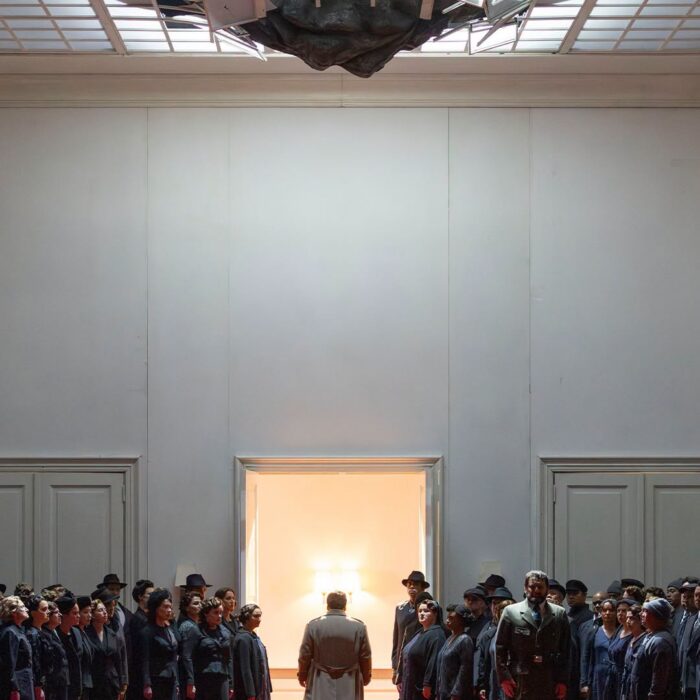
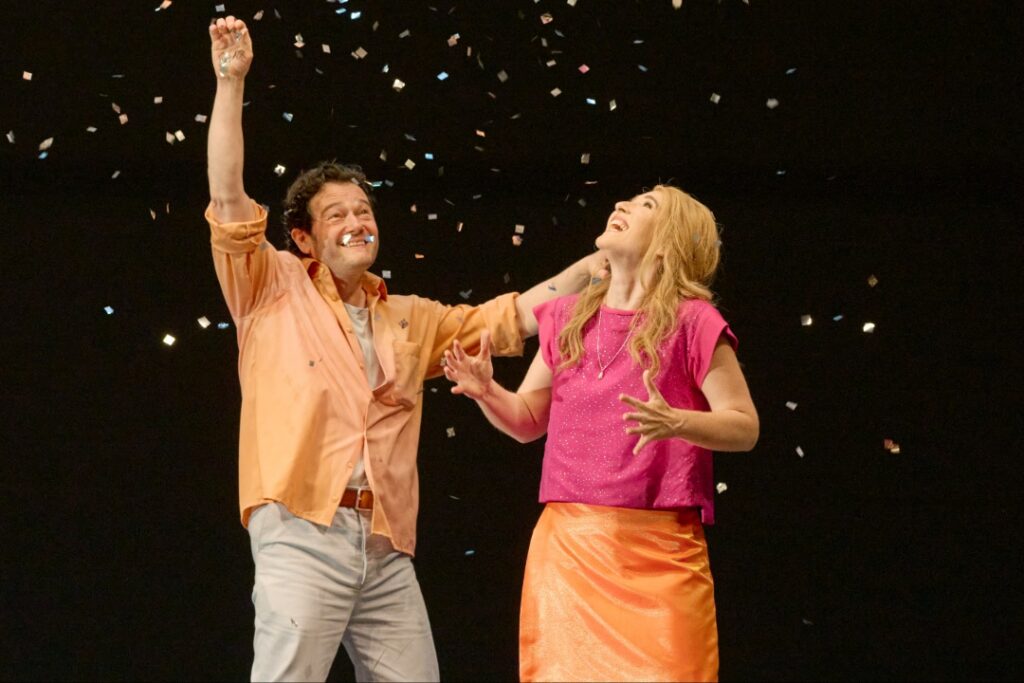
That aesthetic serves “Il tabarro” particularly well. Puccini’s opening opera can easily sink into picturesque verismo, all fog, dockworkers and overheated adultery. Gürbaca strips away the anecdotal clutter and directs attention to the true subject of the piece: a marriage hollowed out by grief and turned poisonous by suspicion. The staging emphasizes emptiness rather than bustle, emotional paralysis rather than street life. Michele, Giorgetta and Luigi are not part of a broad social canvas so much as inmates of a pressure chamber, and that concentration sharpens the opera’s fatalism. The very lack of decorative realism becomes expressive. This is not Paris as lived-in environment but Paris as dead emotional weather. In consequence, an air of generalized depression permeates and puts members of the audience in a bad mood.
The danger with such an approach is that “Il tabarro” also depends on texture: on the sense of a wider world humming around the protagonists, against which their misery becomes all the more suffocating. Gürbaca occasionally pares the piece down so insistently that some of the score’s rough social grain is lost. But the gain in psychological focus is substantial. Michele’s jealousy, Giorgetta’s desperation and Luigi’s reckless ardor all register as symptoms of a larger condition: lives narrowed to the point where violence begins to seem less like an aberration than the final logical consequence of emotional confinement. This may suit an opera such as Berg’s “Wozzeck,” but is rather extreme for Puccini.
Nicole Car, took the formidable assignment of singing Giorgetta, Suor Angelica and Lauretta in a single evening, and proved the indispensable centre of gravity. As Giorgetta she brought a warmth of tone that saved the character from mere generic dissatisfaction. There was no attempt to turn her into a hard verismo heroine; instead Car let her voice bloom into the line, finding in Giorgetta’s music not only erotic hunger but a deeper fatigue with the life that trapped her. She phrased intelligently and with enough restraint to avoid the usual trap of making Giorgetta simply “the adulterous wife.” What emerged instead was a woman whose longing soured into recklessness, and gave the part a degree of inwardness it does not always receive.
Arturo Chacón-Cruz as Luigi supplied the necessary voltage opposite her. His voice may not have the most brutal metal one could imagine in the role, but there is a communicative urgency to his singing that suits Gürbaca’s more concentrated conception of the opera. Luigi must feel like an eruption into Giorgetta’s suffocated world, and Chacón-Cruz achieved that less through sheer size than through ardor and immediacy. If the role can sometimes come across as a stock verismo tenor part, here it was a genuine dramatic catalyst.
Ambrogio Maestri’s Michele was more complicated. He brought immense authority to the role, and there were moments when the sheer scale of the voice and the heaviness of his physical presence gave the character exactly the oppressive gravity the drama requires. Yet Michele is not only a wounded husband; he is a man whose grief has curdled into watchfulness, and the role ideally needs more inward shading than Maestri provided. At times, the performance risked becoming a little too monolithic, too dependent on mass rather than nuance. Even so, the final scene landed with grim force, and one was left in no doubt of Michele’s tragic weight.
(Photo: © Wiener Staatsoper / Michael Pöhn)
Suor Angelica
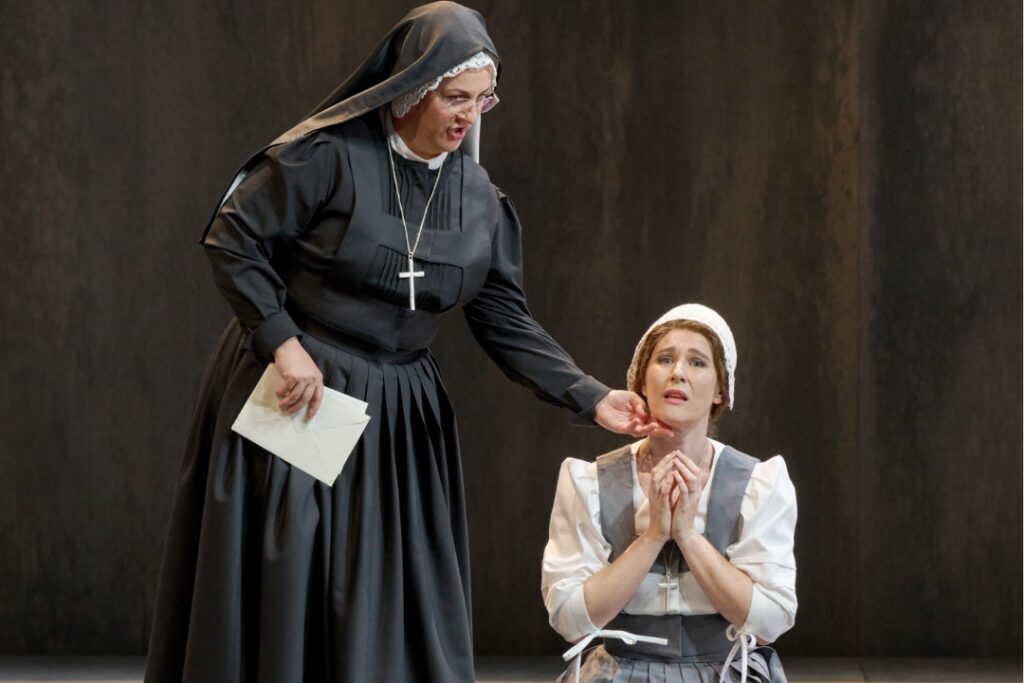
If “Il tabarro” emerged as an anti-picturesque chamber tragedy, “Suor Angelica” became the evening’s emotional and moral heart. Gürbaca’s reading refuses to sentimentalize the convent, as if none of these nuns felt any piety or serenity. Such a harsh un-Christian view of the convent almost guarantees a weak staging of “Suor Angelica.” This is no oasis of spiritual consolation. Instead it is presented as a place of discipline, repression and carefully regulated identity, a social mechanism that has absorbed Angelica’s punishment and made it into routine. The production’s visual language repeatedly stresses isolation rather than communal devotion; the effect is to recast the opera less as a tale of private grief than as a study in institutional erasure. Angelica is not simply mourning her child. She is a woman from whom almost every social and personal identity has been stripped away, and the arrival of the Princess becomes the moment when that erasure is sealed.
Car‘s Angelica is not a creature of generalized saintliness, nor does she indulge in easy sobbing pathos. Instead she builds the performance with patience, allowing the voice to remain inward and contained until the emotional ground suddenly gives way beneath it. What is impressive is not merely the beauty of the singing, though the tone retains its plush lyric warmth, but the control of the dramatic arc. Car understands that Angelica cannot peak too early; she must seem to live in a state of disciplined emotional suspension until the Princess’s revelation makes that discipline impossible to sustain. When the break comes, it is all the more devastating for having been so carefully prepared.
Car’s “Senza mamma” was moving precisely because it was not milked. She resisted the temptation to turn the aria into a detachable set piece. Instead it felt like the point at which language itself became barely adequate to contain grief. The line remained poised, the legato unforced, but beneath the surface one heard the collapse of a woman who was trying for years to survive on memory alone. In this overly cold production, Car’s Angelica provided the necessary core of human vulnerability. Without her, the severe staging would collapse; with her, it acquired emotional consequence.
(Photo: © Wiener Staatsoper / Michael Pöhn)
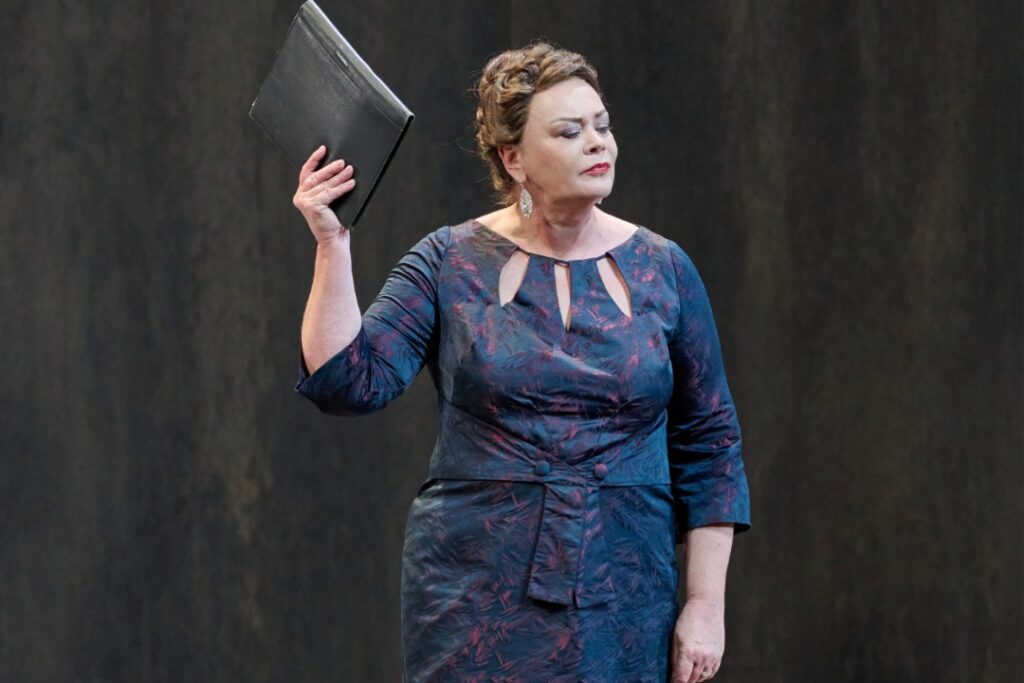
Violeta Urmana’s Zia Principessa was one of the evening’s greatest assets. Too often the Princess is played as a straightforward villain, but Urmana performed it from within an absolute conviction of social rightness. She did not sneer or over-color the cruelty. Instead she let her voice’s dark authority and aristocratic steadiness do the work. The scene became terrifying because the Princess never appeared to think of herself as cruel at all. She simply administered the logic of class, family and punishment with pitiless calm. Such an approach is fine and even laudable, but things seriously got out of control with Gürbaca rewriting the plot. In an obvious indication of the stage director’s antipathy for the upper class, the Princess is a true monster who had falsely informed Angelica of her child’s death two years before to break her so that she would sign the required documents, something she would have done happily as the beneficiary is her younger sister. In Gürbaca’s rewrite, the Princess returns with Angelica’s son after she had lost all hope and drank poison. Thus, there is no miracle with the appearance of the Virgin Mary with her dead son as a sign of God’s forgiveness. Instead, Angelica committed mortal sin for nothing. It does not get any bleaker.
(Photo: © Wiener Staatsoper / Michael Pöhn)
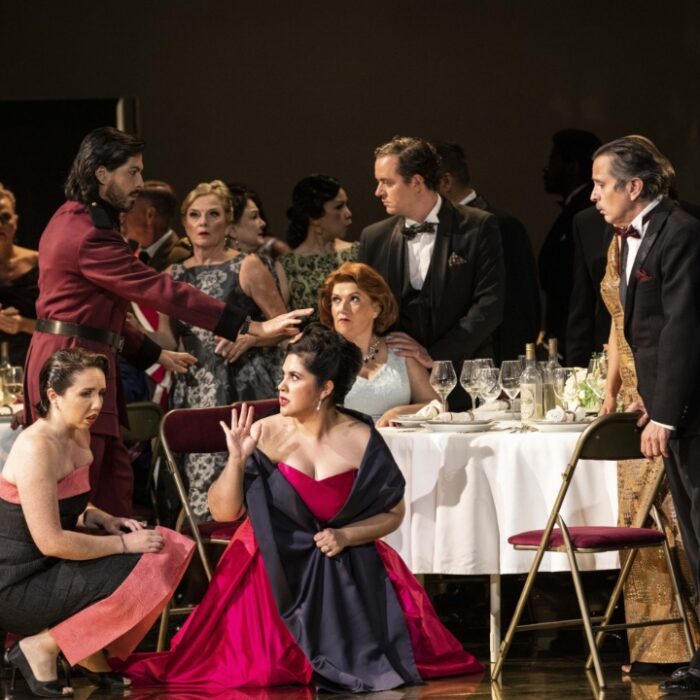
Gianni Schicchi
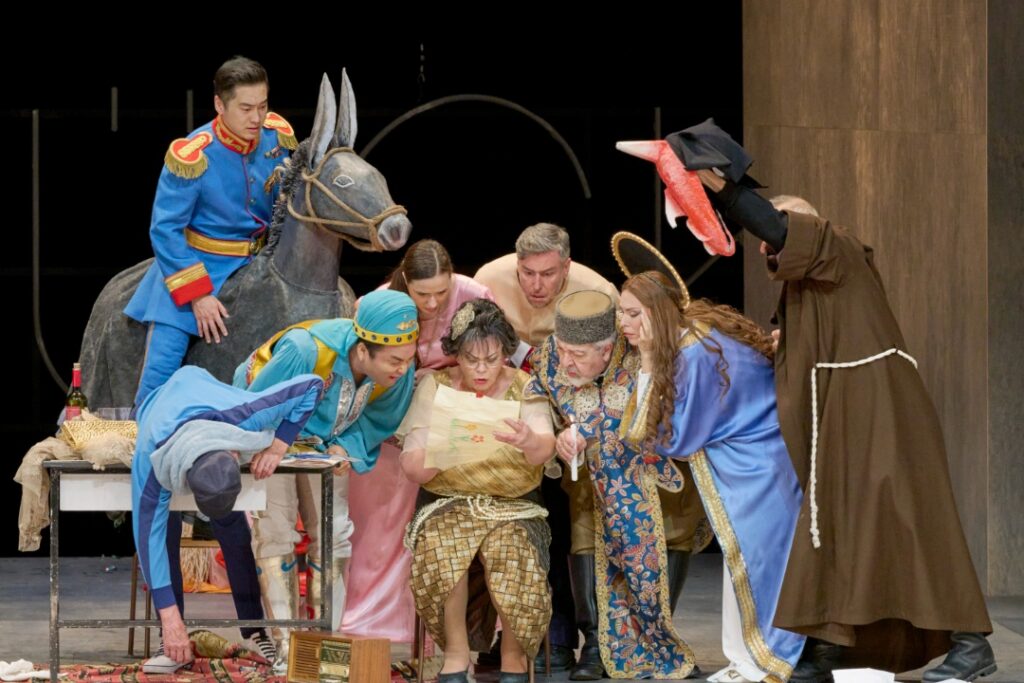
After the intensity of “Suor Angelica,” “Gianni Schicchi” arrived not as comic relief in any cozy sense, but as the final and most grotesque expression of the evening’s view of human appetite. Gürbaca is clearly not interested in genial Florentine farce. The Donati household is a nest of predators, and the visual style becomes more exaggerated, more grotesque, almost carnivalesque in its distortions. The point is well taken: “Gianni Schicchi” is a vicious comedy about greed and opportunism, and too many productions smooth away its acidity in favor of easy charm. Here the family’s vulgarity is thrust directly into the foreground.
Whether the staging entirely finds the right comic rhythm is another matter. “Gianni Schicchi” is the most mechanically precise of the three operas, and it needs pace, snap and the sense that every movement of the ensemble is locked into Puccini’s timing. Gürbaca’s hyper-characterized approach is often funny, and certainly never bland, but there are moments when one feels the production leaning so hard into grotesquerie that the farce loses its buoyancy. The comedy becomes a touch effortful where it should feel mercilessly light on its feet.
That said, Maestri was in much surer territory here than he was as Michele. As Schicchi, he dominated the stage with exactly the combination of vocal amplitude, theatrical cunning and amused authority the role needs. He knew how to command ensemble scenes without bulldozing them, and he relished the part’s manipulative intelligence. Importantly, he did not try to make Schicchi lovable. This was not a rogue with a heart of gold but a highly intelligent operator who recognizes greed when he sees it and simply outplays everyone else in the room. Maestri’s comic instincts remained formidable, and the evening came fully alive whenever he took control of the dramatic machinery.
Kang Wang was a fresh-toned and sympathetic Rinuccio, who brought a welcomed lyrical lift to a role that often functions as little more than tenor upholstery. His “Firenze è come un albero fiorito” was performed with open, ringing enthusiasm and gave the opera a needed shaft of youthful energy amid the surrounding moral squalor.
Car, returning for Lauretta after the emotional demands of the first two operas, sensibly refused to over-inflate her role. Car’s “O mio babbino caro” was tender and neatly shaped, integrated into the scene rather than floated out as a gala interruption. In the context of this production, Lauretta was less a sentimental ingénue than one more participant in a world where affection and self-interest were never entirely separable.
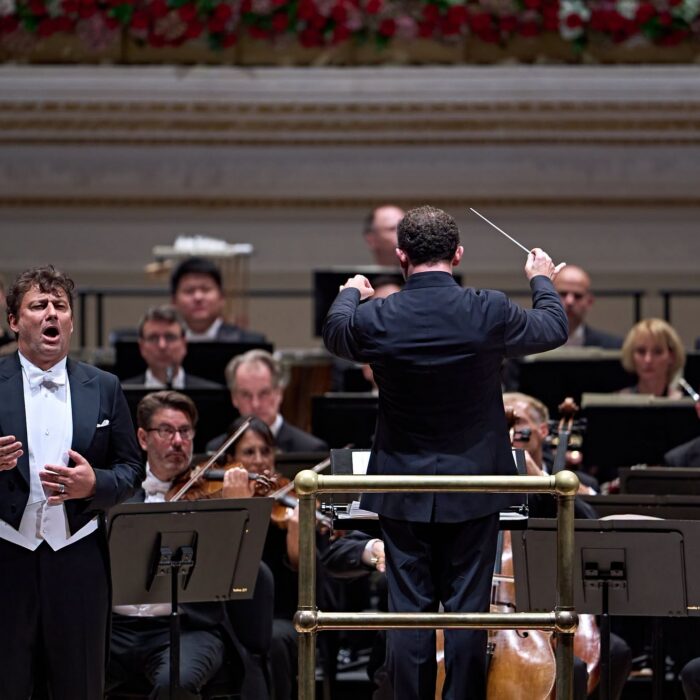
Lorenzo Viotti proved an important unifying presence in the pit. One of the pleasures of the evening was hearing “Il Trittico” conducted not as three unrelated miniatures but as a score of striking formal intelligence. Viotti gives “Il tabarro” the dark tensile line it needs, keeping the orchestral textures mobile without underlining every moment of melodrama. In “Suor Angelica,” he was attentive to long span, allowing Puccini’s emotional architecture to accumulate patiently rather than flooding the listener with instant sentiment. And in “Gianni Schicchi,” he provided rhythmic spring and bite, even if the staging did not always match the score’s perfect comic velocity. The Vienna State Opera Orchestra responded with refinement and color throughout, and Viotti’s control of transitions helped the evening cohere as a single experience rather than a triple bill in the old-fashioned sense.
Unfortunately, Gürbaca’s production was too severe, too analytical, and too skeptical of easy sentiment. One can be generous and see it as a compelling attempt to make sense of the work as a whole. It sees the three operas not as unrelated exercises in different genres, but as linked studies in possession, grief, coercion and survival. However, that ambition costs the staging spontaneity; occasionally one longs for a little more air, a little less insistence.
The exercise in Angst seems ridiculous as the director has opted to move the action to the present day when unhappily married couples usually choose divorce, unwed mothers are not forced into a convent and rich people have formally registered wills.
In the end, this “Il Trittico” fails because it takes the opera as a dour exercise in all that it is negative: infidelity, jealousy, repression, cruelty, despair, dishonesty and greed. These may not be the exact seven deadly sins but they come close. Alas, stage director Tatjana Gürbaca felt they were something worth celebrating, when they certainly are not.