Theater for the New City 2026 Review: Leonard Lehrman’s ‘SIMA’ and ‘E.G.: A Musical Portrait of Emma Goldman’
Two Operas, One Warning: History’s Unfinished Fight for Dignity, Justice, and Humanity
By Chris Ruel(Photo: Jonathan Slaff)
Theater for the New City (TNC) presented two chamber operas by Leonard Lehrman, “SIMA” and “E.G.: A Musical Portrait of Emma Goldman,” on January 22 and 23, 2026, respectively, with each performed on alternating nights between January 8 and 25. This reviewer chose to watch the two operas back-to-back to better understand Lehrman’s range, as I had not previously experienced the composer/librettist’s work.
The two operas couldn’t be more different, yet their themes are beautifully connected, and their significance extends beyond time to resonate with us.
“SIMA”
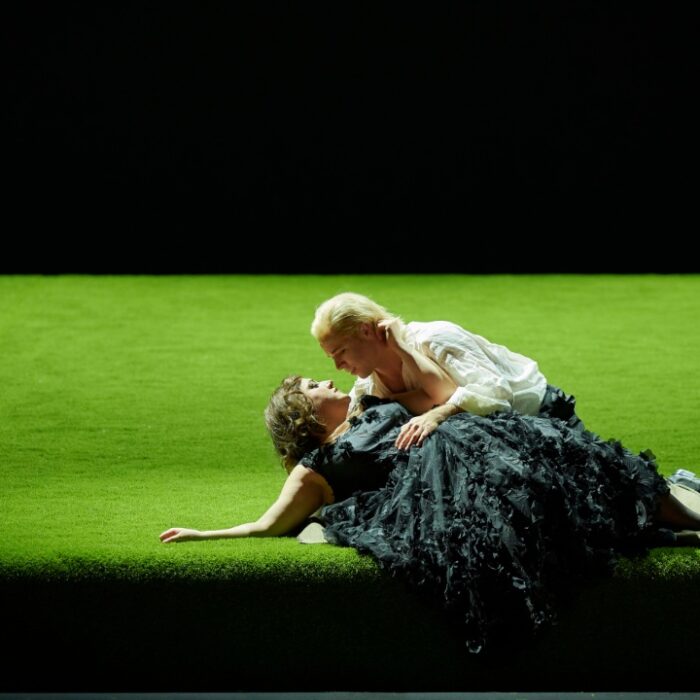
“SIMA,” (pronounced see-mah) is based on “Cheta Krasovitzkikh” by David I. Aizman (1869-1922), starred sopranos Christine Browning and Clair Iverson as Regina, Bennet Pologe as Yakov, mezzo-soprano Perri Sussman as Manya, soprano Samantha Long as Lyuba, and Hannah Grace Hollingsworth in the title role. Lissa Moira directed, and Lehrman conducted the New York City orchestral premiere.
Originally presented by the Ithaca Opera Association in a concert on August 6, 1976, and later staged in October of the same year, the opera premiered in Europe at the Juedischer Musiktheaterverein Berlin in May 1984. It was performed in German. Excerpts have been performed in English, French, German, and Russian across four continents. Surprisingly, four NYC companies attempted to produce it, with TNC being the first to bring it to the New York stage.
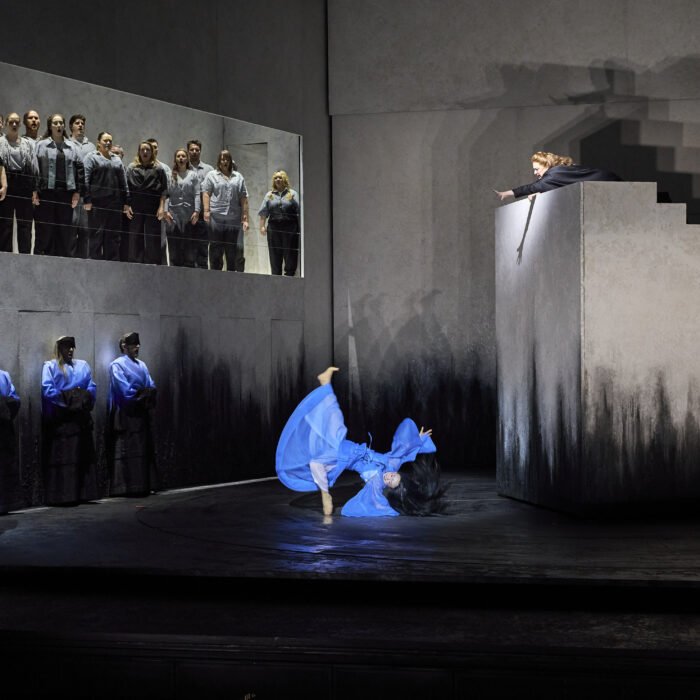
The opera has two acts, each with five scenes, and is introduced by a prelude and an entr’acte. The setting is Russia after the pogroms that followed the 1905 revolution. In the first scene, Yakov Isaevich Krasovitsky—a factory manager—and his wife, Regina Samoilovna Krasovitskaya, are traveling to an orphanage for children who lost their parents in the pogroms. They take public transportation, a streetcar, even though they are wealthy. After adopting a little girl named Sima, which means “treasure” in Aramaic, they leave in a carriage, which better reflects the couple’s social standing.
The scene at the orphanage is crucial. Regina, after showing affection to the girl, treats her more like a toy than a child. While Yakov is less eager about adopting Sima, Regina takes charge, and he quickly gives in to his wife’s demands.
Regina plans to use Sima to showcase her virtue and status by reaching out to all her social contacts and urging them to adopt a child as well. She states that there are still 112 children at the orphanage, whom Regina views more as commodities than as people. To her surprise, her friends aren’t interested in expanding their families, which deeply disappoints her—not because the kids need help, but because they don’t see the social status that adopting a child would bring.
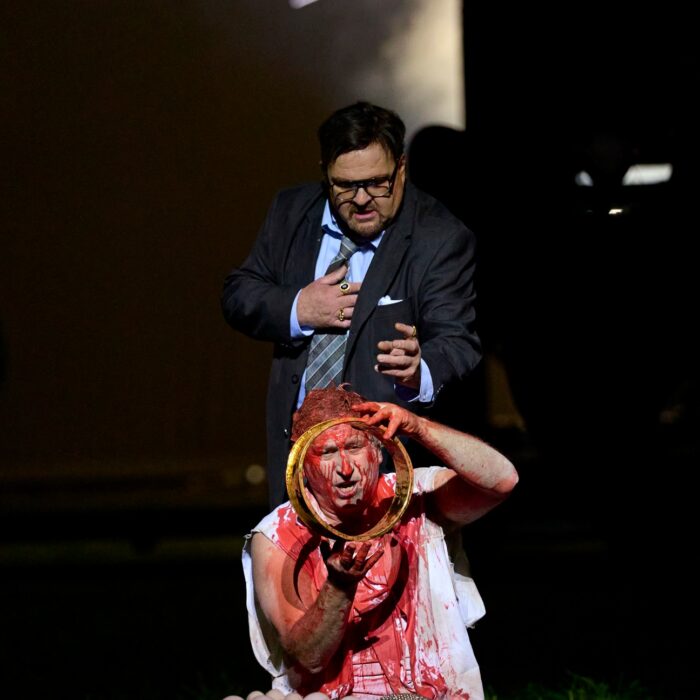
Upon returning home, Regina hands Sima off to Manya, the Ukrainian maid, and has no intention of helping to raise the child. She places that responsibility entirely on Manya’s already overburdened shoulders. This push causes her to snap, and Lehrman includes a powerful scene of a frantic letter-writing fit, drawing from operatic tradition. Manya’s instability arises from being overworked and underpaid, but her task of nannying Sima pushes her to her breaking point. At this moment, the audience learns that Manya had a child who died, though the details are unclear. The point, however, isn’t how her child was lost but that forcing someone else’s child on her triggered her breakdown.
Meanwhile, Yakov faces a strike at the factory. He tries to calm the workers by offering to pay them even though they refuse to work. However, he feels devastated when his revolutionary friend snubs him, shocking Yakov, who is genuinely trying to do right by the workers. Later, under pressure from the factory’s board, Yakov betrays his friend out of petty revenge and self-interest, destroying the illusion that he is on the workers’ side. This also causes him to question his morals.
At home, Manya is pushed to her limit as she tries to manage the young Sima, who is determined to make things as difficult as possible for the maid by getting dirty, refusing to bathe, and being a general nuisance to the exhausted Ukrainian.
Regina no longer cares for her toy child, and she and Yakov decide to return her to the orphanage, which would bring shame upon them. Very reluctant to do so, the couple chooses to send Sima to Manya’s family, once again avoiding the responsibility of raising her. The opera ends on a dramatic yet unresolved note. Manya decides to murder Sima, raising a crowbar to strike her while she sleeps. Instead of killing the girl, Manya drops the crowbar and embraces the child, suggesting that Sima has become the child she lost. End of opera.
No Nice and Tidy Ending
The ambiguous ending, which refuses to tie everything up neatly, was, in this reviewer’s opinion, an excellent conclusion to the compact opera. While undoubtedly challenging for some (as evidenced by overheard comments), I enjoy untidy endings and the questions they provoke after the show. Open-endedness adds a layer of realism that is often missing from canonical works. Anti-catharsis is always a risk, but art without risk—where everything is explained—can be less intellectually engaging and more satisfying to the soul. This isn’t a value judgment, as there’s a place for both.
Individual Performances
The January 22 production featured Claire Iverson as Regina, while two earlier shows in the run starred Christine Browning. Both Iverson and Browning were hired at the last minute because the original vocalist dropped out of the production in December. This left the singers with little time to prepare and learn the music. Since I did not see Browning in the role, I cannot comment on her ability to step in, but Iverson’s performance was excellent given the circumstances. Although she had to use an iPad with the score, she was very convincing as the vapid socialite. As a result, she performed the staged production in a quasi-concert style. It was an interesting combination that worked, demonstrating Iverson’s talent, professionalism, and commitment.
Bennett Pologe (Yakov) was well cast as the brow-beaten husband trying to balance his wife’s whims with the seriousness of dealing with striking workers and revolutionaries. He was sometimes comedic, but mostly he played a man exhausted by the times and his home life.
In the role of Manya, Perri Sussman delivered a compelling, non-cliché portrayal of a domestic on the brink of sanity. She was perhaps the most interesting character because she was given a backstory, and her break from reality was earned, not added just to create a mad scene or as a nod to Tatyana’s letter-writing in “Eugene Onegin.”
Young Hannah Grace Hollingsworth portrayed the rambunctious and headstrong Sima. While earning sympathy from the audience for her character, she also showed the child’s efforts to escape Regina’s household by becoming a thorn in everyone’s side. Her actions suggested a desire to return to the orphanage, but with Manya’s sudden affection before the curtain fell, one was left to wonder whether Sima might face a better life with the Ukrainian as her adoptive mother than return to the orphanage.
Samantha Long as Lyuba, the orphanage supervisor, and Adele Grant as Zhena, Lyuba’s assistant, both had successful outings.
The parallels between the United States today and an authoritarian regime’s intent on terrorizing immigrants and citizens alike with deportation, imprisonment, and even death, naturally came to mind first.
Beyond the pogroms of the Russian Revolution, the exploitation of workers by industry remains just as true today as it was then. Big business cares little for labor; their only motivator is greed—humanity be damned.
Lehrman’s score was chromatic but retained lyrical qualities. The composer included several Russian folk melodies, which helped connect the music more distinctly to the setting.
A common saying is that history doesn’t repeat exactly, but it rhymes, and “SIMA” is a great example of that, as is Lehrman’s other opera, presented the following evening, “E.G.: A Musical Portrait of Emma Goldman,” to which I’ll now turn my attention.
“E.G.: A Musical Portrait of Emma Goldman”
(Photo by Jonathan Slaff)
“E.G.” is an intriguing work, blending elements of an opera, a stage play, and a one-woman show, with a hint of Broadway in the score. Lehrman composed the piece, and the libretto was a collaborative effort between the composer and co-librettist, Karen Ruoff Kramer. The opera premiered on May 4, 1986, starring Elizabeth Parcells (1951-2005). The full opera has been performed 42 times since 1987 across five countries, with excerpts performed over 100 times on four continents.
The opera consists of two acts. Each act features songs that connect to questions from a visa application. For instance, the second question was DATE, PLACE OF BIRTH, for which Goldman answered Haymarket. Musically, this led to a rousing song about the Haymarket Affair.
A Little History of the Haymarket Affair
The Haymarket Affair in Chicago marked a crucial turning point in the U.S. labor movement. On May 4, 1886, a rally demanding an eight-hour workday escalated into violence when a bomb was thrown at police.
Eight anarchists were arrested. Four were hanged. Three others received death sentences, while one was sentenced to 15 years in prison. Of these, three were pardoned, and one died in his cell. The four who were executed were posthumously pardoned.
If there was a catalyst shaping Goldman’s life, the Haymarket Affair was it. This event marked the figurative birthplace of the most famous anarchist in America.
The impact of Haymarket was so profound for E.G., she wished to be buried alongside the four martyrs, and that is where she is interred today. And so, with each question, E.G.’s story is told.
It seems straightforward: visa application questions answered through song and spoken word. But under the hood, the structure is complex. Each response included, on average, three songs. And those pieces were often sung by four or five different characters. For example, the final number for DEPENDENTS has five: E.G., Johann Most, Alexander Berkman (Sasha), Fedya, and Ed Brady.
Yet there were only two people on stage. How did they do it?
One Person, 15 Characters
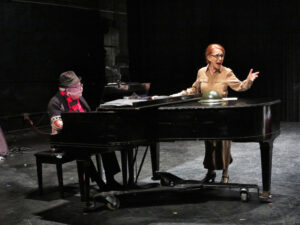
Lehrman played 15 different characters, ranging from V.I. Lenin to the artist Modest Stein (nicknamed Fedya), all from the piano, using hats as markers for each role. The images of the real people were projected onto a screen so the audience could always recognize who Lehrman was portraying.
The composer’s main character was Alexander Berkman (Sasha), a well-known anarchist who stood on a similar revolutionary level as E.G. Both were deeply connected intellectually and emotionally, forming a very close pairing.
Within the opera, E.G. and Berkman engage in banter to provide background. If these conversations are not followed by songs, E.G., in a soliloquy style, speaks about the topic at hand. During the banter, Lehrman was the opera’s comic relief, putting on hats and speaking using numerous accents. He often interjected something humorous during the E.G.’s soliloquies. It was akin to running color commentary.
The voices and accents, the humor, and the quick character shifts were Olympic-level.
Overall, the opera’s entire structure was clever and highly effective.
E.G.
Soprano Caryn Hartglass played the title role as E.G., delivering lines with some operatic singing blended in.
A test of an actor’s ability is how well they suspend disbelief. I didn’t see Hartglass; I saw E.G. To me, that’s one of the highest praises you can give an actor. I was thoroughly engrossed by Hartglass’s performance. The gears were turning as I thought about Goldman and her world, and how closely it mirrors ours.
Protests are happening across the United States and are being met by state-sanctioned violence. There are martyrs. There’s a heavy-handed Department of Justice. The rights of women, workers, and those the government has determined to be “political enemies” are being trampled upon. It’s sad and terrifying—but, honestly, it’s nothing new.
E.G.’s Battles for Rights Continue Into the 21st Century
From Hoover sending in the United States Army—under George S. Patton—to clear, violently, the Bonus Army camps assembled by 20,000 World War I Veterans, to Kent State and crackdowns against Vietnam protestors, violence against civil rights leaders, the list goes on all the way to Minneapolis today.
Consider the struggles still being fought today, many of which E.G. was on the front lines of both advocating for and fighting against over a century ago. These include the right to freedom from religious control (E.G. was an atheist), women’s bodily autonomy and abortion (E.G. believed in a woman’s right not to carry a pregnancy), early LGBTQ rights (when asked about her views on homosexuality, Goldman said, “I find men more interesting, and so do some men.”), and sexual freedom (Goldman had a libertine streak, advocating for free love well before the hippie movement emerged). And remember, the central device of the opera is a visa application.
In 1919, E.G. and Berkman were called “alien agitators” and expelled from the US because she persistently spoke out, defended the Haymarket anarchists, opposed the draft (World War One), and refused to conform to the expectations of a “respectable” woman.
She later went to Soviet Russia but observed that the Bolsheviks had replaced one form of tyranny with another. She spoke openly about this and was kicked out, effectively making her a woman without a country.
Her feelings for the US ran deep. The government revoked her citizenship in 1909 to deport her, and as portrayed in the opera, she longed to come back.
Final Thoughts
What can we make of SIMA and E.G.? I suggest that each opera highlights historical issues that remain relevant today, such as wealth inequality, pogroms, deportation, civil rights, women’s rights, workers’ rights, and LGBTQ rights. These works remind us not to take these rights for granted and to recognize that, historically, fighting for them has been necessary. While progress can sometimes seem slow or reversible—like taking one step forward and two back—others have gone before us and won.