Teatro Regio di Torino 2025-26 Review: La Cenerentola
Vasilisa Berzhanskaya Triumphs in Rossini’s Comic Gem
By Ossama el Naggar(Photo: Mattia Gaido)
Rossini’s “La Cenerentola” (1817) is quite different from the familiar children’s tale most of us grew up with. Librettist Jacopo Ferretti (1784-1852) opted for a more realistic Italian view of the fairy tale. His Cinderella is bereft of fairy godmother, magic carriage or glass slippers. Some attribute this rational approach to the Enlightenment, while others believe it is due to Italian culture. Mediterranean children’s tales traditionally inculcate valor, honor, honesty and pragmatism rather than the supernatural. Dragons and fairies dwell more comfortably in the mist and cold than under the warm rays of the sun.
Therefore, rather than a fairy godmother, it’s Alidoro (the Prince’s tutor) who poses as a beggar, only to be chased away by Cenerentola’s stepsisters. Despite being treated as a servant in her own home, the kind maiden gives Alidoro food and coffee. This is how he discovers the girl’s goodness, deems her a potential bride for Prince Ramiro, and decides to help her win the Prince’s heart.
In lieu of a wicked stepmother, we have a spendthrift stepfather who’s squandered Cenerentola’s inheritance from her mother and who treats her as a servant. Instead of glass slippers, there’s a pair of diamond bracelets. Cenerentola gives one to the Prince to help identify her. To test the mettle of her stepsisters, stepfather and even Cenerentola herself, the Prince uses subterfuge, posing as his own valet and vice versa.
Production Details
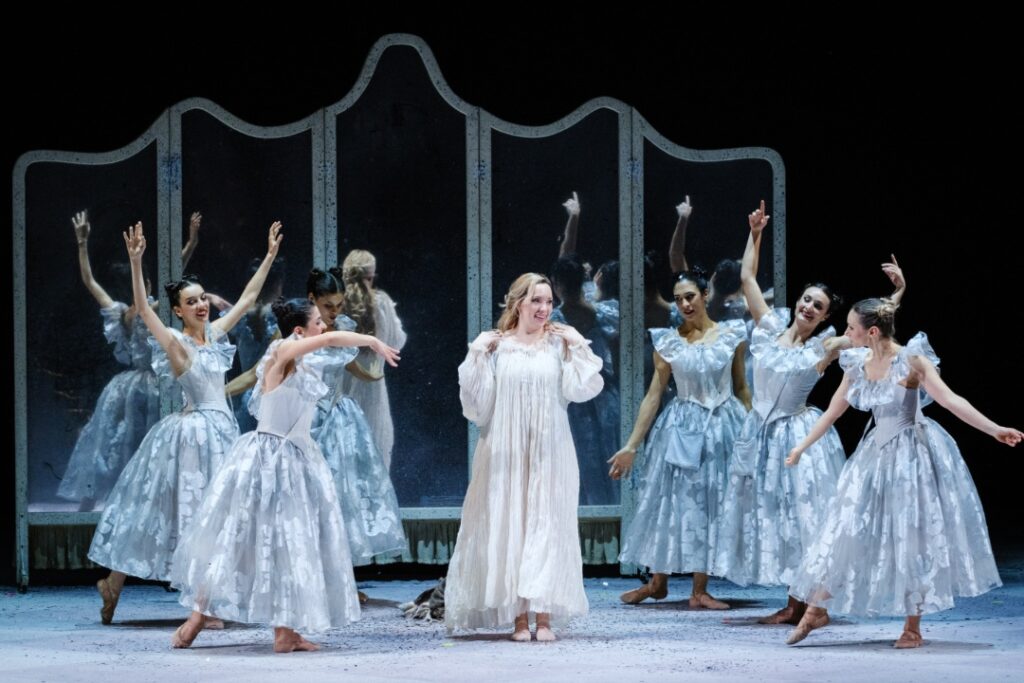
Manu Lalli’s staging of Rossini’s opera on January 20th was a revelation; she deftly merged Ferretti’s non-magical narration with the familiar magical tale by Perreault. Though purists may be offended by this “betrayal,” I admired the delicate balance. Lalli is an acclaimed stage director attempting to bring opera to children. Judging from the public’s reaction, she was successful in reconnecting adults with their inner child. Her brilliance is that she doesn’t oversimplify the story to appeal to a child’s mind. A contrario, she elevates a child’s mind to the actual story by introducing an element of magic.
Given her miserable life, Cenerentola seeks refuge in books, particularly fairy tales. Roberta Lazzeri’s elegant sets paid homage to French director and set designer Jean-Pierre Ponnelle (1932‑1988), whose production of Rossini’s opera firmly reestablished the opera in the repertoire. Similar to Ponnelle’s conception, Lalli’s was faithful to Rossini’s intention of creating a fairytale for children as well as adults, eschewing the comedic excesses resorted to by many. Though Ponnelle was able to create a living fairy tale despite the absence of magic in Rossini’s Italian telling of the story, Lalli chose to introduce magic, but ever so subtly.
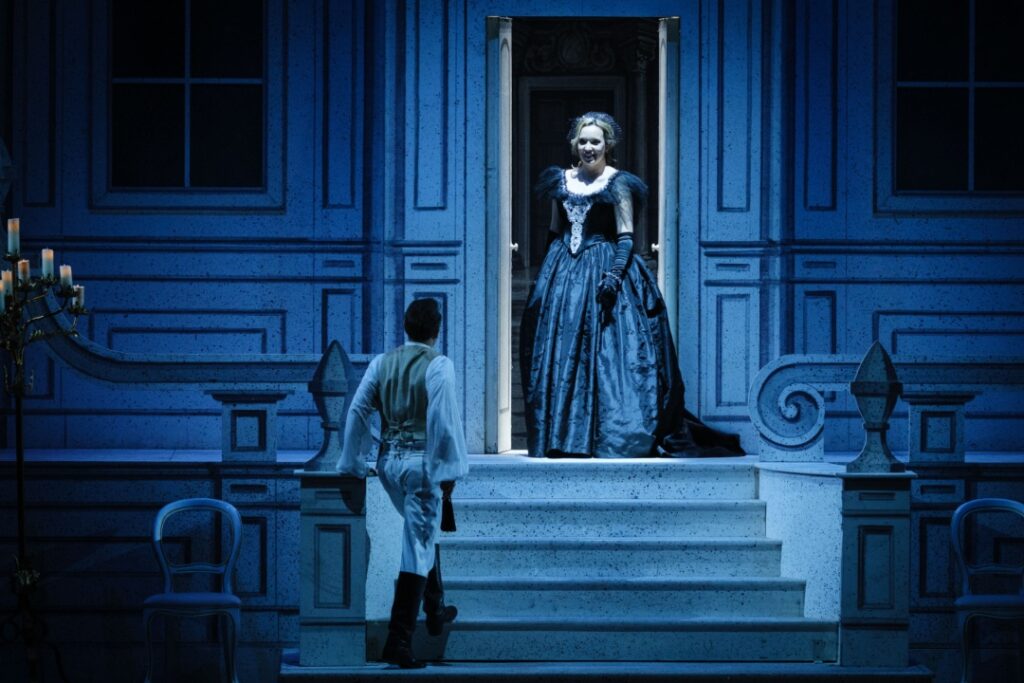
(Photo: Mattia Gaido)
Huge books were made to resemble stylized furniture, reflecting Cenerentola’s dreaminess. A half dozen fairies and one child fairy (Cenerentola’s inner child) appear at various moments, as if in a parallel universe. Given the highly ballabile (danceable) nature of Rossini’s music, they provide an elegant terpsichorean dimension. Lalli’s fairies dress Cenerentola for the Prince, though it’s Alidoro who arranges the transformation. Even the pumpkin is reintroduced by the child fairy as a make-believe carriage.
Just as in Ponnelle’s “La Cenerentola,” Lalli clearly understands that with Rossini, the secret to charm and lightness is to avoid comedic excess. Nothing kills comedy faster than buffoonery. Happily this does not apply here.
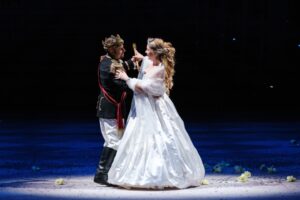
Vasilisa Berzhanskaya as Angelina (Cenerentola)
I first heard Vasilisa Berzhanskaya as Rosina in a 2022 production of “Il barbiere di Siviglia” in Florence. For the first time, I was not sure if this was the standard version with a mezzo Rosina or the less frequently performed soprano version. The timbre was distinctly mezzo, but the dazzling coloratura was more that of a soprano than a mezzo. In the 2024-25 season, she was in the opening opera, “La forza del destino,” starring Anna Netrebko in the mezzo role of Preziosilla, a role that I distinctly disliked but that I truly enjoyed by Berzhanskaya. In August, during Pesaro’s Rossini Opera Festival (ROF), the thirty-two-year-old Russian dazzled in a concert of soprano arias. Though not abandoning the mezzo repertoire, Berzhanskaya is embarking on a soprano career. Next month, I’ll hear her Norma in Parma.
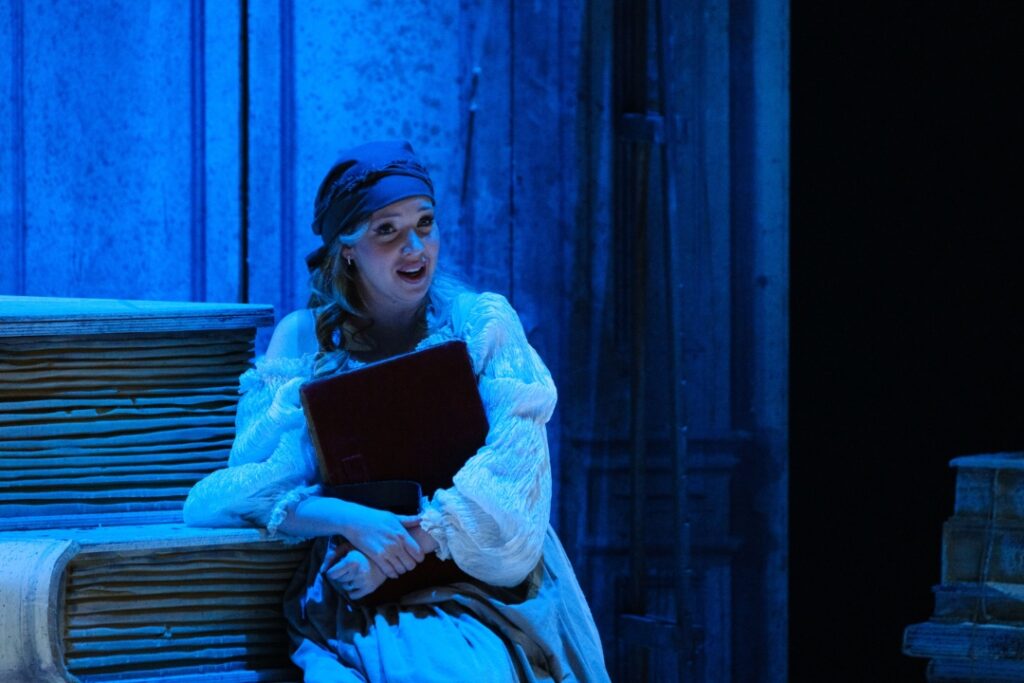
(Photo: Daniele Ratti)
Though now rare, singers with a huge vocal range were known in Rossini’s time. Isabella Colbran (1785‑1845), was Rossini’s muse and eventually his wife. Her contemporaries, Giuditta Pasta (1797‑1865), Giulia Grisi (1811‑1869) and Maria Malibran (1808‑1836) were each creators of major bel canto roles, singing both soprano and mezzo roles. Some described such a voice as soprano sfogato, or “vented” soprano. Some contemporary mezzos are attempting soprano roles, though I’d qualify the results as rarely convincing. However, in the case of Berzhanskaya, she’s a singer with an immense vocal register.
The opera’s most popular musical excerpt, the glorious aria and rondo “Nacqui all’affanno…Non più mesta,” was delightful thanks not only to Berzhanskaya’s brilliant vocal prowess, but also her ability to portray a modest, kind, yet strong-willed Angelina. With her huge vocal range, Berzhanskaya had no difficulty with the aria’s higher notes, as some mezzos do.
Stellar Cast Highlights
Maltese tenor Nico Darmanin was a revelation. His light lyric tenor was perfect for the role, as was his virile demeanor and charm. He impressed with his agile voice and ease in reaching the Rossinian high notes. His timbre is darker and his voice bigger than the typical Rossini tenor, more Francisco Araiza than Lawrence Brownlee, which suits this role in particular. Endowed with magnetic stage presence and good looks, Darmanin’s future looks bright indeed. He was charm personified in Act one’s duet with Cenerentola, “Un soave non so che.” His Act two aria, “Si, ritrovarla io giuro” was also brilliantly rendered, with impressively secure high notes in the cabaletta.
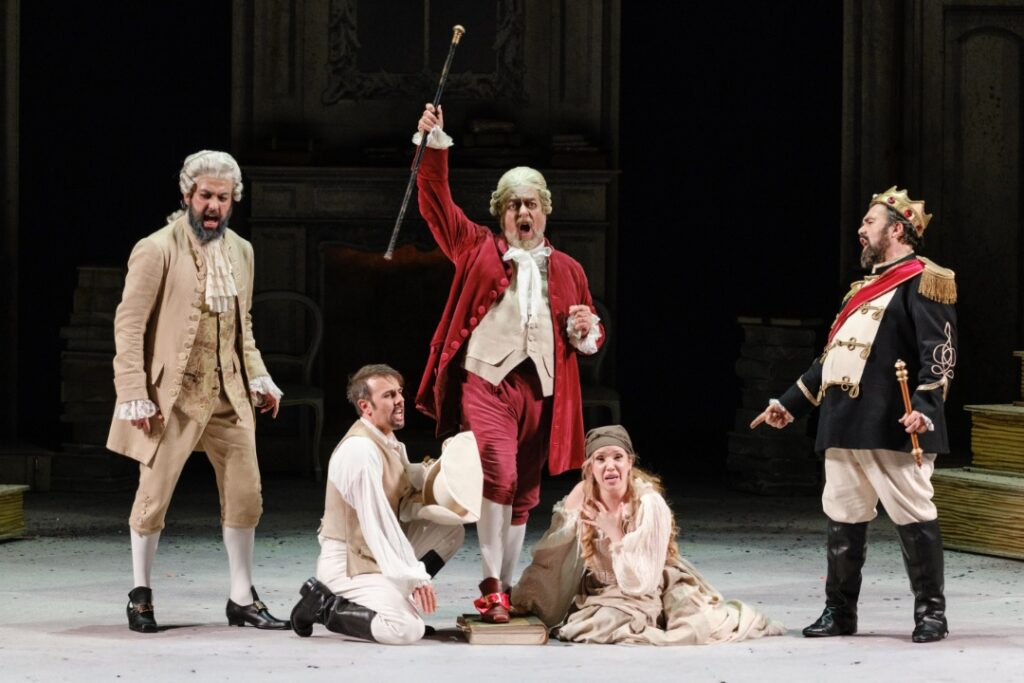
(Photo: Mattia Gaido)
Baritone Roberto de Candia and bass Carlo Lepore were ideal choices in the roles of Dandini and Don Magnifico. Very much in demand in comic opera, both are blessed with a natural comedic touch and know how to navigate comedy without being clownish or vulgar. Lalli chose not to overdo the poverty of Don Magnifico nor its attendant pathos. Simple avidity is good enough to explain the man’s behaviour. He impressed in his Act two aria, “Sia qualunque delle figlie,” thanks to his comedic gifts and the dizzying speed of the aria’s finale. De Candia, portraying the valet Dandini, seemed to have a ball impersonating Prince Ramiro. Thanks to his stage presence and comic flair, he elicited much laughter. In his first aria, “Come un’ape ne’ giorni d’aprile,” it was clear he was enjoying his new princely station. In Act one, he enjoyed making fun of Don Magnifico and his daughters (“son tutte papa…talis patris, talem filias” and “vere figure etrusche”). He was wickedly hilarious when he revealed his identity to old Don Magnifico in the delectable duet, “Un segreto d’importanza.”
Azerbaijani bass-baritone Maharram Huseynov made the most of his small roles of the prince’s tutor Alidoro and Rossini’s substitute fairy godmother. The stepsisters Clorinda and Thisbe were convincingly performed by Belarusian soprano Albina Tonkikh and Canadian mezzo Martina Myskohlid respectively. These roles are not too demanding vocally but they do call for more than capable acting, which both singers effortlessly managed. Like Ponnelle, Lalli did not fall into the trap of morphing the stepsisters into monstrous creatures or buffoonish clowns. They were almost attractive outwardly, betraying an interior ugliness. And they were particularly effective in the ensemble passages at the end of Act one, “Parlar, pensar, vorrei.”
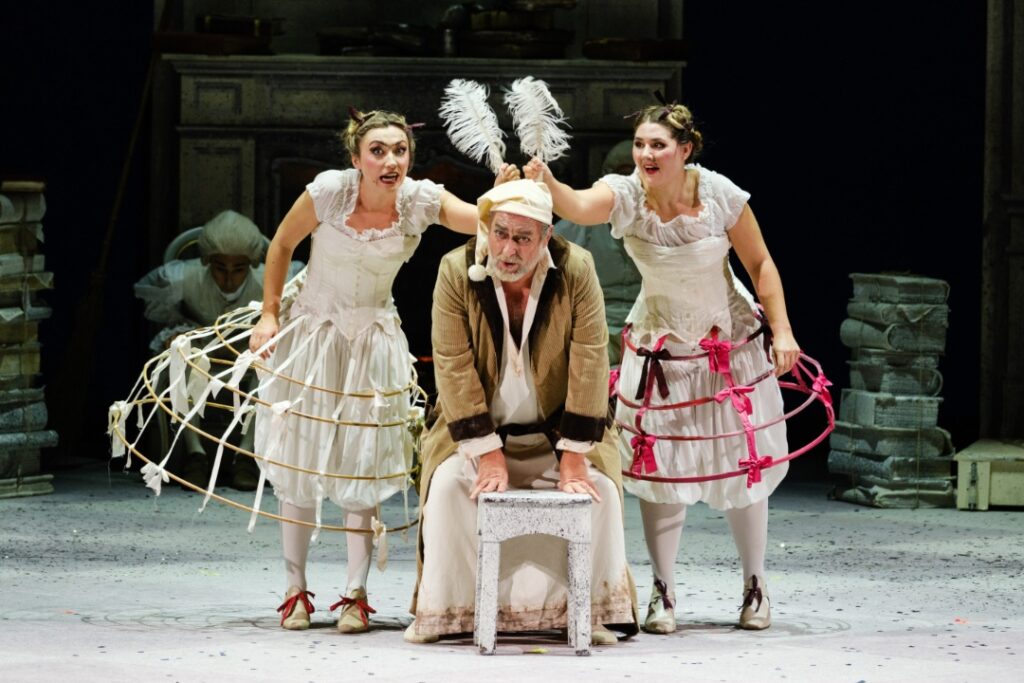
(Photo: Daniele Ratti)
Despite a long, illustrious career, this is apparently the first time conductor Antonio Fogliani tackled this opera. He conducted with poise, eschewing the tendency to play Rossini at high speed from the very start. The overture was measured, becoming a true delight as it eventually reached the finale in style, and not at a frenzied tempo that could render later acceleration heavy‑handed. Having collaborated with both Rossini festivals (Pesaro in Italy, Wildbad in Germany), Fogliani enjoys an affinity for Rossini’s music.
Rossini’s opera is appropriately named “La Cenerentola, ossia La bontà in trionfo” (“Cinderella, or the Triumph of Goodness”). In this elegant production, featuring the terrific Berzhanskaya, one could add another sobriquet, Berzhanskaya in trionfo!
(Photo: Mattia Gaido)