Teatro Municipale di Piacenza 2025-26 Review: L’italiana in Algeri
By Bernardo Gaitan(Photo: Andrea Mazzoni)
Composed in 1813, “L’italiana in Algeri” remains a masterpiece of bel canto dramma giocoso. Its plot, which worked in Rossini’s Europe, continues to function today, albeit from a different perspective: that of clichés associated with immigration.
In the Ottocento, a remote setting such as Algiers aroused the public’s curiosity; Rossini and his librettist Angelo Anelli filled the story with exotic stereotypes that were then considered fascinating. Today, outside that context, certain references to Muslim themes, Arab practices, and customs foreign to the West may be perceived as problematic. Without entering into political positions, it is undeniable that immigration has profoundly shaped the countries of Central Europe. The outskirts of many Italian cities reveal how North African communities have settled, creating improvised landscapes with precarious constructions and low-quality materials, often without full integration into the host society. Within this framework, Fabio Cherstich’s production proves extraordinarily topical: although it draws on prejudices, clichés, and stereotypes—at times politically incorrect—in a comedy written more than two hundred years ago these elements emerge as coherent and surprisingly effective within his contemporary reinterpretation.
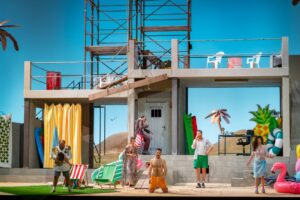
Cherstich signs a staging of notable intelligence, co-produced by the Teatro Municipale di Piacenza together with the theaters of Reggio Emilia, Modena, and Ravenna, the Fondazione Haydn of Trento and Bolzano, and the OperaLombardia circuit. The involvement of so many theaters results in an ambitious production that delivers comedy with millimetric precision, engaging with the present through contemporary imagery that channels Rossinian irony: The Bey’s palace becomes the skeleton of an illegal construction site, evoking both an Italian provincial setting and a stereotyped, imagined North Africa. Mustafà is no longer an oriental sovereign but a building foreman, surrounded by laborers more credible as undocumented workers than as an Ottoman court. The arrival of the Italian castaways in Algeria by inflatable boat carries pointed irony, reversing the contemporary migratory routes more commonly seen toward Italian shores.
Nicolas Bovey’s set design establishes a recognizable contemporary environment: a stroll through the outskirts of any European city reveals unfinished buildings that may never be completed, inhabited by the less fortunate. To situate the action in Algeria, dunes in the background and a relentlessly sunny sky facing the sea complete the landscape. Crates of evidently stolen goods coexist with construction materials: office furniture transformed into a throne, wheelbarrows and shovels serving as means of transport. The characters inhabit this space naturally; its resemblance to present-day reality is precisely what generates the comedy.
The stage direction is agile, filled with gags of surgical precision that succeed largely thanks to the mime Julien Lambert, whose dynamic acrobatics elicited laughter, supported by five additional extras who energize the action. Arthur Arbesser’s costumes, contemporary and laden with stereotypes of Europeanized Africans, feature sweatshirts imitating luxury brands, sleeveless shirts, shorts, and comfortable yet vulgar attire, prioritizing comfort over aesthetic harmony. Alessandro Pasqualini’s lighting, consistently refined, stood out particularly at the end of Act one with an intelligent “black box” effect for the rhythmic “Nella testa ho un campanello.”
Musical Highlights
Musically, Alessandro Cadario delivered an extraordinary reading, stylistically rigorous and meticulously prepared. From the overture onward, a clearly defined concept emerges: carefully studied tempi, a brilliant sound, and ingeniously calibrated dynamic balance. Leading the Orchestra dell’Emilia-Romagna Arturo Toscanini, which responded with cohesion and fidelity, the interpretation gained brilliance and keen attention to orchestral color, with particularly purposeful dynamics. The all-male Claudio Merulo Chorus of Reggio Emilia, prepared by Martino Faggiani, demonstrated both musical and theatrical assurance and virtuosity.
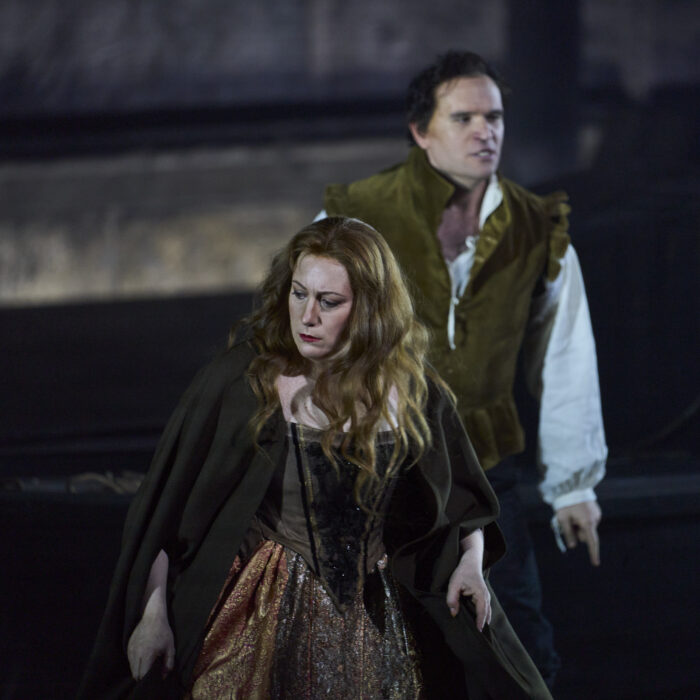
Although the title refers to the female protagonist, the true dramatic axis is Mustafà, given his stage presence and the breadth of his role. Giorgio Caoduro crafted a vocally secure and theatrically effective Mustafà: a dark timbre, even emission, and excellent articulation of the sillabato enabled him to meet the demands of the score with ease. Dramatically, the bass opts for controlled comedy; arias, duets, and ensembles were handled with confidence. His stage ease, strong comic flair, and distinctive physique establish him as a standout interpreter of the role.
Mezzo soprano Laura Verrecchia as Isabella combines an even vocal line, firm technique, and mastery of agility with commanding stage presence. Her robust timbre, supported by well-projected lower register, underpins a solid interpretation. Both her phrasing and acting are captivating. Her “Pensa alla patria” drew significant ovations for its vocal and dramatic impact, while in “Per lui che adoro” the rounded elegance of the coloratura clearly displayed her command of the role.
Replacing the indisposed Ruzil Gatin, tenor Antonino Siragusa assumed the role of Lindoro–an ideal choice for a part he thoroughly commands. Solid projection, impeccable coloratura, and secure high notes characterized his performance. In “Languir per una bella,” he demonstrated firm technique, timbral beauty, and ease in the most vertiginous agile passages. He also performed the usually omitted second-act aria “Concedi, amor pietoso,” delivered, like the rest of the role, with exceptional quality.
(Photo: Andrea Mazzoni)
Another highlight was Marco Filippo Romano, who once again brought experience and precision to Taddeo: impeccable comic timing, clear diction, and notable stage mobility. His seamless integration of technique and performance turns each intervention into an effective component of the comic mechanism, with particular merit in the recitatives.
Gloria Tronel shaped an actorially attentive Elvira in the first act; vocally she began with some difficulties–throaty emission and strained high notes–but improved considerably in the second act. Her facility in the upper register was evident at the close of Act one, where the high C’s were delivered with natural ease. Giuseppe De Luca(Haly) and Barbara Skora (Zulma) completed the cast with solid ensemble integration.
At the conclusion of the performance, prolonged and enthusiastic applause for all the performers and the conductor sealed an evening that revitalizes the comic dimension of Rossini’s masterpiece within a strikingly contemporary setting.