Teatro alla Scala 2026 Review: Francesco Meli & Luca Salsi’s Recital
By Bernardo Gaitan(Photo: Brescia e Amisano © Teatro alla Scala)
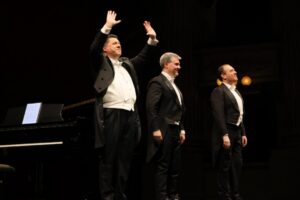
At a time when vocal recitals seem to have lost some of the prominence they enjoyed throughout much of the twentieth century, it is particularly significant that two artists at the height of their careers should choose to celebrate a decade of collaboration through a format that demands complete artistic exposure. Such was the occasion at Teatro alla Scala, where the Genoese tenor Francesco Meli and the Parmese baritone Luca Salsi appeared together, accompanied at the piano by Nelson Calzi, in an evening conceived as a tribute to Giuseppe Verdi.
At the same time, the event served as a celebration of an artistic friendship that has marked some of the most significant moments of their respective careers. The occasion also carried strong symbolic value for both singers: ten years had passed since they first shared the stage at La Scala in “I due Foscari.” In a sense, the concert functioned as a retrospective of two parallel artistic journeys that have found their principal point of convergence in Verdi.
Francesco Meli made his debut at the Milanese theatre in 2004 with Poulenc’s “Dialogues des Carmélites” and has since amassed more than 150 appearances on La Scala’s stage. Luca Salsi, for his part, debuted in 2008 as Marcello in “La Bohème” and has gone on to become one of the theatre’s most familiar and welcomed presences. The program was conceived as a dramatic journey through some of the most intense pages of “Don Carlo,” “La forza del destino,” and “Otello.” Interspersed among them were two piano works by Franz Liszt, transforming operatic drama into pure instrumental evocation. The result was a genuine Verdian fresco in which many of the composer’s great themes were distilled and brought together.
Illuminating Performances
From the opening phrases of “Io la vidi e al suo sorriso,” Meli confirmed that he is currently enjoying a particularly solid phase of artistic maturity. The tenor has managed the natural evolution of his instrument with intelligence; without sacrificing brilliance or flexibility, it has gained expressive density and dramatic depth. His vocal production remained balanced throughout his entire range; the high notes, besides ringing and endowed with squillo, emerged securely and firmly supported, albeit with a rather pronounced vibrato that appeals to Italian audiences. His middle register has acquired a particularly attractive consistency. His elegant phrasing reached moments of remarkable refinement. In “La vita è inferno all’infelice” and later in “O tu che in seno agli angeli,” he succeeded in combining lyricism and emotional intensity with admirable control. Particularly noteworthy was his interpretation of “Dio! mi potevi scagliar” from “Otello.”
Luca Salsi offered a demonstration of why he is currently regarded as one of the foremost Verdian interpreters of his generation: his vocal performance remains exemplary. The baritone possesses a voice that seems tailor-made for this repertoire. His dark timbre, harmonic richness of his middle register, and the firmness of his vocal projection allow for an immediate identification with Verdi’s characters. In “Son io, mio Carlo… Per me giunto è il dì supremo,” the nobility of his character emerged naturally through expansive and carefully articulated phrasing. Every inflection seemed to respond to a perfectly defined dramatic intention. Equally striking was “Urna fatale del mio destino,” in which the singer displayed a remarkable variety of expressive colors. Yet it was probably in “Credo in un Dio crudel” that Salsi reached some of the interpretative heights of the evening. Jago’s monologue found in him a wholly worthy interpreter.
Naturally, some of the most celebrated moments came when the two voices joined together. The artistic affinity between Meli and Salsi was evident and extended far beyond mere musical coordination. “Dio che nell’alma infondere” was one of the most warmly applauded excerpts of the evening. Equally successful were the selections from “La forza del destino,” where the dramatic tension gradually intensified before culminating in a finale of enormous emotional impact. The excerpts from “Otello” provided another of the recital’s high points. “Ora e per sempre addio sante memorie,” “Era la notte Cassio dormiva,” and the ensuing “Si per ciel marmoreo giuro” allowed the audience to appreciate the full expressive maturity of both artists.
More Musical Highlights
Special mention must be made of Nelson Calzi’s talent, whose contribution was far more significant than that of a mere accompanist. A pianist with extensive experience in the vocal repertoire, he succeeded in creating a flexible sonic fabric that remained constantly attentive to the singers’ needs. His ability to breathe with the voices, sustain the musical lines, and recreate the orchestral atmosphere without ever lapsing into exaggeration constituted one of the fundamental pillars of the evening’s success. The two Liszt performances, needless to say, were crystalline and deeply moving, while also providing an opportunity to appreciate his qualities as a soloist. In both “Widmung” and the brilliant Concert Paraphrase on “Rigoletto,” Calzi demonstrated secure technique and a remarkable ability to balance virtuosity with expressiveness. Far from serving as mere interludes, these pieces acquired a distinct personality within the overall architecture of the concert.
Calzi’s technical level was masterful: he tackled the octaves with tremendous power, negotiated each and every one of the difficult thirds with assurance, and above all, in the encores, displayed an exceptionally high level of pianistic technique.
At the conclusion of the performance, the audience’s response was exactly what one would expect for an occasion of this nature. The prolonged ovations prompted a series of encores, beginning with the duet “All’idea di quel metallo portentoso” from “Il Barbiere di Siviglia,” performed jointly by both singers. They then offered solo selections, one operatic and one from the Neapolitan repertoire: Salsi performed “Cortigiani, vil razza dannata” from “Rigoletto”–during which Calzi once again demonstrated his formidable pianistic technique–and a melancholy transposed version of “Ingrato core,” while Meli offered “Forse la soglia attinse… Ma se m’è forza perderti” from “Un ballo in maschera” and Tosti’s “L’ultima canzone.”
The evening resulted in an extraordinary number of curtain calls, with the artists repeatedly returning to acknowledge the applause, while from the loggione there inevitably rang out the traditional cry: “Viva Verdi!”
Categories
Reviews