Staatsoper Stuttgart 2025-26 Review: Don Giovanni
By Ossama el Naggar(Credit: Martin Sigmund)
While the midsize southwestern German city of Stuttgart is not an international operatic centre like Berlin or Munich, it’s nonetheless important to opera’s history. It witnessed the world premieres of three major works: Strauss’s “Ariadne auf Naxos“ (1912); Zemlinsky’s “A Florentine Tragedy” (1917); and Philip Glass’s “Akhnaten” (1984), in addition to several operas by Carl Orff and Werner Egk. Its opera house is one of the country’s most beautiful, with splendid acoustics.
For a long time, I’ve been leery of seeing Mozart’s Italian operas in Germany or North America, especially his three collaborations with librettist Lorenzo Da Ponte. The issue of decent Italian diction has come a long way in the last decades, thanks to excellent language coaches. The “qvesta” and “qvella” instead of “questa” and “quella” heard on pre-1970 recordings from Germany and Austria are mercifully long gone. However, the subtle humor of Da Ponte (1749-1838) may be difficult to grasp. In Germany, directors tend to revert to thick Teutonic humor, and in North America, slapstick. However, friends at an opera festival last summer favorably mentioned this production of “Don Giovanni: (premiered in 2012), so I took a chance on hearing its revival this season.
The trip was certainly worthwhile. German director Andrea Moses (b.1972) has original and stimulating ideas. My fears about humor soon dissipated as her take on “Don Giovanni” (seen January 31) could only be described as brilliant. Unlike some directors, Moses seems to have carefully read and understood the libretto, and was thereby able to bring the characters to life. But she certainly wasn’t hesitant to alter their traits, starting with the three women.
It’s not fortuitous that Da Ponte and Mozart opted for three women to represent the “Ewige Weibliche,” or “Eternal Feminine.” They’re different on several levels, starting with social class. Donna Anna is an aristocrat, Donna Elvira is bourgeois, and Zerlina is a peasant, or working class. Vocally as well, the three are distinct. Usually, Anna is a dramatic soprano, Elvira is a lyric soprano, and Zerlina, either a soprano leggero or an earthy mezzo. Psychologically, Anna is often portrayed as hysterical; Elvira, as sentimental or clingy; and Zerlina, modest and naive.
In this refreshing approach, Moses chose to stress class identity and to empower the women. Her Don Giovanni is a serial seducer to be sure, but not a Casanova type. Rather, he’s a happy consumer of carnal pleasure, not an artist in the affairs of the heart. He’s also the owner of a hotel which serves as his lair, enabling access to a large variety of women. Without scruples, he also preys on his female staff. Given his attachment to his business, his international conquests cited in Leporello’s catalogue are most likely a thing of the past.
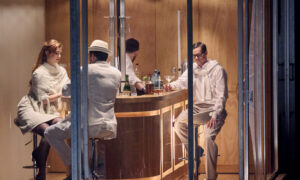
Christian Wiehle’s sets were simple but intelligent: an art déco two-floor hotel affording a clear view of the action. On the ground floor is a bar doubling as a pick-up joint. A revolving stage allowed different perspectives into intimate happenings of the hotel’s guests. The opera opens with Anna and an unmasked Giovanni making passionate love in her room. A disagreement between the two soon sours the mood and Giovanni takes his leave, pursued by the agitated Anna. Awakened by the turmoil, Il Commendatore (her father) follows and confronts Giovanni. This signifies that Anna was a willing sexual partner and not a rape victim. Hence, her excessive grief about her father’s demise is possibly due to her guilt. Indeed, Moses sees Anna as manipulative. When singing her Act one aria, “Or sai che l’onor”, she’s observing her fiancé’s reaction. When Ottavio doesn’t react vehemently, she ups the ante.
Martina Russomanno, the only Italian in the cast, is a lyric soprano with extreme ease in her higher register and excellent technique. Rarely have I heard a singer tackle Donna Anna’s arias with such effortless finesse. Even more than the aforementioned aria, Act two’s “Non mi dir” elicited well-deserved enthusiastic applause. In addition to technical prowess, Russomanno is an exceptional actress, convincingly personifying a wealthy upper-crust woman. Her take on the role evoked the Milanese variety: a stiff, upright posture, a demi-sourire, and an air of indifference.
Anna’s fiancé Don Ottavio, sung elegantly by Moritz Kallenberg, was a perfect match: equally stiff, and uncomfortable in his own skin. This made for a troubled relationship. Unlike many directors, Moses didn’t make Ottavio much older than Anna, nor did she make him effeminate or overly mannered. He was simply boring, overly polite and with a low sex drive; no wonder Anna conducted an affair with Giovanni. Kallenberg was so convincing that some may have thought his Ottavio demonstrated insufficient passion in his singing. On the contrary, he acted the reluctant fiancé so definitively that he had to sound as he did: reserved and timid. A gifted actor, he seemed like a decent but ineffective man. Kallenberg sang Act one’s aria, “Dalla sua pace” with elegant and beautiful phrasing; his Act two “Il mio tesoro” was even more delightful as he managed the florid high notes with absolute ease.
Donna Elvira is usually portrayed as a tender woman, ready to forgive Giovanni, despite his serial seductions. Others portray her as a bookish intellectual, but distraught, as she’s experienced intense love possibly for the first time. Moses sees her differently: a possessive, petty busybody, a bourgeois spinster-in-the-making, intent on grasping a potential husband. In short, Donna Elvira is a virago. This is not far-fetched, for Elvira’s lines do indeed reflect an overly eager and determined woman. As this portrayal does not match a lyric soprano’s tender voice, Moses and the conductor opted for a mezzo. Croatia’s Diana Haller is no light mezzo like Frederica von Stade, Elina Garança or Vasilisa Berzhanskaya; she’s equipped with deep notes that lend her ample gravitas. More than any other character, Haller’s Elvira was truly larger-than-life. By her very extravagance, she provided much of the comedy in this production, for it’s clear the director understands this opera is no tragedy, but rather a dramma giocoso, one sprinkled with many comedic moments.
Though she provided many laughs (but none in poor taste), her portrayal of Elvira as an overbearing virago made one cheer for Giovanni, not her. Vocally, she was effective in the aria “Chi mi dice mai,” though I still think the role is best served by a lyric soprano. This view was confirmed in Act two’s “Mi tradì quell’alma ingrata,” perhaps Mozart’s most moving aria. Haller’s mezzo does not work in this aria, and despite some beautiful singing, one could not perceive Elvira’s vulnerability.
Baritone Johannes Kammler’s voice was a good fit for Moses’s vision of Don Giovanni. More sweet than imposing, this Giovanni is far from threatening, though he’s not without charm. In his own modest way, he’s something of the neigborhood seducer. Kammler is a great actor and has mastered Italian, making the most of his lines. Pivotal passages, such as “E un’impostura della gente plebea”, “Chi a una sola è fedele, verso l’altra è crudele” and “Tu ch’hai la bocca dolce più del miele,” were savored, and in turn sounded delectable. His champagne aria, “Fin ch’han dal vino,” had a mischievous but not frenetic tempo, indicating conductor Cornelius Meister was perfectly in sync with the director’s vision. This is a rather lazy, not overly scheming, not overly extravagant Don Giovanni.
Cornelius opened the performance with a majestic overture, announcing more drama than comedy. He refrained from quickening the tempo, a commonplace problem with those who want to take on “baroque” airs. His capable support of the singers was noted, especially Anna and Ottavio in their demanding arias.
Austrian bass-baritone Michael Nagl provided the appropriate voice and character for Don Giovanni’s wily servant and witness to his exploits. Though some prefer similar voices for Leporello and Giovanni, alluding to the former being the latter’s alter ego, I much prefer clearly distinct voices. I also prefer Leporello to have a lower and darker voice, as it allows for more comedic color. His catalogue aria “Madamina, il catalogo è questo” was brilliantly staged using video, supposedly representing a computer screen where Leporello shows a bewildered Elvira all her rivals.
New Zealand’s Natasha Te Rupe-Wilson was a sensational Zerlina, vocally and dramatically. Far from an ingénue, Moses’s Zerlina is a conniving, upwardly mobile schemer. Not content with her fiancé Masetto, the hotel’s barman, as a modest advancement, she’s testing the waters to see if she can snag the wealthy hotel owner. Moses gave her other troubling attributes; she enjoys beating up Masetto. In her beautifully sung Act one aria, “Batti, batti, o bel Masetto,” she ends up pummeling him, insinuating spicy sexual peccadillos for this young couple. Even in the Act two aria, “Vedrai carino,” where she’s supposedly consoling her just-beaten groom, she roughs him up again. Luckily, Te Rupe-Wilson is blessed with a glorious voice that’s much more than that of a soubrette. The famous duet with Don Giovanni, “Là ci darem la mano,” was charming, thanks to the charisma of both, but even so, it failed to convince, as this Zerlina was no nubile bride – more than a match for the alleged seducer.
Her fiancé Masetto, sung by American bass-baritone Andrew Bogard, had just the right voice for the role. He impersonated a naive working class man to a tee, easily duped and manipulated. Of all the characters in this “Don Giovanni,” his Masetto elicited the most sympathy.
By making the three women anything but victims, Moses has emasculated Don Giovanni. In this staging, rather than him seducing them, they were using him for their sexual gratification (in the case of Anna, it is explained that her fiancé has a low sex drive and is cold). The fact that he is not the seducer but that the three women are the initiators is the reversal according to the stage director. It’s a view but few would be totally convinced by that view.
In the pivotal dinner scene, there are no musicians performing on the stage-within-a-stage, and Don Giovanni’s gargantuan feast consists only of bland appetizers typical of a three-star hotel. When he says “Io spendo i miei danari, mi voglio divertir,” you question his grasp on reality. Furthermore, Moses dispensed with the supernatural, with Il commentatore returning in the form of a recovering man. What? The grief, the tombstone, the wreath Anna laid – all were apocryphal?
It’s revealed that Anna’s father was a psychiatrist and was only injured at the opening of the opera. He tries to counsel Giovanni to mend his ways, but fails. Somehow, Leporello shoots his master (but not fatally). Confronted by Masetto’s working class goons, probably cuckolded by Giovanni, the cowardly man shoots himself. Given Don Giovanni’s psychological profile, this was a surprising but unconvincing ending to an original production. However, altering the ending almost exculpates the serial seducer.