Rossini Opera Festival 2026 Review: Matteo Mancini & Giuseppe Toia in Recital
By Bernardo Gaitan(Photo: Rossini Opera Festival)
As part of the recitals that traditionally accompany the Rossini Opera Festival’s program, a recital was held featuring baritones Matteo Mancini and Giuseppe Toia, with Michele D’Elia at the piano.
Mancini and Toia appeared relaxed from the very beginning, comfortable with a repertoire they know and perform regularly. The program allowed them to explore different facets of the Rossinian buffo universe through characters such as Figaro, Bartolo, Dandini, Don Magnifico, Slook, Taddeo, and Geronio. Both singers proved to be solid performers, although with clearly distinct artistic personalities.
Matteo Mancini possesses a beautiful, powerful, brilliant, and effervescent voice, complemented by a graceful physical presence that enhances his stage appeal. The Rossinian repertoire seems particularly well suited to his vocal qualities, and he demonstrates a strong understanding of the demands of the bel canto style.
In “Largo al factotum,” Figaro’s cavatina from “Il Barbiere di Siviglia,” he immediately displayed the qualities of an instrument capable of making itself heard with ease while tackling Rossini’s writing with confidence. From “La Cenerentola” came Dandini’s cavatina, Come un’ape nei giorni d’ aprile” in which he also stood out. He was equally impressive in Slook’s cavatina, “Grazie… grazie… Troppo presto,” from “La cambiale di matrimonio,” and concluded his participation with Batone’s aria, “Una voce m’ha colpito,” from “L’inganno felice,” once again demonstrating his stylistic command.
Giuseppe Toia, for his part, possesses a highly expressive voice, but his true talent lies in a more difficult-to-define quality: extraordinary charisma. He is a true force of nature on stage. Without even opening his mouth, with barely two glances, he is capable of winning the audience over completely. His ability to communicate and build a character through stage presence is immediate, and in this recital he once again demonstrated an exceptional instinct for comic timing.
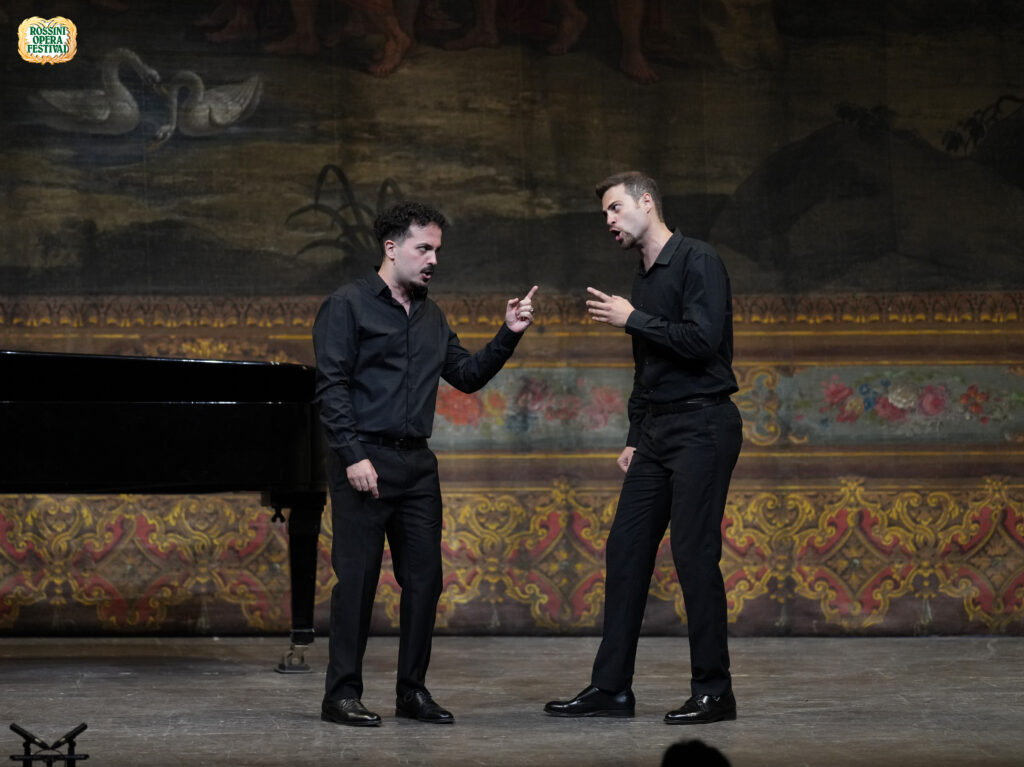
His performance as Bartolo in “A un Dottor della mia sorte,” together with Don Magnifico’s aria “Sia qualunque delle figlie,” and especially his turn as Taddeo in “Ho un gran peso sulla testa,” confirmed his ability to transform each number into a small theatrical scene. It was precisely during this aria that he forgot part of the text from “L’italiana in Algeri,” but the mishap ultimately worked in his favor: Toia knew how to react and regain control of the situation on the spot, restarting from the point of interruption and earning applause from the audience. This is an especially valuable quality for anyone seeking a career on stage, where not everything can be anticipated and the ability to deal with the unexpected is part of the profession. To conclude his participation, he performed Geronio’s aria, “Se ho da dirla, avrei molto piacere,” from “Il turco in Italia,” this time using a music stand to avoid any further mishaps.
Together, Mancini and Toia performed the duet “Un segreto d’importanza” from “La Cenerentola” with tremendous humor and physical-comedy gags. They then offered the duet “Dite presto, dove sta questa gran difficoltà” from “La cambiale di matrimonio,” again displaying an enviable vis comica.
The third protagonist of the evening was pianist Michele D’Elia, whose contribution went far beyond that of a mere accompanist. He demonstrated an extraordinary ability to reproduce at the keyboard everything contained in the demanding reductions of the orchestral scores: thirds, octaves, and the other challenges of writing that requires solid technique and rigorous classical training.
But the most interesting aspect of his participation was precisely his ability to shift his mindset between his two roles during the concert. As an accompanist, D’Elia is attentive and generous: he enjoys accompanying singers, smiles as he plays, and provides them with constant support. He even moves his lips while performing their parts, showing that he knows the texts. The complicity he shares with both singers is evident and contributes to the naturalness with which the recital unfolds.
As a soloist, by contrast, he must assume a different kind of concentration. His performance of “La Pesarese,” the fifth piece from Rossini’s “Album pour les enfants dégourdis,” acquired a special significance because Rossini dedicated it to his hometown. D’Elia successfully made the transition from accompanist to solo pianist and, immediately afterward, returned to his role of accompanying and supporting the singers.
The recital concluded with the duet “Va taluno mormorando,” between Batone and Tarabotto from “L’inganno felice,” bringing the two singers together once again to close the morning event. Following the enthusiastic applause, they did not hesitate to offer an encore: the duet “Ah, vieni al mio seno” from “L’equivoco stravagante.”
They received enormous ovations at the end of the event, thanks to the combination of three elements: two young baritones who have mastered the Rossinian language and a pianist of whom they can rely to showcase this beautiful repertoire.