Rossini Opera Festival 2025 Review: Cantatas for Soloist, Choir & Orchestra
By Bernardo Gaitan(Photo: Amati Bacciardi / ROF 2025)
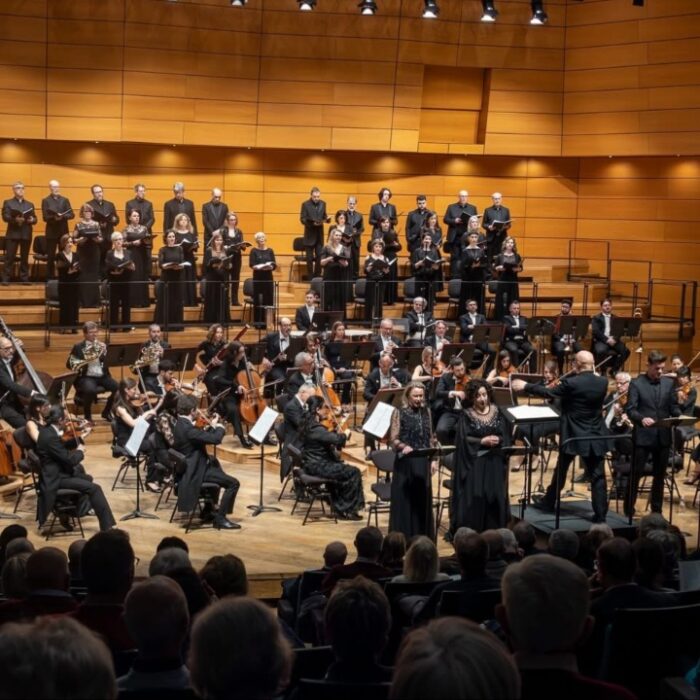
Only at the Rossini Opera Festival can one experience the performance of a true, unpublished jewel by the Swan of Pesaro. Since its founding in 1980, the Festival is held annually in Rossini’s hometown and has played a crucial role in the philological reexamination of many of his works, most of them rarely performed in modern times. Thanks to this effort, several of these pieces have reentered the repertoire and today appear regularly on stage as part of the so-called Rossini renaissance. A shining example of this work was the program presented in a single performance, featuring three cantatas for solo voice, chorus, and orchestra. Audiences were treated to an afternoon of rare gems of great value, with Rossini’s youthful cantatas presented in the critical editions prepared by the Fondazione Rossini in collaboration with Casa Ricordi.
The first cantata, “Il pianto d’Armonia sulla morte d’Orfeo” (The Lament of Armonia on the Death of Orpheus), was not only the opening piece of the concert but also Rossini’s very first composition. Dated July 1808, when the composer was only sixteen years old, it was written to a text by Father Girolamo Ruggia. Even at this early stage, the theatrical instinct of the future opera master is already evident. The work stands out for the ambition of its writing and the complexity of its form: an introductory symphony, recitatives, two arias, and extensive choral interventions. Tenor Dave Monaco tackled the challenging solo part with generosity and confidence, excelling both in the heroic passages and in the more intimate moments. A moving solo from the cello added notable intensity, underlining the unexpected melancholy of the young Rossini.
The second cantata, “La morte di Didone” (The Death of Dido), critically edited by Cecilia Nicolò, was composed between 1810 and 1811. A letter Rossini wrote to his mother in 1812 explicitly mentions this cantata about the abandoned queen. At barely twenty years old, Rossini confronted the Metastasian myth of the Queen of Carthage, betrayed by Aeneas and driven to suicide. In his autograph manuscript, Rossini defined the piece as a “Grand Scene for soprano and chorus,” and indeed the structure foreshadows the great scenes of his later serious operas: a Prelude, choral intervention, recitative, aria with cantabile (“Se dal ciel pietà non trovo”) and cabaletta (“Ah! Quanto pena un’anima”), culminating in the dramatic epilogue “Per tutto l’orrore.” Soprano Giuliana Gianfaldoni embodied a powerfully dramatic Dido, with a luminous voice and admirable stylistic control. In the cantabile, she sculpted broad, sorrowful phrases, while in the cabaletta she unleashed a torrent of precise and brilliant coloratura. The chorus, compact and incisive, contributed decisively to creating a fully theatrical atmosphere, confirming how the cantata already anticipates the great operatic scenes to come.
The program concluded with the extremely rare “Il pianto delle Muse in morte di Lord Byron” (The Lament of the Muses on the Death of Lord Byron). Written in London as a tribute to the English poet, the cantata also carried a political undertone. As Eleonora Di Cintio noted in the program notes, the work helped soften criticism of the composer, since Rossini himself was not particularly moved by Byron’s death- actually, he had only met him once, in a Venetian restaurant in 1817. Composing this piece allowed Rossini to reaffirm his prestige in British society. In the cantata, Apollo’s solo voice converses with the Muses in an elegiac framework that alternates between intimate emotion and solemn expansiveness. Once again, Dave Monaco gave a performance of vitality, noble phrasing, and evident solemnity, highlighting the lyrical nuances and chamber, like subtleties of this work of undeniable artistic and documentary value.
The musical direction of Cesare Della Sciucca, leading the Orchestra Sinfonica Gioachino Rossini, was consistently marked by clarity and rhythmic drive, enhancing the dynamic contrasts and orchestral colors. He was supported by the firm, incisive male Chorus of the Teatro Ventidio Basso, under chorus master Pasquale Veleno. Considering Rossini’s youth when composing these cantatas, one might assume that their style was not yet fully formed (just as the youthful works of Verdi or Beethoven had not yet achieved their unmistakable signatures). Yet the “serious” Rossini is already strongly present here, with echoes—or rather anticipations—of Semiramide and Guillaume Tell, despite being composed nearly fifteen years earlier. Della Sciucca clearly grasped the direction of the young genius’s developing musical thought, delivering a performance that was both beautiful and faithful.
This evening allowed the ROF to showcase the genesis of Rossini’s musical language and to present these rarities within a high-level interpretative framework, reaffirming its mission of research and the integral reappraisal of the Pesaro master.