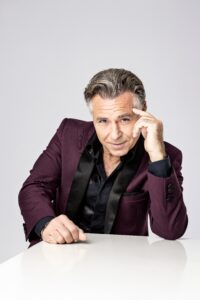
Q & A: Roberto Alagna on Making Waves at 62, Singing ‘Turandot’ at the Royal Opera House & Career Highlights
By Mike Hardy(Credit: Slawek Przerwa)
Legendary tenor Roberto Alagna is celebrating 43 years in the business. Considered to be the least talented in a large family of musicians, he nonetheless spent his youth busking around Paris cabarets, singing pop music accompanied with his guitar. But his passion, fired by Mario Lanza films, was opera and, largely self-taught, he pursued that dream.
That culminated in him winning the Luciano Pavarotti International Voice Competition in 1988 after having been discovered by French impresario and opera director Gabriel Dussurget. There is an account of Pavarotti inviting him to an audition, after Alagna sneaked in to get his autograph when the great, late Italian tenor was visiting Paris.
In 1995, he received the most prestigious British theatre award, the Laurence Olivier Award, for his performance as Romeo in Gounod’s “Roméo et Juliette” and he was subsequently catapulted to international stardom. He was constantly referred to as the “NEW Pavarotti” or “The fourth tenor,” referring to the renowned trinity of Pavarotti, Domingo and Carreras. The government of France named Alagna Chevalier of the Légion d’honneur in 2008.
OperaWire caught up with Alagna at the Royal Ballet and Opera House, Covent Garden, where he is performing the role of Calaf in Puccini’s “Turandot.”
OperaWire: Roberto Alagna congratulations on a successful opening night with “Turandot.” You have well over 100 performances now, here at Royal Opera. What do you remember about your debut here in 1992?
Roberto Alagna: Thank you! Yes, maybe more, I think it was 100 when I did “Andrea Chénier” in 2019. My debut here is a beautiful memory, I remember, because it was “La Bohème,” one of my favorite operas at that time. And I was so happy to be in that production, because I saw a production on video, I remember, with Neil Shicoff, Ileana Cotrubaș and Thomas Allen. And to be here, I was very proud, because sometimes when you are young, you dream about such productions that you see on television. It was such joy, but MORE than joy. It’s like, I don’t know, being part of the history. I say all the time, the art, the lyric art; it’s like a cathedral. And every singer brings a stone to build this cathedral, and I think in that moment I brought my stone.
OW: “Turandot” is a different animal, is it not? Traditionally a more dramatic tenor role, somewhat different from most of the roles you’ve performed as a renowned lyric tenor. And of course, you’re going to be performing it in Milan and at the Met?
RA: And also in Miami and in the summer in Italy. When people say, “this is a part for this type of tenor voice,” or “this is a part for that tenor type,” I usually answer: I believe a part is good for you when you are able to sing the entire opera. Because sometimes you may have a very dramatic voice sound, a baritonal sound, but you can’t sing the opera in integrality. And vice versa. The most important thing is to sing the whole opera. And I think I was very lucky to be a lyric tenor. Because the lyric tenor, the full lyric tenor, can sing everything.
It was like this back then. In the past, the best tenors who sang everything were lyrical. Like Gigli, like Pertile, like Björling, like Pavarotti. This is the most beautiful voice because it offers the most possibilities. Because a lyric tenor, like Bergonzi, can sing from the light repertoire and sometimes even tenore di grazia up to drammatico. And I think I was lucky because when I started, I believed I would sing only a very small repertoire when in fact, I ended up singing a very large one.
OW: There was quite a period of time in fairly recent history where critics were suggesting that whilst Roberto Alagna still had a sound technique, the voice was beginning to sound worn and a little tired. However, I have been reading recent reviews that all seem to point towards some kind of “resurgence,” that you are singing with, for example “a forceful energy.” Is this something you have noticed yourself and have you been training your voice in a different manner?
RA: No, not at all, not at all. I’ll tell you something. From the very beginning of my career, I received bad critical reviews. But I think this is natural. In fact, I was harder on myself than anything the critics might write. Actually, the voice is the same. I think… you can find some critics from 25 years ago, who would say, every time when I come back to the theater: ”Oh, he doesn’t have the voice anymore.”
And then, later, they will write: “Oh, the voice is still there”.
It was like this every year. And all the time, they suggested I had lost the brightness of the past. But when other singers are listening to me, they would tell me: “How was the voice possible to be brighter than today?”
I sing all the time with the same technique, with the same voice, the same sincerity and the same generosity. Because first, you must be generous on stage. In fact, when I’m on stage, I give everything I have in that moment: at that very moment, it is impossible for me to do better because I try all the time to do my very best. Of course, it’s not possible to be all the time like a miracle, but I was quite lucky because I performed a lot. Thank God I received some criticism because I think it was my motivation to improve. To try to be better and better and to reach something.……. I sang a lot, and I cancelled very rarely. And I’m still here at 62!
OW: Quite a few people I speak to within this industry, artists included, often opine that the world of opera is in some kind of crisis, that perhaps it is a dying art. What are your thoughts on this?
RA: Not at all. I think Opera was never so popular than today. Never. You have manifestations of opera everywhere in the world. Festivals, new festivals every summer, everywhere. You have today with the media, with a lot of platforms, MANY possibilities for listening to opera, YouTube, Spotify, a lot, a lot. It was never like this before. It was previously difficult to go to the opera, to have tickets, to listen to opera on television, to have the possibility to listen to singers. Today, you can look on YouTube, and you can find everything. If you want to study, you can watch and watch for hours and hours, and I think it’s fantastic for young singers. You can learn a lot because the real teachers are the singers, not the people who say this and that in the small rooms. It’s not that. The real teacher is the singer who sings on stage. And you can learn there what he’s doing. You can observe everything, the way in which he catches the breath, the emission of the voice, the expression of his face, everything; you can learn a lot by watching the singers from the past.
And before, it was not like this. When I was younger, it was impossible to have that. Actually, I think today, opera is very popular; very popular. Sure, some things have changed, in the taste…… in the style……. but this is normal. It’s an evolution, the normal evolution of life. Fashions change, but I think opera is here forever.
OW: Speaking of young singers, what advice would you offer someone starting out in the art today?
RA: I NEVER give advice. You know why? Because it’s very dangerous. Very dangerous. Giuseppe Di Stefano, the great Di Stefano, said something very philosophical and very wise. He said: “Don’t give me advice because I can make mistakes myself.”
You must learn for yourself, because in fact, an opera singer is something special. It’s a rare something, a talent you received from nature, or from God…….as you want. And you received with this talent a program into your brain and body, like a processor programming.
And you have to find with serenity, with meditation…..you have to find that program, because everything is inside. You have everything. But the problem is after you take advice, you want to look for something different. Maybe you want to hear something different, and it creates a bug in the program. This is the danger. It is more important to try to know yourself and to try to find what you received and to accept that. This is the most difficult thing because all the time you want another voice. It’s very rare when a singer is happy about his voice…… about what he received. He wants all the time to look for another one.
OW: So, I’m guessing you have no aspirations to teach?
RA: No, I don’t want to teach. Because it’s too much responsibility and too risky. When I see on YouTube, or elsewhere, masterclasses with my colleagues’ giving lessons, I start to laugh. It looks like a circus, doesn’t it?
I believe you learn nothing from that. You’d better get to know your body, your possibilities. You must be humble. Try to find out what is your truth. And also, your limits. You have to accept that.
But not to be comfortable all the time. Because a lot of people want to feel comfortable. They do a certain opera because it’s comfortable. They will sing just that. No!. You have also sometimes to take challenges, even to make mistakes, also to push your voice until its limit is reached. Because then you can discover new possibilities in your technique, in your voice, in your body. And after that, you come back from another repertoire, and you will sing better.
And it’s our mission. It’s like a high-level sport. All the time, you must be searching for new possibilities. This is important for you and for the audience. Otherwise, you are just a “gestionnaire;” a manager; not an artist.
OW: You mention sports…..you still seem remarkably fit and healthy Do you still have a fitness regime?
RA: I do Tai Chi. I’m still in good shape. I try to keep my weight down and be careful. I’m 62 now.
OW: Yes, but you know, Gregory Kunde made his debut in this house when he was 62 years of age?
RA: I know, Greg is a great, great singer. He’s 72 now I think, and he sung recently with my wife in Paris, in ‘Aida’ and he was in great voice.
OW: Looking back over your long career, is it possible for you to pick a career highlight?
RA: For a long time, I didn’t really feel part of this profession, or this world. I had followed my own path from the beginning. Maybe for that, I received a lot of harsh criticism, because I was coming from nowhere: no formal conservatory studies, I was all the time very shy at home, with family. In this cycle of theater, home, family, theater. And it was not easy, because at the beginning it was difficult to be accepted, because I came from Cabaret, another world. It was strange. And I was very young. When I started my first opera, I was only 20 years old.
So, for me, whenever I think of the best moments and highlights of my life, they are always tied to an opera character. For example, Rodolfo, he was a dream for me when I was very young.
But also, Cyrano de Bergerac, because in France, Cyrano de Bergerac, for us, is a very wonderful character. And when I had this chance to sing and to be Cyrano, it meant a lot to me and it even changed a lot within me. Because I, like Cyrano, had a lot of complexes, as many people do, and it was my therapy to do Cyrano de Bergerac.
I have many beautiful memories. When I sang “Pagliacci” for the first time, I was very young. I was just 35 years old when I sung it with a great cast and a great conductor. And then I had La Scala. Some other great highlights were my crossover project, which are wonderful memories for me. For example, when I made my Sicilian CD with the Sicilian repertoire, it was amazing because I never imagined that success. We sold one million copies, and we made it just in France. And still today, they are asking me to sing Sicilian songs. I did this recording for my grandmother.
And, of course, it was the greatest of moments when I met Aleksandra here in “L’elisir d’amore!” in my career, I was lucky many, many times. Because I always had beautiful colleagues. I had so many great times with everybody in this profession.
I sang my entire life. I think this is something strong I received, and I think it’s something you receive inside, in your soul, because my father is the same. Today he’s 86. He sings every day, everywhere, and thanks to that, he forgot all the hardships in his life. He can endure any pain, any sadness, because of singing, and I think I am a little bit like him.
OW: What is there left for you to sing? Do you aspire to sing something new?
RA: I think I sang more than I expected to, I received much more than I expected. Because I remember when my mom asked me: “Are you sure you want to sing opera?”
I responded that I just wanted for a few years to sing in a choir. It was my biggest ambition. And I remember every time when they offered me a new opera, I would say:
“Oh, no, no, it’s not for me!,” But after that, I started to read the score, and I fell in love with the music. And when I fell in love, I had to try and conquer, to achieve. And it was always like that. And today, when I think back, I realize I’ve done a lot. Maybe too much, I don’t know, but I’m still here. I’m happy. This is something fantastic, every night, to be a different character. In every opera, you are someone else and because of that…..you start to know yourself better.
OW: I’m going to read you something you said the last time we spoke. You were celebrating 40 years in the profession. This is what you said: “I still have this flame inside, this fire, this passion. I still feel the same thrill for singing like I did at the beginning. I am an eternal student.” You’re now celebrating 43 years singing opera. Do you still have that flame?
RA: Yes. And I will tell you something. I have in my head a sound. Maybe it’s the sound of perfection. And I can’t reach that sound. But I first heard this sound when I was 10 years old. I was in Syracuse. In a cave, an artificial cave called ‘Orecchio di Dionisio,’ the ‘Ear of Dionysius’ made by the tyrant Dionysius. The cave has the most incredible acoustic properties. And when I was 10 years old, I went to this cave and whilst I was there, I sang a sound, a note. And I will tell you something incredible. I received the Holy Spirit in that moment. It was like I had been struck by lightning! I received an energy in my body.
And this sound, I think in that moment the flame, the fire was ignited. Born. In that moment, because I received such a lightning, bolt of light. Like God had lit this flame himself. And after that moment, I dreamt all the time, trying to reach again this sound. But it was impossible. I sometimes remember it when I dream, I hear that sound and feel that sensation again. But as soon as I wake up, I can never find it again!
And my entire life was, and still is, to find the solution, to find a way to reach again this sensation and this perfect sound.