Q & A: Mattia Olivieri on ‘Eugene Onegin,’ Santa Fe Opera & Returning to the Metropolitan Opera
By Francisco SalazarItalian baritone Mattia Olivieri has become one of the most in-demand singers of his generation performing at major opera houses including the Teatro alla Scala, the Metropolitan Opera, Wiener Staatsoper, Semperoper Dresden, Teatro Massimo in Palermo and Opéra de Paris.
He has become renowned for his Italian repertoire in particular the Bel Canto works and has slowly moved into heavier Verdi works as well as experimenting with modern music and singing French and Russian works.
This summer he is singing his second “Eugene Onegin” following his debut at the Palau de les Arts and this season he is returning to the Metropolitan Opera for “Silent Night,” among many other important role debuts and revivals.
OperaWire had a chance to speak with the baritone about Eugene Onegin, singing in Russian and his return to the Metropolitan Opera.
OperaWire: This is your debut at the Santa Fe Opera and your second Eugene Onegin, which you sang at the Palau de les Arts in Valencia. What is the difference between singing in Santa Fe and in Valencia? And how does singing outdoors affect your performance?
Mattia Olivieri: Well, I have to say I was very pleasantly surprised because I had the opportunity to see “Madama Butterfly” and “The Magic Flute,” and I have to say that the acoustics in this theater are incredible despite being outdoors. The structure truly allows you to sing everything—from the softest passages to the most powerful ones. There is an excellent balance between the singers, the stage, and the orchestra pit. It’s truly a magical stage because when the sun sets in Santa Fe, it’s something absolutely extraordinary.
From the audience’s perspective, seeing the stage merge into the desert landscape of Santa Fe is incredibly beautiful. The natural colors of the sunset add something authentic and special to the performance itself. Another thing that really struck me is that sometimes butterflies fly across the stage, or birds pass overhead while you’re singing. It makes everything feel so real and incredibly moving because it’s not something you experience every day.
I’ve also had the privilege of singing at the Arena di Verona and at the Sferisterio in Macerata, which is another open-air venue in Italy. It’s somewhat similar, although the sunset isn’t quite the same. Perhaps it’s closer to the Arena di Verona, but less so at the Sferisterio. Here, especially in “Eugene Onegin,” the stage design leaves the back of the set open. As a result, you actually watch the sky gradually change color until night falls. It’s truly beautiful.
OW: Is singing in Santa Fe similar to the Arena di Verona?
Mattia Olivieri: Yes, in some ways it’s similar but not exactly in terms of singing because here the acoustics are different. Even though it’s an open-air theater, there is still a roof above the audience and stage, whereas the Arena di Verona is completely open. I have to say that singing here feels easier because you receive more acoustic feedback. You can hear your own voice returning to you, and the projection is different. It’s truly a magnificent structure.
OW: This is your second time performing Eugene Onegin. How has your understanding of the role changed after singing it first in Valencia and now here in Santa Fe?
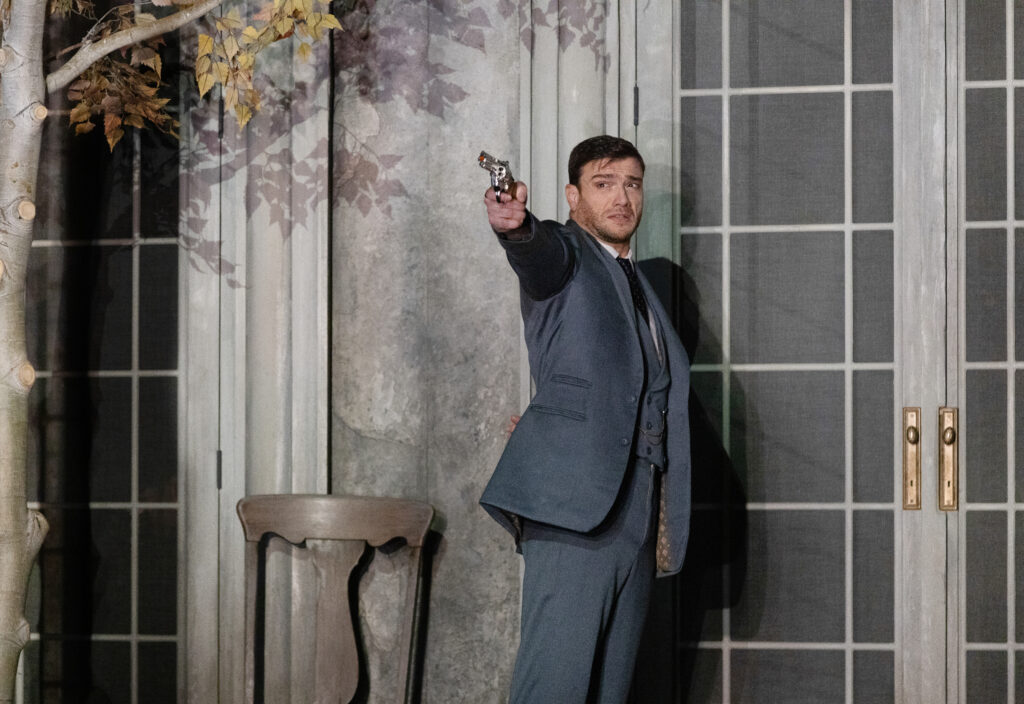
MO: I start from the idea that Onegin is a cold and detached person. In my opinion, he is cold and distant mainly because that’s his way of protecting himself. He hasn’t yet learned how to express his feelings. There’s a crucial moment in the opera that always makes me reflect. For me, it’s the point where Onegin’s entire character changes and that is the duel with Lensky, when he kills his best friend. From that moment onward, everything changes for Onegin.
In Pushkin’s time, duels were common. People fought them all the time. It wasn’t something unusual. But when he kills his own friend, perhaps over something so foolish, everything changes. Later, during the great ensemble scene, Onegin himself admits that he probably behaved badly toward Lensky and Olga. He provoked Lensky simply because he was bored. He didn’t want to be at the party. He felt completely out of place in that world. So, perhaps just to get back at Lensky, he began flirting with Olga. He never imagined that it would actually lead to Lensky’s explosion of anger and ultimately to the duel that cost Lensky his life.
For me, that’s the turning point. Onegin abandons everything. He leaves, spends years traveling, and only much later returns. It is only then that he finally removes the mask he has been wearing.
In my opinion, throughout the first two acts Onegin wears a mask. He presents a version of himself that he wants others to see rather than who he truly is. He is an aristocrat, an educated and cultured man. He knows how to behave in society and certainly knows how to charm women. He isn’t foolish at all. But after killing his friend in the duel, he experiences a profound personal crisis.
For me, that crisis defines everything, including the monologue at the beginning of Act three, when he returns from his travels and admits that traveling no longer brings him any satisfaction. Before, traveling may have compensated for what he lacked. It gave him purpose. Now, even that no longer helps him. Perhaps the remorse has been consuming him from the inside.
When I prepare a character, I always try to connect that character with something personal. If I think about my own best friend—and I know something like this will never happen—I still try to imagine it. When I portray Onegin and Lensky, I think about my own closest friend. If I imagine us arguing and never speaking again, I immediately feel that terrible sense of regret—that it would have been such a foolish thing.
Now imagine that, instead of simply losing your friend, you’ve actually killed him. Onegin loses every certainty he had. So when he returns from his journey in the third act, he has finally taken off the mask he spent years constructing. The tragedy is that it’s too late. Tatiana is no longer free. When he first sees her again, he doesn’t even recognize her. He has to ask Prince Gremin: “Is that Tatiana?” “She doesn’t even look like Tatiana anymore.” “She looks like a queen—a princess.”
Then Gremin enters and tells him, “Yes, she’s my wife,” and sings that magnificent aria. For me, that’s another decisive moment. It’s as though someone drives a knife into Onegin’s heart—and then twists it. Gremin describes how wonderful and perfect Tatiana is, reminding Onegin of everything he has lost. Because this isn’t simply a love story. For me, it’s a story about lost time. Onegin wasted his chance.
His greatest tragedy was that he never allowed himself to be open to genuine emotions.
OW: I’ve also always felt that Tchaikovsky’s music for “Onegin” changes after the second act. In the third act, we hear a much more emotional and expressive Onegin. Earlier, his music is serious and restrained.
MO: Exactly. It’s cold and detached. Even vocally, it’s different. It’s not an aria like Lensky’s, Gremin’s, or even Tatiana’s, where the emotion flows naturally. Onegin always remains behind his mask. Even in his music, he doesn’t truly communicate his feelings.
That’s why, for me, the third act is the most rewarding part to sing. That’s where he finally removes that mask. He finally reveals who he really is. The tragedy, of course, is that time has already passed and tt’s too late.
OW: In the opera, we never actually see the years Onegin spends traveling after the duel. How do you imagine that period when you’re creating the character?
MO: As I was saying before, I believe those years, between the duel and Gremin’s ball, were probably the darkest years of his life. Onegin is someone who struggles to express his emotions. Because of that, I also think he struggles to build genuine friendships. When he loses Lensky, he loses what I believe was his only true friend. I like to think Lensky was the one person who truly understood him. The only one capable of staying close to someone as difficult as Onegin. Because Onegin isn’t an easy person, nothing is ever good enough for him. He constantly hides behind this mask of superiority. He believes he’s above everyone else.
If I put myself in Lensky’s shoes, I imagine it couldn’t have been easy to be his friend. So losing Lensky destroys him.
When I think about it, I imagine a completely empty man. A hollow man. Someone who has lost everything inside. That’s why he begins traveling again. He tries to fill that emptiness. But nothing helps anymore. Meeting new people doesn’t help. Visiting new places doesn’t help. Going to parties doesn’t help. He was always a man who lived in society, always surrounded by social events. Now even those things have lost all meaning. That’s why, when he returns in Act three, especially in his first monologue, I see him as completely empty. Completely lost.
Then suddenly he sees Tatiana again. And something comes back to life inside him. She awakens memories of what he once had. What’s especially beautiful is that he begins singing words that echo those from Tatiana’s Letter Scene. For me, that’s the moment when hope returns. Even if it’s only the smallest spark. The hope that perhaps he can recover the time he has lost.
OW: In the final scene of the opera, you can still see that hope. But we know that in this scene Tatiana is the one who appears cold. How do you interpret this scene in order to show all of Onegin’s emotions?
MO: This is my favorite scene in the entire opera. It’s the moment when the cold, controlled Onegin disappears and the truly emotional Onegin emerges. What I enjoy most is portraying that transformation. You go from someone who is serious and emotionally restrained to someone who completely explodes. At that point he simply can’t contain his feelings anymore. He experiences every emotion imaginable.
At first he is gentle and affectionate. He promises Tatiana that he can give her everything, that he can make her happy. But as the scene progresses, he becomes increasingly desperate. Finally, he almost turns aggressive—not violent, but overwhelmed by desperation.
He insists: “No, you’ll be happy with me—not with someone else. You have to be with me.” It’s an incredibly difficult scene because it’s overflowing with emotion.
This final act is where he truly loses control. He’s no longer the composed man we’ve known until then. Whenever I prepare a role, I always try to find something in the character that connects with my own life. Some personal experience. Because in the end, every performer brings their own experiences onto the stage. Of course, everything also depends on the director and on the dramatic interpretation we’re creating together. But I always like to bring something truthful. I try to bring part of my own truth into every character.
After all…Who hasn’t cried because of love? Who hasn’t gone through heartbreak? Who hasn’t been devastated after losing someone they cared about? Who hasn’t reached that last desperate moment where you try one final time to tell the other person, “Everything will change.” “Please believe me.” Especially after you’ve made mistakes yourself.
That’s how I see Onegin. He’s desperately trying to convince Tatiana that they could still be happy together. Then there’s that brief moment of calm in the duet, when they both seem to acknowledge: “We could have been happy.” If you stop and think about it, that’s another knife through Onegin’s heart. Because once again he’s confronted with the realization that he wasted time. That is his greatest regret.
OW: You could even say that the greatest tragedy of the opera is that Onegin loses everything because he was arrogant.
MO: Yes. Absolutely. But again, I think that arrogance was actually a form of self-defense. He created this version of himself to protect himself from other people. It was like wearing armor. Something he used to protect himself because it made him feel safe. As long as he stayed inside that armor, nobody could hurt him. From the outside he appeared to be completely self-confident. A respectable man. Someone who always knew exactly what he was doing. But in reality he was incapable of recognizing the true value of genuine human feelings. And because of that, in the first act he rejects Tatiana’s sincere love.
It’s remarkable how much this character changes throughout the opera. Perhaps more than almost any other operatic character. Many characters remain fundamentally the same from beginning to end. Onegin doesn’t. He changes completely.
OW: The repertoire often assigns baritones the role of the villain, so they don’t always get characters with this level of psychological complexity. Tchaikovsky wrote extraordinarily sophisticated music. As an Italian, tell me about the challenges of singing in Russian? And what’s the difference between singing in a Romance language like Italian and singing in Russian?
MO: Well, there are obviously sounds in Russian that simply don’t exist in Italian. There are also some guttural sounds that are completely unfamiliar to us. But I have to say that singing in Russian is wonderful. I truly love it.
I remember when I first started learning this role—it was incredibly difficult mainly because there are so many consonants grouped together. I also remember working with my language coach. In Italian I always try to make sure the audience understands every word I sing. I wanted to achieve the same clarity in Russian. But at first I had the opposite problem. Especially while preparing the role, I emphasized the consonants too much, and that interrupted the legato. So it was a real challenge. But it was a beautiful challenge.
As you said, Tchaikovsky wrote extraordinary pages of music. They’re demanding, but they draw you into an incredibly beautiful emotional world. I have to say that Russian is a wonderful language to sing. Even now, for example, some of my colleagues—Olga Kulchynska, who’s singing Tatiana—have told me I can sing other Russian repertoire. Now that I’ve become more familiar with the language, I’ve discovered just how beautiful it really is.
OW: Let’s talk a little about your relationship with Olga Kulchynska and the work you are doing together. How did the two of you develop the relationship between Tatiana and Onegin?
MO: The relationship between the two characters is completely reversed in the third act. At first, Onegin is the cold one. He’s the one rejecting Tatiana’s sincere love. By the third act, everything has changed. Now Tatiana is the composed and determined one. She has made a commitment to Prince Gremin. She tells Onegin very clearly that she isn’t going to turn back. Meanwhile, Onegin tries to persuade her in every possible way.
For me, the process was actually quite easy because Olga and I already knew each other. We’re friends. We’ve worked together before. That made it very natural for us to build this relationship for the final scene of the opera. The director also wanted that final encounter to be extremely passionate. And I can honestly say that we both cry on stage. Not because we’re acting, but because we’re so emotionally immersed in the scene that the tears simply come naturally. It’s something incredibly beautiful.
OW: Conductor Keri-Lynn Wilson is well-known for Russian repertoire. Tell me a little about working with her.
MO: Maestro Wilson always emphasized one thing above all else, Legato. She constantly encouraged me to search for that long vocal line. At the same time, she wanted Onegin to remain noble. Even during the first two acts, even in moments like the Larina party—when Lensky challenges him—she never wanted me to lose that sense of aristocratic elegance. She didn’t want Onegin to become someone who shouts or loses his dignity. Even when he becomes angry and accepts the duel, she wanted him to do so with elegance because he’s surrounded by people. He never wants anyone to see what he’s really feeling. That was the central idea behind our work together.
I appreciated it enormously because I personally love singing with as much legato as possible. For me, pursuing the most beautiful legato is always the ideal. Working with Keri-Lynn has also been wonderful because she’s always smiling. When you’re singing and the conductor is smiling at you, you naturally feel more relaxed. You feel supported. She’s always there with you. It’s truly a pleasure to work with Maestro Wilson.
OW: What kind of production has Santa Fe created for this festival?
MO: It’s actually a revival of a production that premiered during the pandemic. It’s largely a traditional production. The costumes are absolutely beautiful. The sets are extraordinary. Visually, I think audiences are going to love it because it contains everything many people hope to see when they go to the opera. There are magnificent evening gowns, tailcoats, and Masks. All the visual elegance people associate with this repertoire.
At the same time, the director introduced several psychological elements. For example, I appear briefly during Tatiana’s Letter Scene. At the very end of the scene I appear almost like a vision inside her imagination. There’s even a kiss between us because the director wanted to create the feeling that this entire sequence exists inside Tatiana’s emotional world.
The Larina party is also presented almost like a nightmare taking place in her mind. At one point I even appear wearing a bull’s mask. Tatiana is dressed in a magnificent gown that’s deliberately torn and stained. All of these elements help create the feeling that what we’re seeing isn’t entirely reality but rather a kind of dream—or nightmare—inside her head.
OW: I’d like to finish by asking you about your return to the Metropolitan Opera. You’ll be singing “Silent Night.” You’ve already appeared at the Met in “Florencia en el Amazonas.” Your repertoire is largely traditional Italian opera, especially bel canto. What attracts you to performing more contemporary works like “Florencia en el Amazonas” and “Silent Night?” What do you enjoy about these operas?
MO: I’ve always believed—and I’ve said this many times—that precisely because I’m Italian, I don’t want to limit myself to the idea that “He’s Italian, so he should only sing Italian repertoire.” I enjoy discovering different musical worlds. For me, that’s the beauty of music.
It doesn’t exist in just one category. It isn’t simply bel canto. It isn’t just Rossini, Mozart, Donizetti, Bellini, and a little Verdi. Music is universal.
About a year and a half ago I made my debut in “Il prigioniero” by Luigi Dallapiccola. It’s a 20th century work, written using twelve-tone techniques. I have to say it was one of the most fascinating scores I’ve ever studied and performed. Sometimes music that feels completely unfamiliar to you opens your mind, it changes the way you think. It allows you to discover entirely new perspectives. I’ve always been an extremely curious person. I’ve never wanted to remain confined within my own little garden. Of course, being Italian gives me access to an enormous repertoire. There are countless Italian operas that I could sing. An extraordinary amount of music has been written in Italian. But I’ve never wanted to stop there. Again, I don’t want to be placed inside the box that says: “He’s Italian, therefore he only sings Italian opera.” I enjoy challenges. I enjoy discovering new things.
So when the Metropolitan Opera offered me “Florencia en el Amazonas,” I was absolutely thrilled. Then, as I began studying the score and later rehearsing with Maestro Yannick Nézet-Séguin, I still remember those first orchestra rehearsals. Listening to the music was an incredible experience. In some ways it reminded me of Puccini. Not because it sounds exactly like Puccini, but because Daniel Catán’s orchestration paints everything so vividly. He describes the Amazon River. He describes the storms. The landscape. The atmosphere. If you removed the text completely and simply watched actors moving across the stage, the orchestra would already tell you exactly what’s happening. That’s something Puccini also does extraordinarily well. If you removed the singing from “La Bohème” and simply watched the characters moving while listening to the orchestra, I think you could still understand the emotions and the dramatic action taking place on stage. I’m thinking, for example, about the third act. The orchestra itself almost makes you suffer alongside the characters. Everything is so vividly descriptive.
For me, “Florencia en el Amazonas” works in much the same way. So when the Met later offered me “Silent Night,” I was immediately enthusiastic. I was completely open to it because it’s wonderful to express yourself through music that isn’t part of your everyday repertoire. It’s easy to remain inside your comfort zone.
In Italian we have an expression: “Staying in your own little vegetable garden.”
It’s easy to stay there because you know the ground. You know what you’re doing. But once you step outside it, you never know what might happen. I’ve always enjoyed experimenting. I’ve always enjoyed exploring new repertoire. Of course, always respecting my own voice and my own vocal development. I never accept a role without thinking very carefully about whether it’s right for me. For example, I’m now 42 years old, and only recently have I begun singing Verdi roles. I deliberately didn’t begin earlier. I preferred to let my voice develop naturally. Now I’m gradually entering the Verdi repertoire. I have several Verdi debuts coming up, and I’m very excited about them.
Ultimately, what I enjoy most is not limiting myself to Italian repertoire alone. I adore Italian opera. It’s beautiful. After all, I grew up with it. But at the same time I love experimenting.

Stories you may also like…
Q & A: China Now Music Festival Artistic Director Jindong Cai on Celebrating America’s 250th Anniversary Through Chinese-American Experience

Q & A: Victoria Frances Young on Her Fixed-Media Operatic Work ‘Breaking News’