Q & A: IN Series Opera Director Timothy Nelson on ‘Passion Plays’
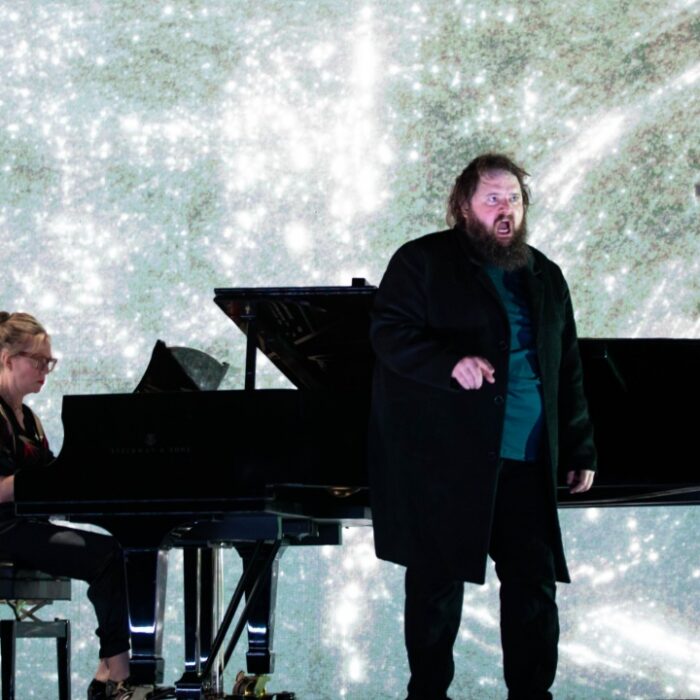
By Arnold SaltzmanIN Series Artistic Director, Timothy Nelson, who is passionate about opera is presenting a series of “Passion Plays” based on the music of J.S. Bach, Gabriel Fauré and Adrienne Torf. While IN Series does not normally present a festival of new works, this is a special offering to audience members who can purchase tickets to all three events, each of the first three weekends in March, including “Only the Air,” “Passio,” and “For Women Serving Time.”
Performances will take place at Dupont Underground (DC) and Baltimore Theater Project (Baltimore). IN Series program notes: “This festival brings three new music-theater works to life, each exploring different aspects of human passion, suffering, redemption, each with a unique musical landscape, and all featuring world class artists using music, drama, and meaning to spark transformation.”
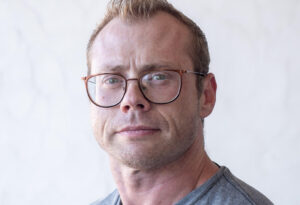
OperaWire visits with Director Timothy Nelson to learn more.
OW: It’s a pleasure to meet you. I have attended a number of IN Series productions, and I’m looking forward to the new Festival of “Passion Plays.” What brought you to Washington?
Timothy Nelson: Although I spent a lot of time in the DMV area growing up, I was born in rural West Virginia and grew up in the Blue Ridge mountains of Appalachia before going to school in Baltimore and running a small opera company in Baltimore for a number of years. What brought me back to Washington, and indeed the US, was IN Series and a desire, this was immediately after the 2016 presidential election, to be in the trenches in my home country. I didn’t want to be a freelance director, I wanted to be able to help transform a community over a lifetime, and in particular my American community.
OW: Would you agree IN Series is more than a lab for opera, it is a full opera company, with a chamber music approach?
TN: I don’t think I’d ever describe IN Series as a lab for opera. I suppose because all the work we do is new in the sense that it reimagines both repertoire and form, and tries to explore how ELSE music and theater can align to change people, it is inherently experimental, but not for the sake of experimentation the way a laboratory is. I think we are actually much more interested in existing canons of work across times, places, peoples, experiences, how these things intersect to tell more interesting (and incidentally interesting stories), and how the unexpected, the surprising, blending can, again, transform.
OW: How has IN Series changed since you became Director?
TN: It’s most important, to recognize that whatever we are, whatever we are able to do, it is only because of the vision and imagination, and courage of those that came before. In this case our founder Carla Hubner, who was creating a place of artistic bravery and boldness in the early 80’s that rivals any innovation happening in the arts anywhere. That quality is in our DNA at IN Series because of her, and what I inherited was a gift, and opportunity, of a place that was already ripe for doing the sort of things I want to do, that give me joy and I hope bring beauty into the world. I only feel lucky that I was able to see that opportunity and to take it. We’ve grown significantly in budget and scope, and I think redoubled our efforts to balance, or juggle, excellence, innovation, compassion, focus and love of local artists, creativity, authenticity, but again in a way that was always in our essence. I suppose we have professionalized and better understand our own position in the industry as a sort of good-natured anti-opera, I hope a vision of a different way of being for our industry. Mostly, however, we stay focused on doing good work, and working in a good way.
OW: Years ago I attended IN Series programs at Mount Vernon College and the Washington Masonic Temple in Alexandria – including productions of Copland’s “The Tender Land” and Mozart’s “Don Giovanni” conducted by Joel Lazar. How is the repertoire for opera changing?
TN: Sometimes I wish the repertoire was changing more than it is, and I almost always wish the way we present the repertoire would change. I think because of the work IN Series does, and because of our place in the artistic firmament, I may have a reputation of someone that hasn’t always loved or appreciated the canon. Nothing could be further from the truth. I actually see much of the work I do coming out of a deep love and admiration, and study of the canon. The playing with it may be irreverent at times, but it is never cynical – I do it, we do it, because we think an irreverent attitude to the canon is how we can save the canon. Just as our inflexible approach to the constitution as sacrosanct may very well signal the death knell of our nation’s core text, so too I fear the opera industry’s inability to imagine other approaches to the canon is the noose too often around opera’s neck. I love opera, I love good singing, I love story told through music so well written it is itself its own compelling subtext. My biggest challenge in programming at IN Series is often not allowing myself to do a piece just because I love them, but ensuring they align with the vision and values of this organization. There is so much out there I’d love to direct or produce, but my first priority has to stay true to the IN Series mission.
OW: I’ve seen your productions Blitzstein’ “The Cradle Will Rock” and Verdi’s “Rigoletto” in a circus setting, as well as Stradella’s “St. John The Baptist” and Damien Geter and Jarrod Lee’s “The Delta King’s Blues” which has been my favorite. These were innovative productions. How do you decide on repertoire and artistic input for these works?
TN: Many of these I only produced. “The Cradle Will Rock” was by the wonderful Shanara Gabrielle, and “The Delta King’s Blues” by Alicia Washington. I did produce them all, and am very proud IN Series mounted these particular works when we did. Choosing repertoire is a strange dance done with the universe. One wants to think, and claim, that an overarching vision always informs it, but, for me at least, there is a lot of trusting the universe, or maybe it’s a muse. Ideas float around, sometimes purely and sometimes because a random opportunity arises, you see a pattern, you think now is the moment to strike and produce this or that, you have a certain artist that can finally sing an impossible role, etc, etc, etc. It’s hard to say exactly how these things come together, and I’m not sure I don’t rather enjoy more that it is a touch random. I love surprises, I love being surprised, I love surprising myself, and I love when the universe sends me a surprise challenge that becomes an opportunity.
OW: As a prominent Washington Opera company there will be increasing demand for your opera productions. Do you have a plan for expansion of performances or changing locations? Additional locations?
TN: We have just announced plans to make the 340 Maple Drive space along DC’s Wharf, where you would have seen both “St. John the Baptist” and also “The Delta King’s Blues,” into our permanent home. It closes next month for a massive renovation and will open as a new arts hub shared jointly by the theater company Theater Alliance and a new organization called 4EYE Film Center. This space will house a 150-seat black-box theater, a micro-cinema, rehearsal rooms, scene shop, community spaces. It is a move that for us will allow us not to have to reinvent the wheel for each production and to instead focus on greater artistic excellence and production ability. We will still do at least one site-specific production somewhere else in DC each year. Site-specific work is one of my great joys and takes us out in the community, matching repertoire with geography and in a meaningful way.
All that said, I am at my very core committed to the power of small. I love working on a small scale for intimate audiences, the visceral up-close experience, but more than that I think it has a unique power that all the scale and largeness of the Metropolitan Opera or the Kennedy Center can never compete with. That size does something, for sure, but our size does something as well, and I choose to live in this space for a reason. There is a limit to how much bigger I would ever want to be.
OW: Is there some balance you seek to achieve between standard opera repertoire and new opera concepts? Or are you seeking to redefine what opera means, especially with a work based on Bach’s “St. Matthew’s Passion” and Fauré’s “Requiem?”
TN: It has perhaps less intention than people might imagine. Something in the way I look into “opera,” for lack of a better word, made me more expansive in my understanding of what falls within that word. IN Series, in my tenure, has staged Berlioz’s “L’Enfance du Christ,” the Mozart “Requiem”, Britten’s “Canticles,” the “St. John the Baptist” oratorio you mentioned, the Monteverdi Vespers of 1610, and many more works that don’t usually get dramatized. I confess; however, it isn’t because I want to stage things that aren’t normally staged, but because I just see the dramatic potential and power of ever musical work, I don’t see genre. The idiosyncrasies of an oratorio or concert work, for me, become innovations to the operatic form and ways to learn new approach to theater and storytelling. The Verdi “Requiem,” which was of course the first thing I produced at IN Series, is to me as operatic as any other piece of the canon.
OW: All of these “Passion Plays” are being presented in the Dupont Underground. Does that present different logistical and audio issues to solve?
TN: I hope my answers up to now have made clear that I tend to always see challenges as really opportunities in disguise. The Dupont Underground is one of the great uniquely DC venues. It is also an organization that has done impressive, deep, and meaningful work to improve and meet the community where it is. They are still on that journey of course, but the work is being done. Since we’ve started producing there, and we were one of the first the “The Nightsong of Orpheus” in 2022, they’ve grown hugely and become a hub for other theater companies producing. The uniqueness of the space – its layout and its acoustics – for me are chances to do something different with space and sound. Again, I arrive at the power of the surprise, which to idiosyncrasies of the Underground are yet one more chance to exploit in trying to make an experience that transforms.
I’m looking forward to an interesting series, and continuing the journey IN Series has been making in establishing itself as an American Opera company of note!
Categories
Interviews