Q & A: Conductor Gregory D. McDaniel on His Own Path of Professional Discovery
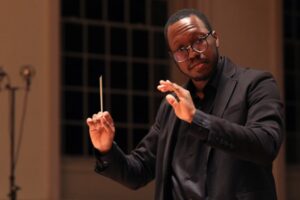
By Lisa Winkler“It takes a village to raise a child” is a proverb that has served conductor Gregory D. McDaniel well. Thanks to musical educators and mentors, he knew he wanted to pursue a career in conducting music at an early age. A Houston native, McDaniel has about five months left with the New Jersey Symphony (NJS) as a Colton Conducting Fellow, where he’s served as assistant and cover conductor and has led the orchestra on several pieces these past two seasons.
OperaWire chatted with him while he’s serving as the Artistic Director of the Houston Ebony Opera Guild and is preparing to conduct NJS’s family production of “The Magic Flute” in the spring.
OperaWire: You grew up with music in the house. Did that influence your career choice?
Gregory D. McDaniel: My mother listened to a wide variety of music, including rock and roll, gospel, and Motown. During car rides, my fraternal grandmother would often play jazz. However, I wasn’t exposed to classical music until middle school. My choir and general music teacher at the time, Mrs. Shirley J. Wiggins, assigned us a project in which we had to learn about different marches. It was a “drop the needle” style test, where we had to identify the composer, title, and specific history of each piece. I still remember some of the pieces we studied, such as Kenneth Alford’s “Colonel Bogey March,” Elgar’s “Pomp and Circumstance,” and Berlioz’s “Hungarian March.” While most of my classmates found the assignment torturous, I absolutely loved studying for the test and wanted to learn more about classical music.
OW: So how did you pursue learning?
GM: I began studying at my local public library. While I was in the sixth grade, I discovered that the downtown Houston public library had an extensive fine arts collection, and I found compilations of CDs of operas, oratorios, and symphonies. I would listen for hours then go home, put on my headphones and would listen some more. I began wanting to know what notes were sung and played by the musicians, so I would check out the scores and study them. My rule was that I would not listen to a piece of music unless I had its accompanying piano-vocal or full score in front of me. This greatly improved my music literacy skills over a short period of time. I was also heavily involved in the choir program in school as a boy soprano. These experiences made me gravitate to pieces with gratifying soprano vocal solos/parts and masterful choral writing.
OW: Any pieces stand out from that time for you?
GM: I found a recital CD of Leontyne Price performing “Live at Carnegie Hall” and became mesmerized. From there, I found Handel’s “The Messiah,” which was one of the first full works I ever completed with the score. The cast of singers of that recording was quite memorable; with Kathleen Battle, Florence Quivar, John Aler, and Samuel Ramey. I became a sponge, and one recording would lead me to another recording. One masterwork led to the next… I just kept going. I think by the time I entered high school, I listened to and learned about 20 operas, five full symphonies, and many masses and choral-orchestral works by various composers such as Beethoven, Mozart, Verdi, Schubert, and more.
OW: When did you first see an opera performed live?
GM: My first opera live was during a field trip as a freshman in high school. We went to see the Houston Grand Opera perform a production Verdi’s “Rigoletto.” I listened to the opera many times so seeing it live was an amazing experience. I knew the arias before they were sung. I think no one in the class was as excited as I was by the performance. It was at that point that solidified my dream of being a conductor.
OW: Can you share your career path?
GM: I pursued a degree in music education from the University of Houston. At that time, even though I knew I wanted to conduct, I did not think it was something I could pursue. Most professional opera conductors’ resumes and career trajectory also did not look like mine. Many of those musicians started playing piano at age three, I started much later. I also noticed that during my time of researching this career, I did not see much diverse representation in the field too. This was about twenty years ago, and finding conductors that looked like me in the opera, choral, and orchestral field were not in the forefront. After much research, I began to find out about many influential conductors in the field of opera, choral music, and orchestral music like Moses Hogan, Dr. Nathan Carter, Maestro Willie Anthony Waters, and Maestro Henry Lewis.
OW: What changed the picture for you?
GM: In addition to my research on African-American conductors, and while at the end of my undergraduate studies at the University of Houston (UH), I heard about the American Choral Directors’ Association Undergraduate Choral Conducting Competition. I figured, “why not audition for this?” With the help of the faculty, I submitted my audition material. I received notice that my submission was accepted into the semi-finals. I then made it into the finals, then finally won the competition. It was a fantastic opportunity, and I proved to myself that I could do this.
OW: What happened next?
GM: Upon graduation, I went into the choral teaching field and then spent about twelve years teaching choral music, both at the junior high and high school levels.
OW: How did you make the transition to conducting?
GM: About ten years ago, I began entertaining the idea of leaving the teaching profession to pursue a full-time career as a conductor. Also at that time, I met Robert Franz while he was working in Houston as Associate Conductor of the Houston Symphony Orchestra (HSO). In addition to his work at HSO, he was conducting in Idaho, North Carolina, and was an in-demand conductor, teaching privately, and leading masterclasses. He encouraged me that if I was serious about conducting, I needed to “get in front of an orchestra.”
Another colleague from UH was the music director of a local volunteer orchestra and allowed me to be a “fly on the wall.” That lead me to becoming an assistant conductor for the organization. That launched my conducting career. I was with that orchestra for about six seasons, and I received invaluable experience on and off the podium. I would teach during the day and then conduct in the evening. Any conductor would tell you that it is all about podium time. Everything is theoretical until you are in front of real musicians. What may work in the mirror may not work with live musicians. I took advantage of as many opportunities I was given to conduct.
OW: Then graduate school to conduct?
GM: Yes, I finally made the decision to pursue graduate school. Also, teaching during the pandemic made that decision possible and easy to make. It was tough teaching music, especially choral music online, so that year, I looked at programs, and applied to three. I ultimately made the decision to attend the University of North Texas, and it was the best decision for me at that time. It was also great to be back in school again, participating in classes ranging from Symphonic Repertoire to Schenkerian Analysis. I worked on focusing and simplifying my conducting gesture and expanding my gestural vocabulary.
OW: As a conductor is it necessary to play a lot of instruments? What instruments do you play?
GM: It’s not necessary to know how to play every instrument, but it is imperative to know as much as you can about the instrument mechanics, its functions, and its range. While also being aware of what pieces of the orchestral repertoire best utilize and highlight that specific instrument’s fullest capabilities. This is especially helpful when listening and adjudicating auditions. I studied piano and took string and brass method courses as an undergraduate.
OW: What are the most challenging aspects of being a conductor?
GM: You have to be prepared in everything, and even then, something will arise that you did not anticipate. When I say everything, I mean, everything. It is people management, public speaking, time management, knowing names, listening yet not listening, hearing inside and outside of the orchestra, knowing how to pivot if something arises, the list goes on. However, what makes it challenging, also makes it fun. It’s like being an athlete. You are often in high stress situations and you are stuck in thinking and moving ahead while also being in the moment. I have to say that a lot of my experience through teaching music greatly prepared me for professional conducting.
OW: What lessons did you take away from teaching public school?
GM: I realized when I entered the teaching profession, my approach to classroom management was blatantly different than when I was in school. I remember many of my teachers basically saying, “it’s my way or the highway.” We began to see that we could not use that approach for success. I am not saying that it could not be done, but the environment would not be conducive for learning if the students feared their classroom environment. When I began teaching, if I was going to succeed, I needed to connect with my students. They want respect and trust. The more I understood what was going on in their lives and how they learn, the better the outcome. This was tough to balance at first, but by the time I got past my first five years, the easier this became.
OW: Did any want to pursue a career in music?
GM: It is less common for students to pursue a career in music, particularly from places that are not fine-arts magnet schools and programs. If so, the percentage is pretty low. Most of my students, with the encouragement, and sometimes pressure from their families, would go into law or medicine, and many of them were undecided. However, at the last school I taught before graduate school, I managed to persuade one student to attend college for music. She is currently in graduate school now and wants to be an educator and classical performer. I’m over the moon about it! It is a full circle moment.
OW: Are there any favorite pieces you’ve conducted?
GM: There are so many to list. A few that come to mind are “The Adventures of ET” by John Williams, “The Dialogues of the Carmelites,” the first full opera I ever conducted; Mozart’s Symphony no. 35, and Elgar’s “Nimrod” from Enigma Variations.
OW: What about ones you’re eager to do but haven’t yet?
GM: I’d love to conduct a full performance of “Porgy and Bess.” Again, I have an extensive list. Among them are: Verdi’s “Macbeth,” Berlioz’s “Symphonie Fantastique,” Beethoven’s “Symphony No. 9,” and Tchaikovsky’s “Symphony No. 5,” and lots of operas.
OW: What do you do when you’re not engaged in music?
GM: I love to watch television, especially series from the 90’s and early 2000’s. I enjoy the nostalgia it brings. I also love walking around the various places I’m performing in. It’s a good way to get away from the rehearsal space.
Categories
Interviews
Stories you may also like…
Q & A: Swedish Mezzo-Soprano Alexandra Olsson Andersen on Building a Versatile Career
Q & A: Lawrence H. Levens on Recovering Will H. Dixon’s Lost Opera, ‘Maid of Chatteaulogne’