Orchestra Sinfonica di Milano 2025-26 Review: Verdi’s Requiem
By Federico Ginzburg NatalucciListening to Verdi’s Requiem in Milan is a privilege imbued with an artistic sacredness, if one may so venture to say, that borders on the sanctity of the liturgy itself.
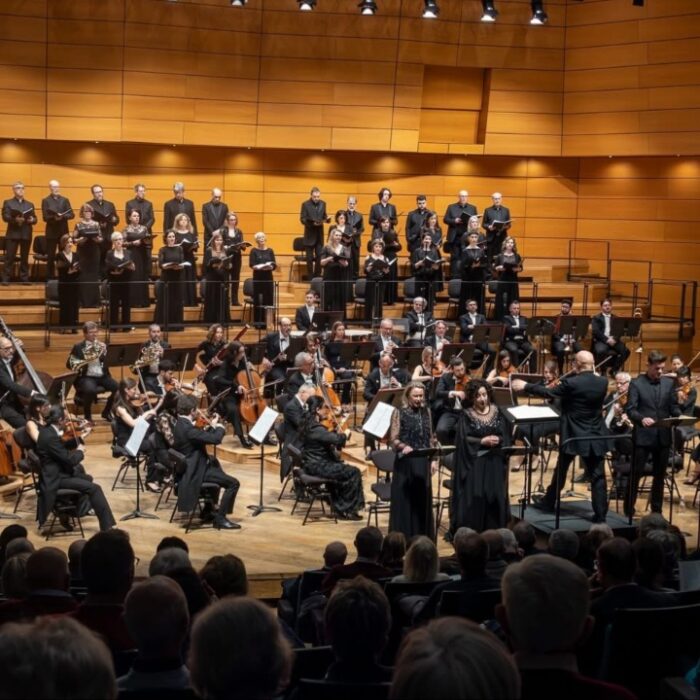
The Requiem was premiered in this very city, at the Church of San Marco, more than 150 years ago, followed by its debut at Teatro alla Scala. Thus, reviving this conjunction in the city will always be an event of singular magnetism. Friday, November 14 was no exception: the evening was charged with overwhelming power which, not only paid immense homage to Verdi’s work but, by a sine qua non condition, rendered homage to the “dramatic” history of Italy—an aspect we shall return to later.
The evening opened with a request for a minute of silence from concertmaster Danilo Giust due to the recent passing of former timpanist Viviana Mologni who was a member of the orchestra for more than 30 years. Three performances of this program were dedicated to her.
Between torment and mercy, Maestro Tjeknavorian’s musical direction delivered one insight after another, reviving the myriad nuances within the score. Undoubtedly his greatest achievement was capturing the work’s dramatic essence, offering marvelous pianissimo climaxes from the very opening Introit, and shattering that serenity with the tempestuous judgment embodied in the “Dies Irae,” which erupts abruptly at several points in the work. And this is key to understanding the exceptional quality of this interpretation.
Coming to mind, we can recall the Requiem’s of Mozart, Fauré, Brahms, and Cherubini, alongside Verdi’s, as the most celebrated and frequently performed; however, the essence of Verdi’s work is very different from any of the others. While each Requiem is a personal interpretation of the liturgy’s dramatic content, if Fauré’s majestic daring lies in distilling the liturgical text into a paradisiacal work full of serenity and peace, Verdi, on the contrary, finds an almost binary contrast—between mercy and torment, as noted at the outset. Every movement that conveys serenity and piety is enveloped by a sulfurous raptus of wrath and judgment. Mozart’s “Dies Irae” may come to mind, yet nowhere in his mass does that movement return—neither the music nor the text—to interrupt the succeeding numbers.
It is as if Verdi, in the act of composition—even though we know that he wrote the “Libera me” first chronologically—becomes enraptured by the wrathful character of the “Dies Irae,” and, like an unrelenting obsession, sees it and depicts it with overwhelming, almost culpable force after passages of peace and mercy. “Dies Irae,” the chorus whispers in the “Liber Scriptus,” a reminiscence that in literature evokes Poe’s “Tell-Tale Heart,” or the violent eruption of the “Dies Irae” as a recapitulation at the close of the “Confutatis.”
Maestro Tjeknavorian’s excellence lay specifically in his perfect control over the seamless interplay between the supplicating lyricism and the bursts of wrath present in the score. Particularly noteworthy was the “Recordare,” which tinted the hall with the serene plea of the two female soloists. Another example of refined interpretation came after the “Quid Sum Miser:” in its final bars, the soloists softened the musical texture into an ephemeral, almost motionless contemplation. At its close, instead of breaking the moment abruptly with the “Rex Tremendae,” Tjeknavorian froze silently for several seconds, allowing the dramatic stillness to settle over the hall—only then unleashing the colossal “Rex Tremendae” as Verdi demands.
These dramatic pauses—or, in some cases, the deliberate absence of them—revealed more about the conductor’s mastery than individual orchestral or choral moments. The orchestra, for its part, offered remarkable unity of texture between the two faces of the Requiem: its pious lyricism and its harshness of judgment and punishment.
Finally, it must be noted that this attentive guidance from the podium never faltered, even in unforeseen circumstances. Tenor Raffaele Abete unfortunately faced notable vocal difficulty due to experiencing throat discomfort, a challenge for both singer and conductor, who followed him rigorously in the second half of the work, slightly adjusting the tempo to allow him more space—a sign of professionalism on both sides.
The Four Faces of the Drama
As mentioned earlier, the performance was undoubtedly an homage to the Italy’s heritage of drama, due to the way the four soloists embodied the archetypal emotions of ancient Greek drama, shifting from mercy to wrath. It is well known that Verdi’s Requiem is the most operatic of all Requiems; it has been staged many times, and its dramatic soul demands an element of acting. This is precisely what occurred: the singers endowed the liturgical archetypes with face and voice, their expressions evoking the masks of Greco-Roman tragedy. Their countenances revealed moments of piety and, at other times, judgment and condemnation—one of the crucial strengths of the performance.
Spanish bass Manuel Fuentes, with his richly colored, velvety timbre, shone particularly in his solo numbers, especially the “Mors Stupebit” and “Confutatis,” where his dark, full lower register was evident, with a tone more clearly focused there than in the middle and upper registers. On the stage counterpart, he accompanied these numbers with an extraordinarily spectral and imposing image, reminiscent of José Ribera’s “Head of Saint John the Baptist.”
As noted earlier, the Neapolitan tenor Raffaele Abete was not at his best due to his vocal condition, particularly in the latter half of the Requiem. Nevertheless, his professionalism allowed him to make a strong impact in certain ensemble and solo passages, showing a voice of considerable projection with notable clarity and a moderate vibrato, as heard in the “Ingemisco.”
Without doubt the star of the evening was Hungarian mezzo-soprano Szilvia Vörös, distinguished by her commanding stage presence and superb vocal craft. Her instrument is remarkably even across the range, with a rounded, richly colored projection, free of harshness. She was mesmerizing in the “Liber Scriptus,” delivering impeccably articulated diction aligned with the text’s dramatic weight and casting almost inquisitorial glances at the audience to embody its apocalyptic character—one of the most unforgettable dramatic moments of the concert. The versatility between her resonant, full-bodied low register in the declamation “Judex ergo cum sedebit,” her impressive coloratura and lyricism, and her flawless blending in ensembles revealed the breadth of her vocal mastery.
Soprano Chiara Isotton displayed from the outset a distinctly dramatic color and a finely controlled vibrato, always balancing sensitively with the ensembles and reserving her full vocal authority for the “Libera me.” In that movement—the most operatic of the entire work—she revealed her strong dramatic instincts. The opening supplication of the “Libera me” had great expressive power. Her commanding coloratura, long-breathed phrasing, natural vocal weight, and well-defined vibrato were always in service of the work’s dramatic purpose. Her projection was exemplary, soaring with ease above chorus and orchestra in the final pages without losing roundness of tone.
In sum, despite the tenor’s difficulties, the ensemble distinguished itself with balanced blend and profound cohesion—both vocal and dramatic. The evening concluded in the most fitting manner: with the fading prayer of the “Libera me.” After the final sustained chord in C major dissolved completely, Maestro Tjeknavorian held his hands aloft, preserving the solemnity of the final silence. The audience upheld that silence with deep respect, restoring the ceremonial gravity inherent to the mass, before breaking into heartfelt applause and a final ovation.