Opernhaus Zürich 2025-26 Review: Scylla et Glaucus
By Laura Servidei(Photo: Monika Rittershaus)
The “Zürich Barock” Festival at the Zurich Opera House presents a rarity: “Scylla et Glaucus” by Jean-Marie Leclair, a composer best known for instrumental music, especially for the violin, which he himself played with great virtuosity. The opera premiered in 1746 and enjoyed moderate success, but soon disappeared from the repertoire. Its first modern performance took place in London in 1979, yet the work remains largely unknown despite its undeniable quality. Written in the form of the tragédie en musique codified by Lully—a genre already falling out of fashion by 1746—the score is both original and clearly shaped by Leclair’s studies in Italy: while firmly rooted in the French Baroque tradition, the vocal writing is rich in Italianate elements.
Myth, Desire, and Transformation
The plot, drawn from Ovid’s “Metamorphoses,” is based on Greco-Roman mythology. In Sicily, the sea god Glaucus falls in love with the nymph Scylla, who firmly rejects him, though her refusal stems from fear that he might break her heart. Glaucus turns to the sorceress Circe for help. Circe, however, falls in love with him herself and attempts to seduce him, but he resists even her enchantments and returns to court Scylla, who has meanwhile softened towards him. The lovers enjoy a brief moment of happiness, but Circe seeks revenge and poisons Scylla, transforming her into a deadly rock in the Strait of Messina, destined to destroy many ships.
(Photo: Monika Rittershaus)
From Mythology to High School Drama
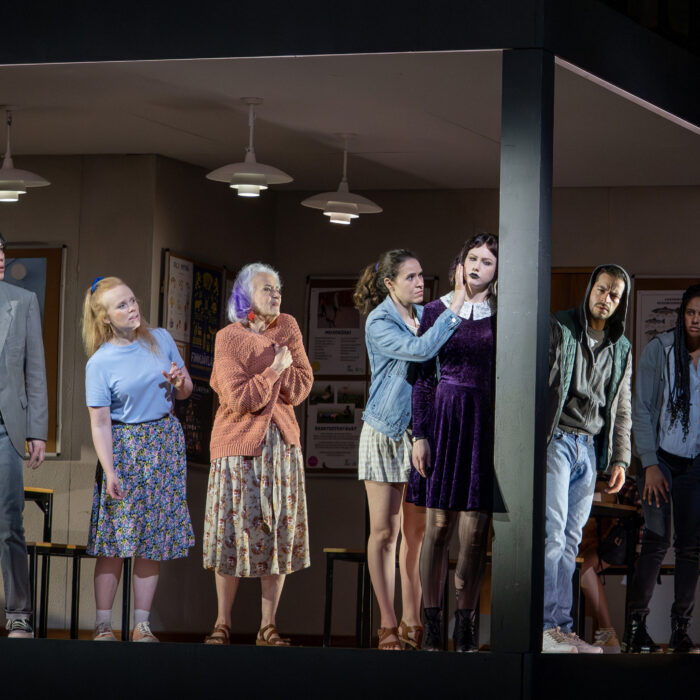
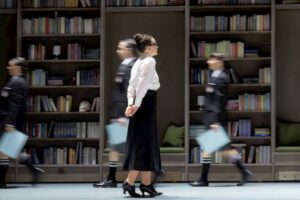
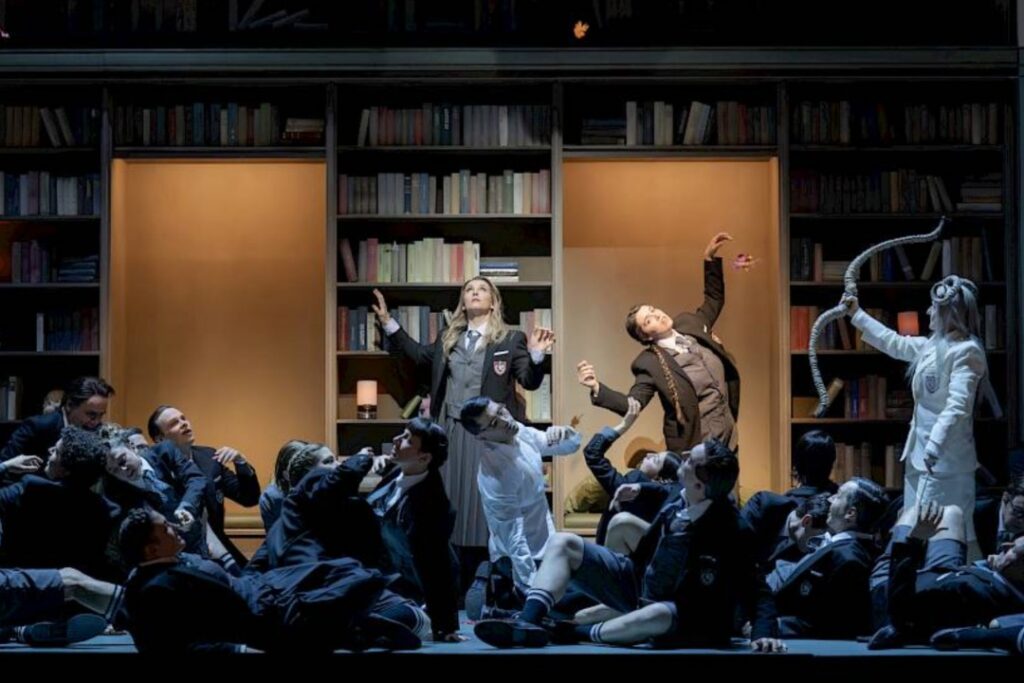
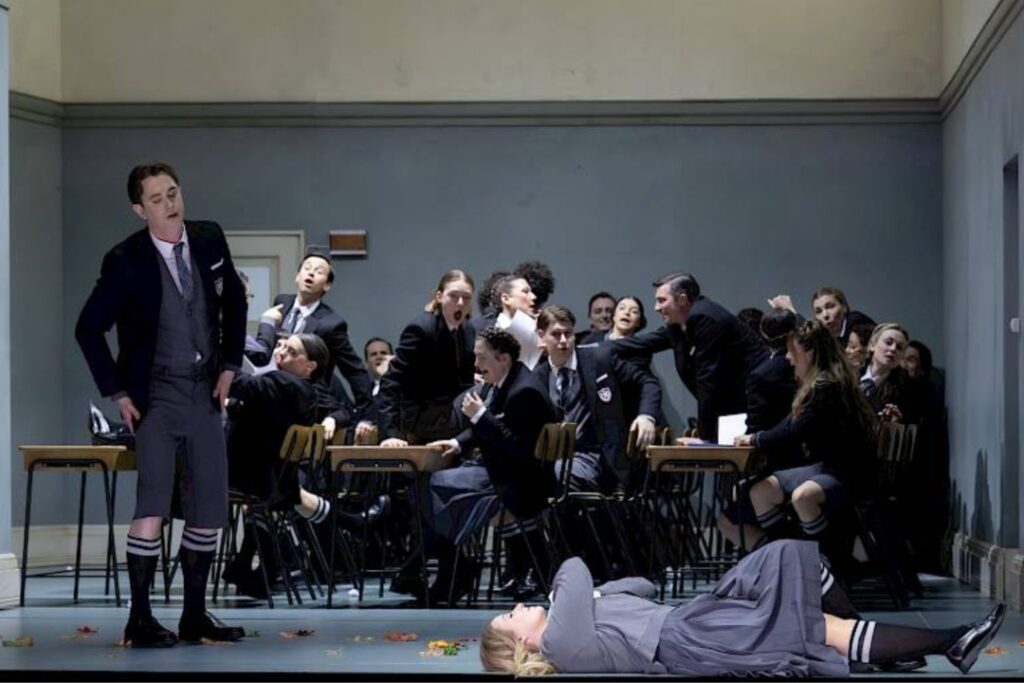
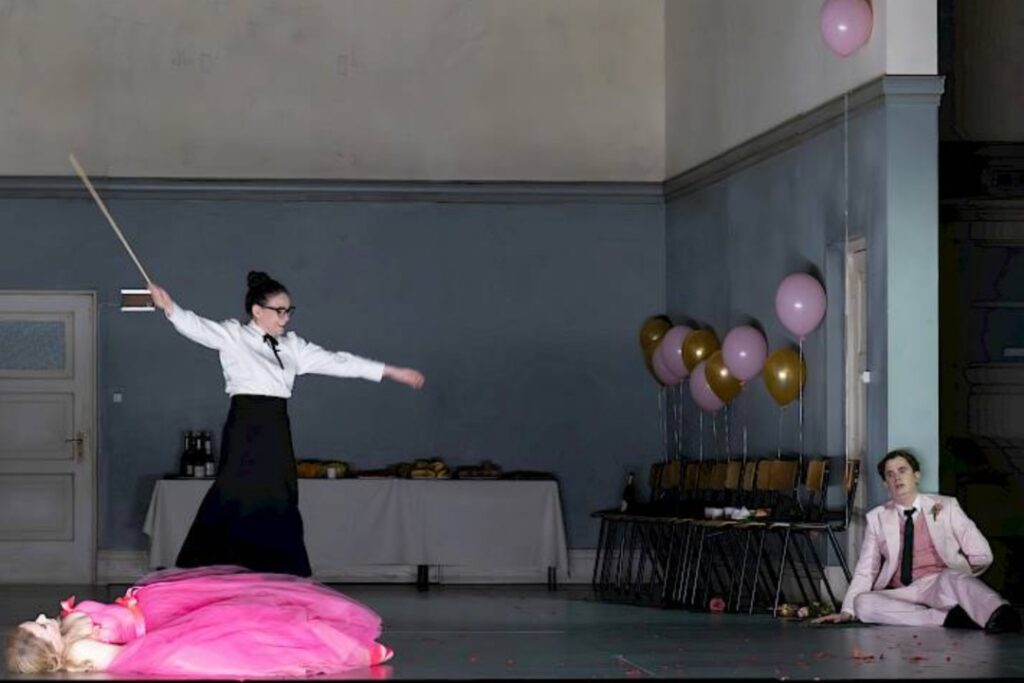
Director Claus Guth relocates the story to the 20th century—likely the 1960s—setting it in a high school, the “Lycée Jean-Marie Leclair.” Scylla and Glaucus become teenage students, Circe a physical education teacher, and the chorus and minor roles fellow pupils. The interiors of this closed institution, designed by Étienne Pluss, include a library, classroom, gym, and locker room. Costume designer Ursula Kudrna outfits the students in traditional uniforms—blouses, ties, jackets, shorts, skirts, and knee socks—while Circe, in a long black skirt, high-necked blouse, pinned hair, and dark glasses, appears almost a cliché of the strict disciplinarian.
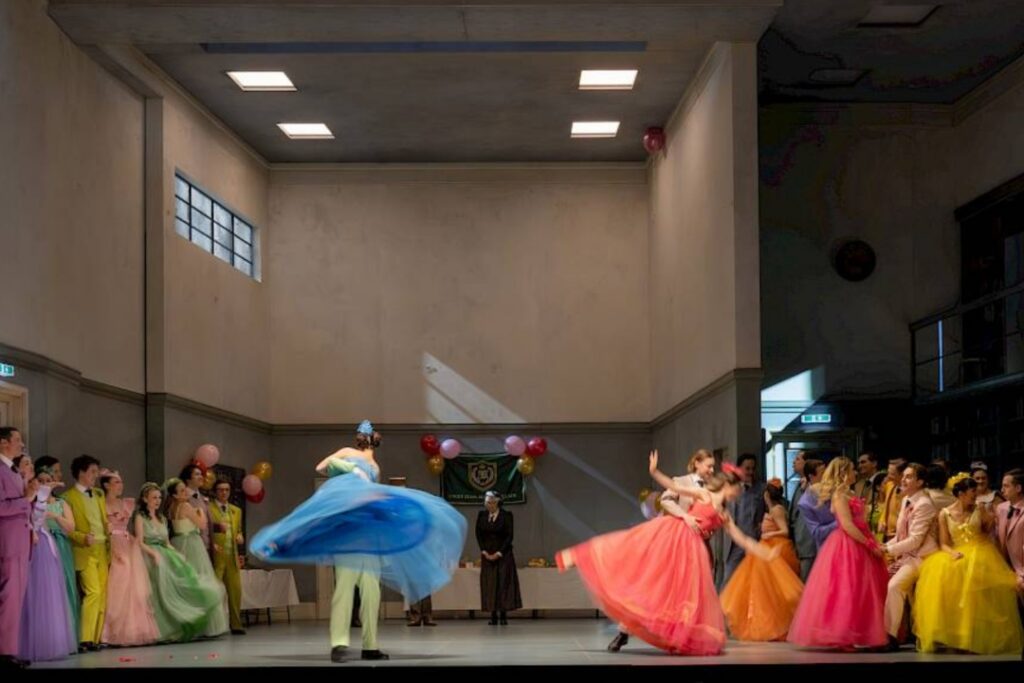
The opera unfolds through recitatives and short arias interspersed with divertissements—choral and instrumental numbers that can fragment the narrative. Guth handles them with grace and humor: in Act two the students stage a mock wedding for Scylla and Glaucus, while in the final act the celebration of their union becomes a graduation party.
(Photo: Monika Rittershaus)
As jarring as it can be to see adults portray teenagers, the concept proves remarkably effective. The love between Scylla and Glaucus readily suggests adolescent intensity; their doubts and emotional outbursts align naturally with the psychology of youth still discovering their feelings, and the language of their affection captures the all-consuming nature of first love. Casting Circe as a teacher pursuing a pupil adds a disturbing layer of perversity to the sorceress, sharpening her characterization. Guth, closely following Leclair and his librettist d’Albaret, presents Circe as a psychologically unstable predator, offering a modern perspective without distorting the original drama. Her façade of respectability fractures through nervous tics and twitches until it erupts in murderous rage. Crucially, this interpretation never feels imposed; it enriches rather than overrides the work.
Haïm and the Art of Baroque Expression
Emmanuelle Haïm, leading her orchestra Le Concert d’Astrée, not only brought the score vividly to life but revealed its complexity and refinement. The ensemble’s mastery of the French Baroque idiom allowed Haïm both precision and flexibility, shaping the performance with a keen sense of dramatic flow. The music moves constantly between French grandeur and Italian expressiveness, and Haïm honored both, turning the piece into a genuine rediscovery.
The chorus plays a significant role, and the Zürcher Sing-Akademie performed with commitment, clear phrasing, and solid precision. Only occasionally did they lag slightly, and it was striking to see how quickly Haïm brought them back into alignment.
(Photo: Monika Rittershaus)
A Terrifying Circe, a Poignant Scylla, a Refined Glaucus
Circe dominates the opera with its most dramatic music, and Chiara Skerath rose impressively to the challenge. Her powerful, incisive soprano—bright and metallic in the upper register—combined agile, expressive coloratura with a fully committed interpretation. In Act four, after Glaucus rejects her, Circe summons demons and the goddess Hecate to obtain a deadly poison; in this emotionally charged scene, Skerath was truly outstanding—indeed, terrifying.
Elsa Benoit as Scylla offered a lyrical, sweet-toned soprano with radiant high notes. She conveyed the character’s emotional range with nuance: fear of physical love mingled with anticipation, and lingering doubts about Glaucus’s fidelity. Her delicate vibrato lent a touching fragility to the role, perfectly suited to the character, and her command of French Baroque style was impeccable.
Anthony Gregory sang Glaucus with a lyrical tenor comfortable in the upper register; while not quite the ideal haute-contre, his timbre came close. His technique was admirable, with seamless legato and clean, precise coloratura. Gwendoline Blondeel charmed as Temire, Scylla’s confidante, with a bright, smooth soprano and a lively, tomboyish stage presence. The cast was completed by Jehanne Amzal as Dorine, Circe’s confidante, her soprano warm and rounded.
In the final scene, after Scylla’s death, Circe is led away by the police. Glaucus picks up the glass of poison as if to drink it himself, but the lights go out before his fate is revealed—a final coup de théâtre.
(Photo: Monika Rittershaus)