Opernhaus Zürich 2025-26 Review: Aci, Galatea e Polifemo
By Laura Servidei(Photo: Toni Suter)
Ovid’s “Metamorphoses,” written in the first century A.D., profoundly influenced Baroque art in all its forms: literature, the visual arts, and music. It is an epic-style compilation of over 250 Greek and Roman myths centered on transformation, spanning from the creation of the world to the deification of Julius Caesar, all linked by the overarching theme of change. Transformation may be rewarding, punitive, salvific, or even accidental, often involving humans or minor deities turned into animals, trees, bodies of water, or constellations. The myth of Acis and Galatea is among those retold by Ovid: the nymph Galatea (daughter of the sea god Nereus and the sea-nymph Doris) and the Sicilian shepherd Acis (son of the god Pan and a river-nymph) are in love. The gigantic Cyclops Polyphemus—also known from the Odyssey—desires Galatea and courts her in a crude and lewd manner, but she continually rejects him. In a fit of rage, Polyphemus kills his rival with a boulder. Galatea and Acis’s parents can only respond through transformation: the young shepherd is turned into a river (his blood becoming water) and at the same time into a river god, thus reuniting him with Galatea in the sea.
Aci, Galatea e Polifemo: A Young Handel in Italy
During his formative Italian journey at the very beginning of the 18th century, George Frideric Handel composed the serenata (or cantata) “Aci, Galatea e Polifemo” in Naples in 1708, for the wedding of Tolomeo Saverio Gallio, fifth Duke of Alvito, and Beatrice Tocco di Montemiletto. The work was commissioned by the bride’s aunt, Donna Aurora Sanseverino, and later performances suggest that the libretto was written by her private secretary and literary advisor, Nicola Giuvo. It is a sophisticated work, demonstrating the mastery that the 23-year-old Handel had already achieved in Italian operatic style. Many of its arias were later reused by the composer, attesting to their quality. Following Scarlatti, the score omits a chorus, relying instead on da capo arias and recitativi secchi accompanied only by continuo, with a few exceptions in which the full orchestra supports the recitative to highlight the most dramatic moments. The rich instrumentation reflects the concerto grosso model, with flutes, oboes, and trumpets added to the string ensemble.
Zürich Barock: Festival Opening
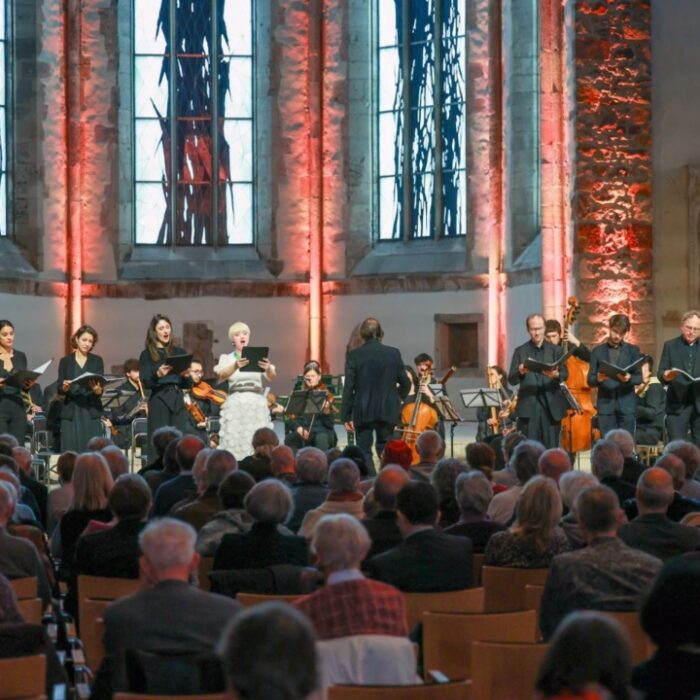
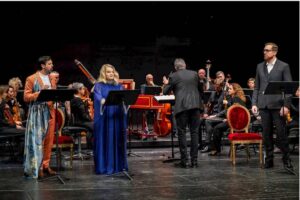
The Zurich Opera House chose this work, in concert form, to open Zürich Barock, a festival celebrating the richness and diversity of Baroque music through opera, concerts, chamber music, and other performances from March 20 to March 29. The Orchestra La Scintilla, the house ensemble specializing in historically informed performance, was led by Philippe Jaroussky, one of the most renowned countertenors of his generation, now increasingly active as a conductor. His deep understanding of Baroque style—shaped by decades as a singer—was evident, and his innate musicality translated seamlessly into his conducting. His reading of the score was precise and energetic; the orchestra followed him in a performance that never stagnated, with pacing always aligned to the dramatic flow. His gestures appeared clear and structured, if occasionally somewhat rigid, though this did not affect the musical result, which displayed a wide dynamic range and refined phrasing. His support of the singers was exemplary, consistently adjusting orchestral balance to allow their voices to shine.
Bruno de Sá’s Striking Sopranist Voice
Only the three title characters appear in this serenata. While the identities of the original 1708 performers are uncertain, Aci was most likely sung by a female soprano, Galatea by a contralto castrato, and Polifemo by the celebrated bass Antonio Manna. In this Zurich performance, Aci was sung by sopranist Bruno de Sá. His voice is striking: it sounds remarkably natural in the soprano range, reaching extremely high notes that are unusual for a male singer–both thrilling and brilliant. His timbre, rather than resembling a female voice, is closer to that of a boy soprano or even a piccolo flute. The upper register is the most compelling, while the voice loses some depth—and occasionally intonation—in the middle range. The aria “Qui l’augel di pianta in pianta” was a highlight, his voice particularly well suited to the bird-like writing, with Philipp Mahrenholz providing a delightful oboe obbligato. Aci’s death scene, “Verso già l’alma col sangue,” was also deeply moving, with Handel’s writing—long notes and dissonances—evoking the breath leaving the body.
Polifemo: A Formidable Bass Role
Polifemo is perhaps the most fully developed character in the serenata, as well as the most self-aware. His role is extremely demanding, filled with coloratura, wide leaps between registers, and an extensive range (from low D to high A); it was clearly written for an exceptional singer. Nicolas Brooymans displayed a deep, powerful bass, with resonant and well-projected low notes. He did not appear entirely secure in the role, which is admittedly treacherous. His timbre is naturally menacing in the lower register, yet smooth and appealing in the middle range. His legato was elegant, and his coloratura commendable. His opening aria, “Sibilar l’angui d’Aletto”—later reused in “Rinaldo” (1711)—is a formidable showpiece for bass, and it comes at the very beginning of the work. Despite some unfocused high notes, Brooymans delivered an impressive performance, supported by Balázs Nemes, Laurent Tinguely, and Paul Muf on trumpet, who played brilliantly.
Elizabeth DeShong’s Velvety Mezzo
Galatea was sung by Elizabeth DeShong, who arguably offered the most beautiful voice of the evening, her rich mezzo both warm and velvety. She was equally convincing in the lament arias, such as her opening “Sforzando a piangere,” where her legato and subtle phrasing were deeply expressive, and in the more fiery numbers, such as “Benché tuoni e l’etra avvampi,” where her agile coloratura was matched by Mahrenholz in a thrilling, high-energy dialogue with the oboe. Her command of Baroque style was consistently elegant.
The serenata includes several ensemble numbers, among which the trio “Dolce amico amplesso” stood out as a highlight. In this scene, the two lovers are immersed in an intimate and sensual duet, while Polifemo, observing from a distance, interjects with harsh, recitative-like phrases. It is an unusual and striking piece, and it was performed with great skill and dramatic insight by all three singers.
Categories
Reviews