Opéra national du Rhin in Strasbourg 2025-26 Review: Hänsel und Gretel
By Andréas Rey(Photo: Klara Beck)
This Christmas season, the Strasbourg Opera is staging Engelbert Humperdinck’s opera “Hänsel und Gretel.” Based on the eponymous fairy tale by the Brothers Grimm, which premiered in Weimar on December 23 in 1893, it is the ultimate Christmas opera.
Exciting Production Details
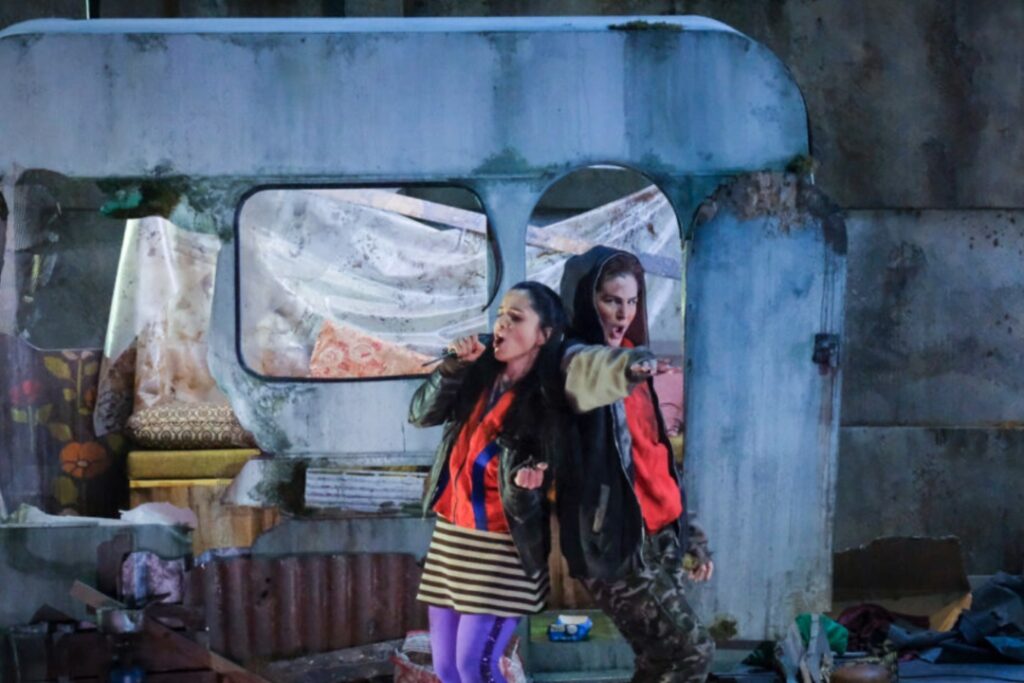
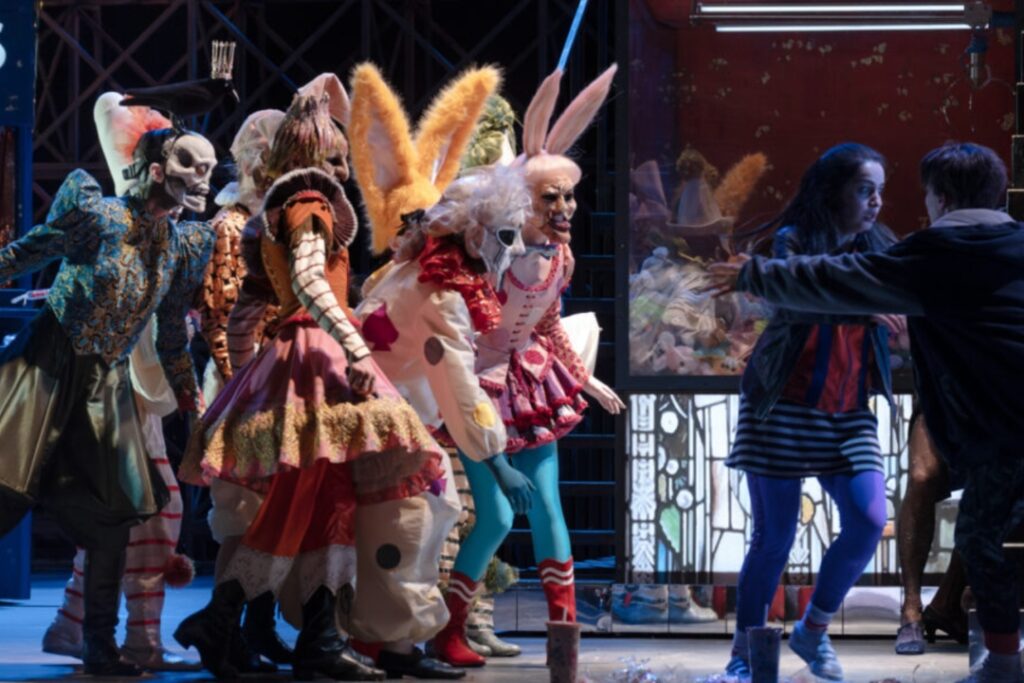
The production, featured December 7 to 17, gets off to a wonderful start. It is set in present day and in a poor wasteland, where the children Hansel and Gretel try to distract themselves from “the hunger that bites them” (“Ei, wie beisst mich der Hunger!” says Gretel at the beginning of the first act) by singing and dancing. The adults, meanwhile, take refuge in alcohol. The family caravan has a broken window and is surrounded by plastic bags. The director, who also designed the sets and costumes, successfully combines fantasy and realism, punctuating the scenography with very well-chosen references. In the second act, the Pink Fairy and the Sandman resemble Stephen King’s killer clown Pennywise, inspired himself by the homosexual pedophile serial killer John Wayne Gacy, who dressed up as a clown to gain the sympathy of his victims’ parents, or the arrival of the Sandman on a swan, like Lohengrin, showing the Wagnerian inspiration of the work. Even the silent dancers who walked on their hands or on all fours on their backs while sleeping in the forest, and painted with skulls, seem justified. The acting is also very good, with Hansel dancing as if in an MTV rap video, for example.
(Photo: Klara Beck)
The pair of children are undoubtedly the more successful of the two couples of the opera. Soprano Julietta Aleksanyan’s voice for Gretel is perfectly suited to the role of the wise sister. Mezzo soprano Patricia Nolz’s voice as Hänsel, who struggles to resist temptation like Fioredelji, has a deep voice and they blended well together, especially in the long duet in the first act, “Mit den Füsschen tapp tapp tapp.” (“With the little feet tapp tapp tapp” ). It’s a shame the orchestra tended to drown them out, especially in the first act. The parental couple was unbalanced. Soprano Catherine Hunold’s voice as the stepmother failed to find charm in her high notes. In contrast, bass-baritone Damien Gastl as the father—arguably the best male voice in the production—was almost bel canto, fluid, and forcibly cheerful, playing well to the humor the character wants to impose on his situation in his arias “Hunger ist der beste Koch.”(”Hunger is the best cook”). Here, the father is more like the children, and the mother is more like the witch.
More Highlights
The highlight of the performance was undoubtedly the second act, in which the voices, set design, and acting were in perfect harmony. From the quasi-sprechgesang, “Kuckuk Eierschluck,” to the Sandman’s song, “Der kleine Sandmann bin ich, st!” (“I am The Sandman, st”), everything here was completely fluid, charming, and natural. This was undoubtedly the act in which soprano Julietta Aleksanyan, who had already begun to charm the audience at the beginning of the first act with her aria “Suse, liebe Suse, was raschelt im Stroh?” (“Suse, dear Suse, what rattle in the grass”), was at her most captivating with “Ein Männlein steht im Walde ganz still und stumm” (“A little man is in the woods, all quiet and mute”). The same goes for mezzo Patricia Nolz, with her aria “Horch, wie es rauscht in den Bäumen! (“Listen, how the trees are rattling”).
(Photo: Klara Beck)
But the most lyrical and therefore most appealing part of this performance was undoubtedly the baton of conductor Christoph Koncz, who, after an opening still a little cluttered with academicism, gradually unleashed the Wagnerian lyricism of his score and made his orchestra sing. The interludes in particular lend their elegance to the Viennese waltz inspirations and those of Wagner’s “Tannhäuser” or “Lohengrin,” while the narrative parts, light and harmonized melodies, draw upon Mozart’s.
Unfortunately, then comes the witch.
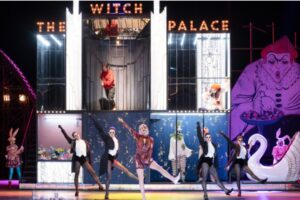
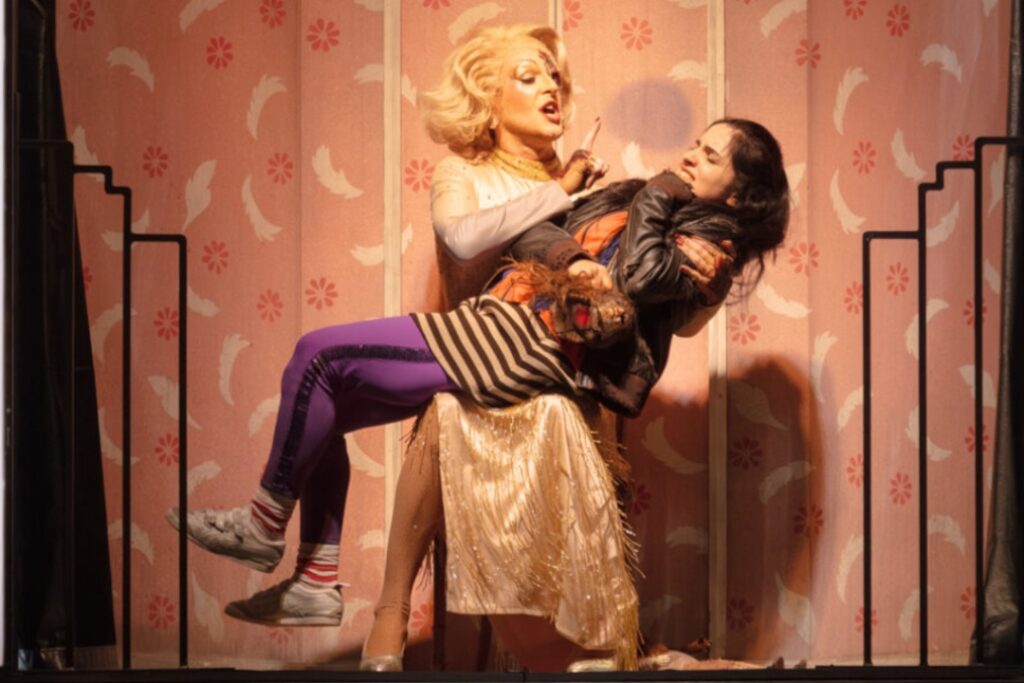
While the idea of setting the house in an amusement park was far from silly, allowing realism to be combined with fantasy—the two main characters eating hamburgers and sweets while drinking sugary soft drinks— its architecture, reminiscent of a butcher’s shop, a fairground attraction, a games room, and a music hall, was exaggerated. But above all, turning the witch into a decomposing transvestite trying to imitate Marlene Dietrich undermined all the poetry that had been so skillfully crafted in the staging up to that point. This was compounded by the fact that the voice of the singer, Spencer Lang, was singularly lacking in color, nuance, and depth, which was problematic for a role that sings continuously throughout the act. Overall, the third act was no longer opera, but music hall, which detracted from the quality of the production.
(Photo: Klara Beck)
Nevertheless and overall, however, the quality of the staging, the singing of the main characters, especially the father, and the orchestra made this production a memorable evening that appeals to both children and parents alike.