Opera Meets Film: Translating Moral Ambiguity in Gordon Kampe’s ‘Dogville’
By John Vandevert(Photo Credit: Jo Schramm)
Operatic depictions of cruelty, vengeance, wrath, mercilessness, wickedness, barbarism, savagery, and anger seem hallmark elements of the genre itself. From villains like Queen of the Night, Lady Macbeth, and Don Giovanni to ghastly characters like Elektra, Scarpia, Iago, Mefistofele, and Caesar, all the way to troubled souls like Wotan, Giorgio Germont, Turandot, Poulenc’s Chaplain, Anna Bolena, and Marguerite de Valois, to be bad is a complex affair. To be a villain is not simply the acting out of evil onto others nor being incorrigibly evil in one’s comportment. Instead, it involves a many number of steps, among them being one’s willful submission to the corruption of the soul, and it is this theme which informed much of opera from the baroque period onwards.
The idea that opera can be, and is, a tool for moral instruction is hardly new, and in many respects, the entire idea of operas as venues for moral and ethical tuition can be connected back to the Greeks, with the chorus playing an integral part in the education of the audience. Within the Age of Enlightenment, the transformation of thought towards humanist philosophizing away from the dogmatism of religious premodernism reconfigured the very function of opera itself. The birth of Renaissance humanism pushed this agenda greatly forward during the 16th and 17th centuries, and operas by those like Monteverdi, Rameau, and Gluck began exploring the true diversity of the human condition like never before. Flash to 2026, however, and moral education seems as at the heart of opera and the operatic debate on its existential value as it was during the 18th to 20th centuries, if not more so.
Interestingly, the debate on opera and morals shifted in the late 19th to 20th centuries away from arguments on the moralization of music for its cultivation of uncontrolled emotion as levied by those like Hugh Reginald Haweis, to a far more neo-Classical tone. In a now famous essay, “On the Social Situation of Music” (1932), by cultural theorist Theodor W. Adorno notes that in the realm of opera, the effort is to produce ‘Gemeinschaftsmusik’ (community music), Moreover, he noted that opera much more than music, and instead, has become a greatly unequal social event where the bourgeois cement their status, with all others privy to the world but only from the outside. As he wrote, “the impoverished members of the middle class do not have the economic power to support such representation.” Even more caustic is his idea of music’s function for the middle class.
“The need for music is present in bourgeois society and this need increases with the problematic social conditions that cause the individual to seek satisfaction beyond immediate social reality.”
But in the 21st century, with the advent of opera being the most accessible it has ever been, thanks to various initiatives and decisions, who opera is composed for and its function has again shifted ever further away from the bourgeois. Opera has always been a performative action, it’s just the nature of that performance has now changed towards one of civic praxis rooted in themes like liberation, critical consciousness, and wokeness. The theatre becomes, as Antonia Rigaud notes, a “utopian communal experience,” with opera becoming “an aesthetic moment directly connected with life and its socio-political context.” With this in mind, let’s now explore German composer Gordon Kampe’s third opera, “Dogville,” by exploring its first form, namely in 2003 film by filmmaker Lars von Trier.
A Brutal Story and a Complex Meaning
Presented as a prologue and nine chapters, von Trier’s story follows the philosophical position that anyone, no matter who they are, have the propensity for evil if one’s moral defenses are not maintained. This has been called many things over the centuries, although best summarized as Kant’s concept, “radical evil.” The film begins in the mountainous, mining town of Dogville with 15 residents who are all part of an ideological cult centered around the real-life Moral Re-Armament (MRA) movement that first began in the 1960s. Effectively a dogmatic cult based around ultra-conservative, evangelist-oriented Christian nationalism, they advocated for four absolutes (honesty, purity, unselfishness, love), with sin being anything that takes us away from God. Changing their name to Initiatives of Change (IoC) in 2001, the ironic part is that the MRA touted unity yet advocated for theocratic dictatorship. Moreover, the IoC has its fingers in the UN and the Council of Europe, something that should worry everyone.
The film explores themes concerning justified violence, religious altruism, coerced unity, ethical relativism, moral hypocrisy and the role of theological dogmatism within contemporary US culture throughout the nine chapters, all themes highly reflective of life within Trump’s America. Grace Mulligan is fleeing from gangsters and runs into the town’s leader, Tom, who holds a town meeting whether to house her, and it’s agreed she gets a two-week trial period. Here is where the horrors of the themes begin as this indentured relationship becomes the pretext for physical and mental abuse against Grace by the cult members. One day, the police accuse her of theft and after denying, she’s forced to do more labour as compensation for the members’ housing her but this only furthers her indentured status, resulting in an increased barrage of abuse including extreme forms of assault.
By chapter seven, Grace is plotting her escape but is thwarted at nearly every turn, resulting in an uptick of the extreme form of sexual assault, but now with the entire town in on her abuse. The love she once showed to Tom is long gone, and at a town meeting, the cult votes to give her to the gangsters. Rebuffing Tom’s faux show of affection, he votes to cast her away yet Grace utters the phrase, “Nobody’s gonna sleep here,” the line sung in “Pirate Jenny” in Weil’s “The Threepenny Opera.” In the opera, Polly Peachum sings the song as entertainment, yet its story is echoed in the opera via Jenny, a prostitute, who’s bribed to turn in ex-lover criminal Macheath to the beggar leader, Jonathan Jeremiah Peachum. Just a song about a lowly woman wishing to enact revenge against those who scorn her, the opera realizes this in Jenny, a woman scorned by even beggars themselves.
Chapter nine sees Grace realize her own revenge, yet does so by submitting herself to a fate of sorts she was born into. The gangsters are revealed to be her own family, with her father being the head, and having seen the cult’s brutality, embraces her desire for vindication. Bringing to the fore the debates regarding revenge and fate as seen in the Grecian plots of Sophocles’s “Oedipus,” Euripides’ “Medea,” Aeschylus’ “Oresteia,” and Seneca’s “Thyestes,” Grace’s thoroughly embraces an apathetic rabidity for retribution. Ordering the complete destruction of the town with unrepentant mercilessness, Grace watches as the townspeople are slaughtered, and personally kills Tom with nothing but the town’s dog as witness. Seeking no approval, absolution, or forgiveness, the end demonstrates many things, among them, corruption of virtue. Quietly ordering their deaths, she added,
“Do the kids first and make their mother watch. Tell her you’ll stop if she can hold back her tears. I owe her that. I’m afraid she cries a little too easily.”
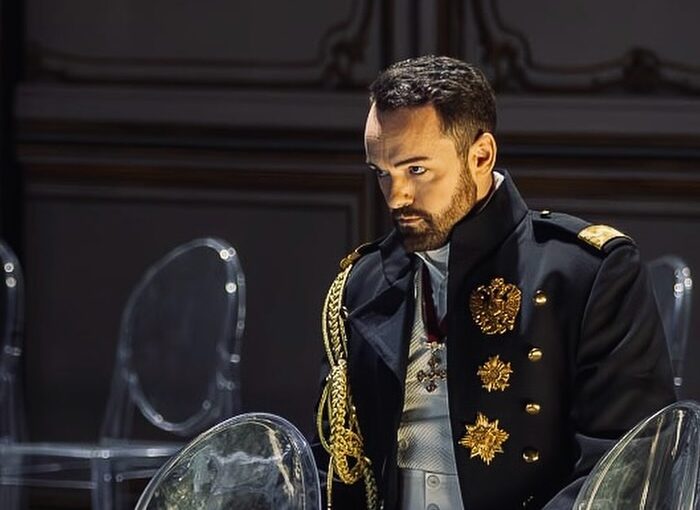
How to get a film of this nature to the operatic stage is hardly straightforward as many themes blend into each other and create a difficult pathway. Yet, in 110 minutes (one hour, 50 minutes), Kampe told the story of Grace’s (un) willing embrace of Kantian evil through a minimalist set design and curated dissonant textures. Removing the narrator and focusing on Grace directly, Kampe’s opera greatly foregrounds Grace’s psychological change as abuse transforms her personal beliefs about the world and those in it as the ending demonstrates. The heart of the opera is its moral cores, namely the dialectic between the collective and individual, ideology and reality, forgiveness and revenge, belonging and alienation, courage and fear, acceptance and opposition, and development and safety. The question hanging over the opera becomes, “Was Grace [revenge] justified?” In the last two years and through 2026, “Dogville” has yet to secure another performance, although given the world right now, the opera is as relevant as ever. What would you be willing to do or not do if you were pushed far enough? Are your beliefs really stable?
Watch