Opera Forward Festival 2026 Review: Theory Of Flames
Michel van der Aa New Multi-media Opera Successfully Challenges our Notions of Truth
By Alan Neilson(Photo: Marco Borggreve)
The Dutch composer Michel van der Aa has carved out a successful niche for himself within the opera world with a series of pieces, which successfully marries accessible music with film and technological wizardry underpinned by a strong narrative. The world premiere of his new opera, “The Theory of Flames,” for Amsterdam’s Opera Forward Festival is his sixth completed work.
A Work Constructed to Test the Audience’s Understanding of Reality
The libretto, also written by Van der Aa, weaves what appears to be, at least on the surface, a straightforward narrative in which the film director, Neola, is making a science fiction film about a laboratory destroyed by fire, in which the scientist Dr. Hari, played by Neola’s partner, Marianne, is working on the possibility of time travel. During their experiments, they receive a written message from the future in Dr. Hari’s handwriting instructing them to “BURN IT ALL.” Later on, during the shoot, Neola discovers material in the archive about a real laboratory fire in which the lead scientist disappeared. The parallels with her film draw her into an obsessive fascination with a possible conspiracy surrounding fire, which leads her to believe that the scientist must still be alive, and she decides to refashion the film as a documentary, using archive surveillance footage. Marianne and Josh, the cameraman, become increasingly alienated from Neola as their shared perceptions fragment and their realities diverge. The narrative takes imaginative twists and turns as it pushes forward, climaxing with Neola reconstructing and then walking into the laboratory fire to prove that the scientist must have survived. The finale then took a further turn that forced the audience to reassess its own understanding of the work, thereby exposing how easily it is for our perception of reality to be challenged.
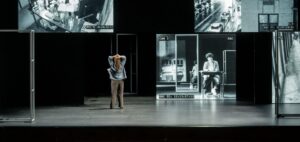
It is an opera in which the present, the future, and the past connect to fashion differing understandings of reality. And it worked exceptionally well, mainly thanks to Van der Aa’s use of video imagery and recorded sound, which were successfully integrated into the score and the staging of the performance. Not only did the images projected onto movable screens often dominate the stage, but the character of the Scientist never appeared in person. The audience thus watched as the onstage characters interacted her video image, in which they sang complex passages together, overseen by the musical director, Elena Schwarz, from the pit, who seamlessly integrated the recorded sound with the live performance of singers and orchestra.
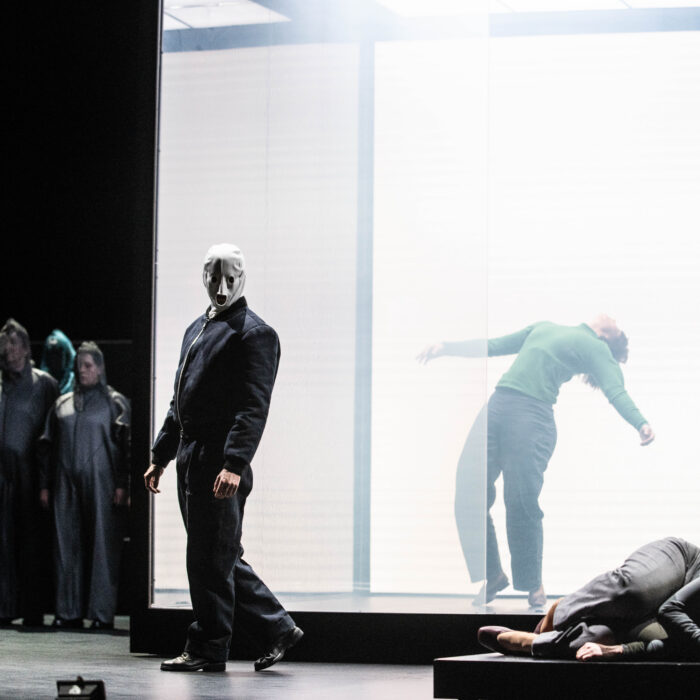
It was perhaps inevitable that Van der Aa was also responsible for the direction, not least because the multiple layers involved in its construction would make it very difficult for an outsider to grasp the full extent and practicalities of his vision for the piece. Aided by Theun Mosk’s set and lighting designs and Judith de Zwarthe’s costumes, Van der Aa created a staging that moved between physical representations, abstract suggestion, and filmic imagery that carried the narrative in a clear, easy-to-follow manner that conjured a sense of place and temporal fluidity. Scenically, there was a notable movement toward abstraction containing unsettling undercurrents as the performance moved towards its conclusion.
An Exciting and Compelling Musical Experience
Musically, Van der Aa’s score is very accessible and neatly aligned to the dramatic momentum and the nuances of the text – features that the Residentie Otkest, under Schwarz’s expert musical direction, successfully captured. The musical arc was expertly designed to reflect the dramatic climax of the fire – its pounding rhythm intensifying the rising tensions as Noala prepared to and then entered the burning laboratory. Frequent passages of urgency, underpinned by a strong pulsating beat, were sensitively contrasted with softer, reflective passages, ensuring the narrative was carried forward without descending into an aimless drift, while the melding of electronically recorded sound with the live orchestra was precisely managed to create colorful textures that promoted the narrative’s emotional and dramatic aspects.
Soprano Julia Bullock produced an extraordinary performance in the role of the Scientist. She recorded the part a year earlier and did not appear in person in the actual production, nor did she take part in rehearsals. Rather, she appeared on film and had no contact with the other singers. Yet her characterization and interactions with the onstage characters were so convincing one would have believed otherwise; her sudden facial movements, glances and stares were so well-timed that her reactions to the other characters appeared to be in real time. Moreover, she cast a dominating presence over the stage. It was also an excellent singing performance in which she used her colorful palette and expressive articulation to develop a convincing characterization.
Soprano Aphrodite Patoulidou put in a compelling performance as the film’s director and creator, capturing superbly her transition into an alternative understanding of reality. Initially open, positive and friendly, her obsession with the fire begins to have an isolating effect, and cracks in her relationship with Marianne and Josh start to appear, causing her personality to fracture. It was a fine acting and singing performance; each line was clearly molded to promote the meaning of the text and carry its emotional content, and her interaction with the Scientist was perfectly managed, making it appear as if they were both physically in the same room.
Mezzo-soprano Helen Charlston used the opportunities in her role as the actress Marianne to show off her wonderful vocal qualities and fabulous technique. The clarity, precision and depth of expression with which she was able to infuse the vocal line were impressive, and allowed her to bring a degree of characterization to her performance that was not always evident in her acting, which could be a bit flat; it was difficult to discern, for example, any noticeable differences between her in the role of Marianne and as Marianne playing the part of Dr. Hari, apart from her change of costume. Her vocal beauty and ability to portray depth and nuance through her voice, however, trumped any such concerns.
The cameraman, Josh, was given a beautifully sung performance by baritone Roderick Williams. Although it is not a role that asserts itself, Williams’ strong stage presence and lyrically seductive voice ensured that he was not to be overshadowed, using his colorful palette, refined phrasing, and expressive sensitivity to characterize the role with strongly expressed emotions.
The film included a number of minor roles that were given solid performances by soprano Taylor Burgess as Dr. Wheeler and actors David Eeles as Dr. Brady and Abel de Vries as Thom.
Overall, this was a work perfectly suited for a festival dedicated to challenging the traditional view of what constitutes an opera. Van der Aa actually defined the work as a film opera, which I believe actually does the work a slight disservice; it is an opera, pure and simple! Although it may not be an opera in the accepted traditional form, from which many contemporary opera composers still take their lead, it is absolutely an opera; it possesses all the characteristics of an opera but is molded to take advantage of the new technologies. It allows modern audiences to engage with contemporary issues in an accessible way, making use of media with which they are thoroughly familiar, and is not in any sense alienating or patronizing. Certainly, it is a work that challenges the traditional model, but it is recognizably an opera and does not challenge the fundamental foundations that define the art form. What Van der Aa’s operas do is to successfully offer up an alternative pathway for opera to move forward without closing off equally valid alternatives for development.